Professional cable manufacturer

Professional cable manufacturer
A practical comparison of armored and unarmored power cables — including SWA, AWA, and PVC construction types, application scenarios, and a decision framework to help you choose the right cable for your project.
Choosing between armored cable and unarmored cable is one of the most common decisions in power distribution projects. The wrong choice can lead to premature cable failure, costly excavation for repairs, or unnecessary expense on over-specified materials. This guide breaks down the construction differences, standards, and application rules for each type — so you can specify with confidence.
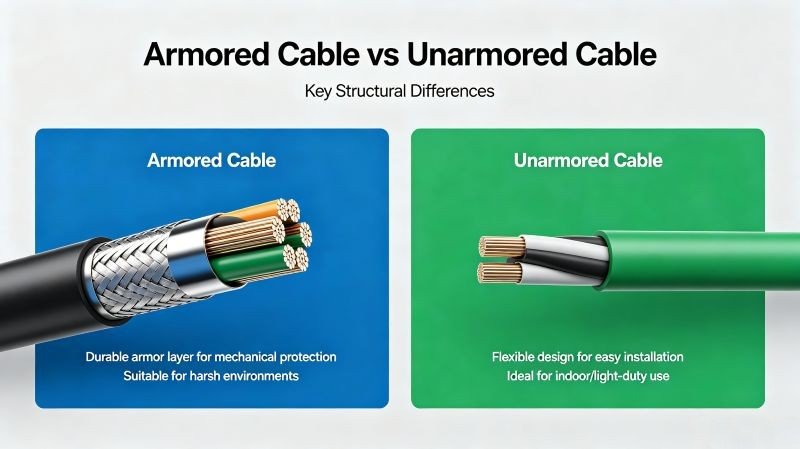
An armored cable is a power or control cable with an additional metallic protection layer — known as the armour — placed between the inner sheath and the outer sheath. This armour provides mechanical protection against impact, crushing, and rodent damage, and in some constructions also acts as an earth continuity conductor.
| Armour Type | Code | Construction | Best For | Common Standard |
|---|---|---|---|---|
| Steel Wire Armour | SWA | Galvanized steel wires wound helically around the cable | Direct burial, high mechanical stress, multicore cables | BS5467, IEC 60502 |
| Aluminium Wire Armour | AWA | Aluminium wires instead of steel — lighter and non-magnetic | Single-core cables (AC systems), where magnetic heating must be avoided | BS5467, IEC 60502 |
| Steel Tape Armour | STA | Two steel tapes applied helically | Light mechanical protection, where flexibility is less critical | BS5467, IEC 60502 |
For multicore cables, SWA is the standard choice — the steel wires add strength and can serve as a CPC (circuit protective conductor). For single-core cables in AC circuits, you must use AWA instead: steel wire armour in single-core configuration acts as a magnetic core, causing overheating and voltage drop. This is a common specification mistake that leads to field failures.
An unarmored cable (also called unarmoured or non-armoured cable) has no metallic armour layer. It consists of conductors, insulation, fillers, and an outer sheath only. Without the armour, the cable is lighter, more flexible, and less expensive — but also more vulnerable to mechanical damage.
Common unarmored cable types include:
Note: While this guide focuses on power cables, specialised armoured data cables (e.g., Cat6a SWA) also exist for outdoor network routing — these are a separate product category from the power cables discussed here.
| Property | Armored Cable (SWA/AWA/STA) | Unarmored Cable (PVC/LSZH) |
|---|---|---|
| Mechanical protection | High — withstands impact, crushing, rodent attack | Low — outer sheath only, easily damaged |
| Direct burial | Yes — designed for underground installation | No — requires conduit or ducting |
| Weight | Heavy — steel or aluminium armour adds mass | Lightweight — easier to handle and install |
| Flexibility | Limited — armour reduces bend radius | Good — tighter bends, easier routing |
| Cost (relative) | +15–30% vs unarmored equivalent (typical range, varies by specification) | Baseline |
| Typical voltage range | 0.6/1kV to 19/33kV (MV applications) | 300/500V to 0.6/1kV |
| Standards | BS5467, BS6724, BS6622, IEC 60502 | BS6004, BS7211, IEC 60227, HD 21 |
| Earth conductor | SWA can serve as CPC (subject to BS7671 calc.); AWA & STA require separate earth core | Separate earth wire required |
Use this decision guide to match cable type to your installation environment:
Choose SWA for any cable laid directly into the ground. The steel armour withstands soil pressure, excavation tools, and ground settlement. Suitable for 0.6/1kV distribution and 11kV medium voltage circuits. Built for heavy-duty environments — explore our industrial manufacturing cable solutions.
Choose AWA when running single-core cables in AC systems — aluminium armour prevents magnetic induction heating that would occur with steel wire armour.
Choose unarmored PVC cable inside buildings, on cable trays, or in conduit. Mechanical protection is provided by the building structure, making armour unnecessary.
Choose LSZH unarmored cable for hospitals, schools, airports, and railway stations. Low smoke zero halogen sheath minimizes toxic fumes in case of fire. Ideal for infrastructure projects — see our commercial construction cable solutions.
Choose LSZH sheathed armoured cable (BS6724) when burying cable near buildings or public spaces — combines mechanical protection with low smoke emission.
Choose H07RN-F or similar rubber-sheathed cable for construction sites, events, and portable equipment. The rubber withstands flexing and abrasion without the weight of armour.
Don't specify SWA for single-core AC cables. The steel wire armour creates a magnetic circuit around each conductor, inducing eddy currents that cause overheating, voltage drop, and reduced current-carrying capacity. Use AWA (aluminium wire armour) for single-core installations in AC systems.
Armoured and unarmoured cables are manufactured to different standards depending on the sheath material and application:
| Standard | Cable Type | Description |
|---|---|---|
| BS5467 | SWA / AWA (PVC sheath) | Armoured cables with PVC outer sheath — most common for UK and Commonwealth projects |
| BS6724 | SWA / AWA (LSZH sheath) | Armoured cables with low smoke zero halogen sheath — for public buildings and tunnels |
| BS6622 | Medium voltage armoured | 11kV and 33kV XLPE insulated armoured cables — power distribution networks |
| BS6004 | PVC unarmoured | PVC insulated and sheathed cables for internal wiring — the standard for building wire |
| BS7211 | LSZH unarmoured | Thermosetting insulated LSZH cables for fire-sensitive environments |
| IEC 60502 | Armoured (international) | International standard for power cables up to 30kV — equivalent to BS5467/BS6622 |
| HD 603 / HD 604 | European harmonised | European standards for distribution cables — covers N2XSY, N2XH and similar types |
SORIVO manufactures SWA, AWA, and STA armoured cables to BS5467, BS6724, and IEC 60502 standards, as well as a full range of PVC, LSZH, and rubber unarmoured cables. Core configurations from 2 to 61 cores, cross-sections from 1.5mm² to 630mm², and voltage ratings from 300/500V to 33kV. Browse the SORIVO power cable range.
Technical data based on IEC 60502-2 (Power cables up to 30 kV), BS 5467 (Armoured cables with PVC sheath), BS 7671 (IET Wiring Regulations 18th Edition), and manufacturer specifications. Bend radius figures follow IEC 60502-2 requirements. Cost estimates are indicative and subject to market conditions, cable specifications, and order volumes.
Tell us your installation environment, voltage, core count, and length. Our team will recommend the optimal cable construction and provide a competitive quotation within 24 hours.
Get a Free Quote →