Professional cable manufacturer

Professional cable manufacturer
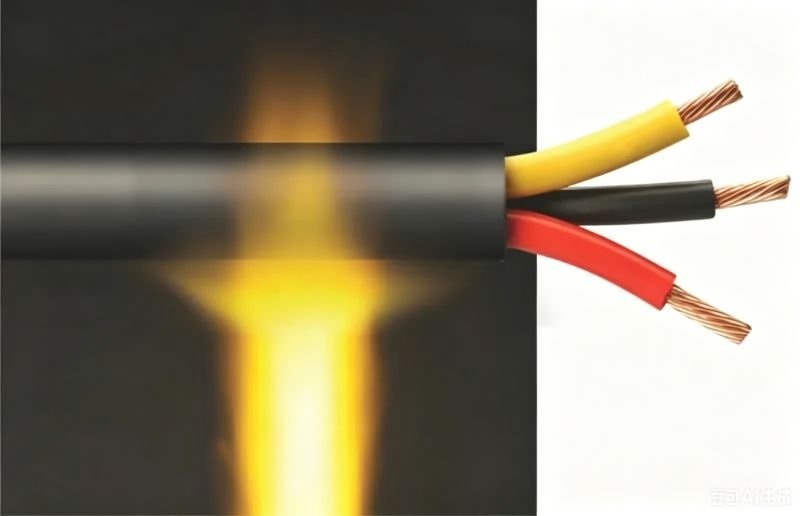
A fire starts in a building's basement electrical room. Within minutes, smoke fills the escape routes. The fire alarm sounds, emergency lighting should guide occupants to safety — but the cables powering them have already failed. The fire didn't reach them; the heat from a nearby cable tray did. The cables were labelled "flame retardant." But that's not the same as fire-resistant.
This distinction — flame-retardant vs. fire-resistant — is one of the most frequently misunderstood specifications in building services engineering. Specifying the wrong type can mean the difference between a building that meets life safety codes and one that puts occupants at risk. This article explains the engineering difference, the standards that define each, and how to choose correctly for your project.
Despite similar-sounding names, flame-retardant and fire-resistant cables serve fundamentally different purposes, tested against entirely different standards.
Purpose: Prevent fire from spreading along the cable run. A flame-retardant cable will self-extinguish when the flame source is removed, limiting fire propagation to a defined zone.
Test standard: IEC 60332 series — the cable is exposed to a standardised flame; the charred length must not exceed a specified maximum (typically 2.5 m for single cables per IEC 60332-1-2, or a pass/fail criterion for bunched cables per IEC 60332-3).
What it does NOT guarantee: Circuit integrity. Once the flame is removed and the cable has self-extinguished, the conductors may have shorted. The cable did its job — it did not spread the fire — but it cannot be relied upon to keep power or signals flowing during a fire.
Purpose: Maintain circuit integrity for a specified duration under direct fire exposure. A fire-resistant cable continues to carry current and voltage even while engulfed in flames, ensuring that emergency systems stay operational.
Test standards: BS 6387 CWZ, IEC 60331-21, EN 50200 — each defines a specific flame temperature, duration, and additional conditions (water spray, mechanical shock).
What it does NOT guarantee: It is not a substitute for passive fire protection. Fire-resistant cables are tested for a defined period (e.g., 90 or 180 minutes), not indefinitely.
| Property | Flame-Retardant (IEC 60332) | Fire-Resistant (BS 6387 / IEC 60331) |
|---|---|---|
| Primary function | Limit flame spread along cable | Maintain circuit integrity under fire |
| Does it keep working in fire? | No — may short once insulation burns | Yes — for rated duration (90/180 min) |
| Test temperature | ~800 °C (applicator flame) | 750 °C (IEC 60331) / 950 °C (BS 6387 C) |
| Water / impact tested? | No | Yes — for CWZ / PH ratings |
| Mandatory for life safety? | Often required for all building cables | Required for emergency circuits only |
| Typical construction | Standard PVC / XLPE / LSZH + basic fillers | Mica tape + fire barrier layers + LSZH jacket |
| Relative cost | Baseline | 1.5–3× baseline |
Building codes worldwide require fire-resistant cables for circuits that must remain operational during a fire. These typically include:
Escape route lighting must stay illuminated for the full evacuation period. Power supply cables to emergency luminaires must be fire-rated to at least 30 minutes (PH30) — and often 120 minutes (PH120) for high-rise buildings where evacuation time exceeds 30 minutes.
Fire detection and alarm systems must remain functional to guide evacuation and alert fire services. Category L1/L2/L3 systems in commercial buildings typically require fire-resistant cabling meeting BS 6387 CWZ or equivalent.
Critical firefighting infrastructure — lift power, sprinkler pump supply, smoke extraction fans — must operate throughout a fire. Most codes require fire-resistant cable with a minimum rating of 60–120 minutes at 750 °C or above.
BS 8519 specifically categorises life safety systems into risk categories, each defining the required fire resistance duration for supply cables. Category 3 (highest risk) demands cables that maintain circuit integrity at 950 °C for 180 minutes with water spray and mechanical shock — matching the BS 6387 CWZ regime.
| Application | Common Code | Typical Minimum Requirement |
|---|---|---|
| Emergency lighting | BS 5266 / EN 1838 | PH30–PH120 (EN 50200) |
| Fire alarm systems | BS 5839-1 | BS 6387 CWZ or equivalent |
| Firefighting lifts | BS 9999 | 120 min fire resistance |
| Sprinkler / fire pumps | IEC 60364-5-56 | BS 6387 CWZ / IEC 60331-21 |
| Voice alarm / PA | BS 5839-8 | BS 6387 CWZ |
| Smoke extraction fans | BS 9999 / EN 12101 | 120 min at 750 °C+ |
| High-rise life safety | BS 8519 Cat 3 | BS 6387 CWZ + water + impact |
For general building wiring — lighting circuits (non-emergency), power sockets, HVAC controls, data cabling — flame-retardant cables meeting IEC 60332 are typically adequate. The key distinction is whether the circuit must function during the fire or merely not contribute to its spread.
The physical construction of a fire-resistant cable is fundamentally different from a standard flame-retardant cable. The difference lies in the fire barrier layer.
| Layer | Standard Building Wire (PVC / LSZH) | Fire-Resistant Cable (BS 6387 CWZ) |
|---|---|---|
| Conductor | Bare or tinned copper, Class 1/2 stranded | Tinned copper, Class 2 stranded — tinning prevents oxidation at high temperature |
| Fire barrier | None | Mica-glass tape wrapped with ≥ 50% overlap (or ceramic silicone rubber) |
| Insulation | PVC (70 °C) or XLPE (90 °C) | XLPE (90 °C) or ceramic silicone rubber (up to 300 °C) |
| Inner sheath | Optional — PVC or LSZH | LSZH — prevents flame propagation between layers |
| Armour | SWA / AWA (if required) | SWA — steel wire provides mechanical protection + heat path |
| Outer sheath | PVC or LSZH | LSZH (low smoke zero halogen) — mandatory for occupied buildings |
Mica is a naturally occurring mineral with exceptional thermal stability — it remains electrically insulating at temperatures exceeding 950 °C. When wrapped around each conductor before the insulation layer, mica tape forms a fire barrier that keeps the copper strands electrically isolated even after the XLPE or silicone rubber insulation has burned away.
Flame-retardant cables achieve their property through chemical additives in the insulation or jacket material:
The key difference: flame-retardant additives modify the material chemistry to resist ignition; mica tape is a physical barrier that preserves conductor isolation regardless of what happens to the polymer.
Specifying flame-retardant cable where fire-resistant is required creates both safety and financial exposure. Here is the TCO picture.
| Cost Component | Correct: Fire-Resistant (BS 6387 CWZ) | Wrong: Flame-Retardant (IEC 60332) |
|---|---|---|
| Material cost (100 m, 4-core 16 mm²) | $1,200–1,800 | $600–900 |
| Installation (identical) | $800 | $800 |
| Upfront saving | — | −$600 to −$900 |
| Compliance risk | Passes inspection | Fails inspection — £4k–£15k retrofit cost + delay penalties |
| Liability in fire event | Circuit operates as designed | Emergency system fails — potential criminal liability, void insurance |
| Replacement cost (if caught) | None | Full strip-out + reinstall: 2–3× original project cost |
| Total 25-year risk-adjusted cost | $2,000–2,600 (known) | $2,400–$20,000+ (unknown) |
Not all cables labelled "fire-resistant" are equal. Here are practical verification techniques for procurement teams:
| Property | Standard Building Wire | SORIVO Fire-Resistant Grade |
|---|---|---|
| Fire barrier | None — basic PVC/LSZH insulation | Mica-glass tape, ≥ 50% overlap |
| Flame standard | IEC 60332-1-2 (self-extinguishing) | BS 6387 CWZ + IEC 60331-21 (circuit integrity) |
| Conductor | Bare copper (Class 1/2) | Tinned copper (Class 2) — IEC 60228, oxidation-resistant at 950 °C |
| Insulation | PVC (70 °C, 15–25 yr) or XLPE (90 °C, 25 yr) | XLPE + mica barrier (90 °C cont., 250 °C short-circuit) |
| Halogen content | PVC = high halogen; LSZH = zero halogen | Zero halogen — IEC 60754 compliant, IEC 61034 low smoke |
| Voltage rating | 300/500 V to 0.6/1 kV | 0.6/1 kV (LV) and 1.8/3 kV (fire alarm/safety) |
| Application | General power, lighting, sockets | Emergency lighting, fire alarms, life safety circuits |
| Certification | CE (self-declaration) | TÜV / BASEC / third-party tested |
| Traceability | Reel markings only | Metre marking + batch number, full traceability |
| Warranty | 5–10 years | 25 years |
SORIVO supplies a complete range of fire-resistant cables to BS 6387 CWZ, IEC 60331, and EN 50200 PH30/PH120 standards, plus LSZH building wire for general installation. Every batch is third-party tested with full traceability documentation.
The difference between flame-retardant and fire-resistant cable is not a marketing distinction — it is an engineering boundary that separates general building wiring from life safety infrastructure.
Flame-retardant cables (IEC 60332) limit fire spread. They are suitable for the vast majority of building wiring: general power, lighting, HVAC, and data circuits. Fire-resistant cables (BS 6387 CWZ / IEC 60331) maintain circuit integrity under direct fire exposure. They are mandatory for emergency lighting, fire alarms, firefighting equipment, and all circuits defined as life safety under BS 8519, BS 5839-1, and BS 5266.
When in doubt, consult the building's fire strategy document and verify the required standard with the project engineer. The cost of upgrading to fire-resistant cable on a few critical circuits is insignificant compared to the cost of a retrofit — or the consequences of a system that fails when lives depend on it.
Need certified fire-resistant cable for your project?
SORIVO supplies BS 6387 CWZ, IEC 60331, and EN 50200 fire-resistant cables with full third-party certification and batch traceability.
Email: sale@sorivocable.com | Phone: +86 19282905529
7×24×365 support — request free technical cable selection
View Fire Cable Range Request Batch Test Report