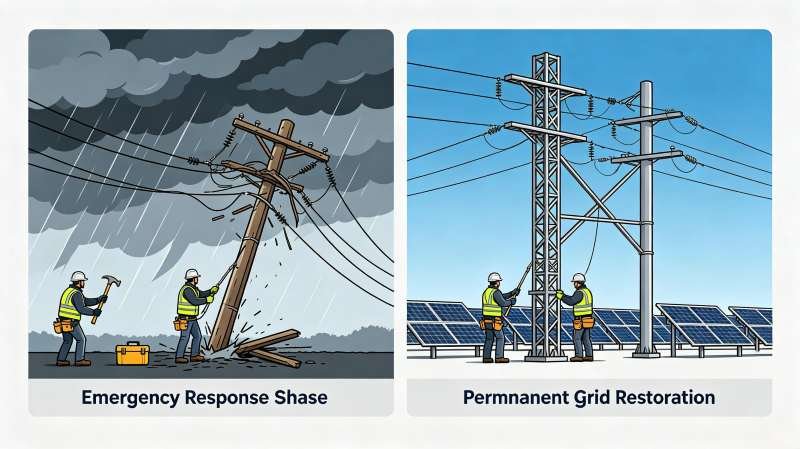
From Emergency Response to Permanent Grid Restoration: A Dual-Phase Approach
Post-disaster reconstruction follows a predictable pattern: you need power within days for relief operations, then a permanent grid that will last decades. Too often, these two phases are planned independently — emergency teams throw in whatever cable is available, and the permanent contractor rips it all out and starts over.
That waste is avoidable. This guide lays out a dual-phase cable and transformer strategy that bridges the gap between temporary power and permanent infrastructure, so the first investment feeds into the second rather than being scrapped.
The Core Idea
Design Phase 1 with Phase 2 in mind. Cable cross-sections, voltage ratings, and transformer footprints chosen during the emergency phase can — with forethought — serve as permanent infrastructure after the grid is restored. This cuts total project cost by 15–25% and shaves weeks off the transition timeline.
Phase 1 — Emergency & Temporary Power: Deploying Within 72 Hours
Phase 1When the grid is gone, the first priority is getting power to shelters, field hospitals, water pumps, and command centres. Speed outweighs perfection. But the choices made in these first 72 hours determine whether the temporary installation becomes an asset or a liability later.
What Temporary Power Demands
- Deployable within 72 hours — no custom fabrication, stocked items only
- Tough, flexible cable that survives rough terrain, debris, and weather
- Compatible with mobile generators and skid-mounted substations
- IEC 60309 compliant industrial connectors for fast hookup
SORIVO's Phase 1 Cable Range
| Product | Standard / Type | Key Properties |
|---|
| Heavy-duty rubber flexible cable | H07RN-F | 450/750 V, oil & weather resistant, abrasion tough |
| LSZH rubber flexible cable | H07ZZ-F | Same rating, zero halogen — use in field hospitals, shelters, crowded areas |
| Industrial plug & distribution cable | IEC 60309 compliant | 16 A – 125 A, IP67 water ingress protection |
| Light-duty flexible cable | H05VV-F / H05RR-F | Camp lighting, office containers, small power tools |
Mobile Substations & Temporary Transformers
- Skid-mounted or trailer-mounted units: 500 kVA – 2,500 kVA
- ONAN oil-immersed, designed for rapid connection to 11 kV or 33 kV lines
- Prefabricated distribution unit includes incoming panel, feeder breakers, and metering — arrives ready to energise
Field Note
In a recent Southeast Asia cyclone relief project, a dual-phase cable strategy was used: 12 km of H07RN-F and three 1,250 kVA skid-mounted substations were deployed within 5 days. The cable was selected with cross-sections that later matched the permanent load — no rip-and-replace when the permanent transformer arrived.
Phase 2 — Permanent Grid Restoration: Building for 40 Years
Phase 2Once emergency operations stabilise, the focus shifts to a permanent network that meets national grid standards and survives decades of weather, load growth, and fault conditions.
What Permanent Reconstruction Demands
- Medium voltage armoured cable — direct buried or in cable trenches
- Fire-rated circuit integrity cable for hospitals, fire pumps, and emergency exits
- UV resistance, moisture barrier, chemical resistance for industrial zones
- 40-year design life with minimal maintenance
SORIVO's Phase 2 Cable Range
| Product | Standard | Voltage Rating | Key Properties |
|---|
| MV SWA armoured cable | BS 6622 / IEC 60502-2 | 6.35/11 kV, 8.7/15 kV, 12.7/22 kV | Steel wire armour, direct burial, copper or aluminium conductor |
| 33 kV XLPE power cable | IEC 60840 | 19/33 kV | Copper tape screen + SWA, substation incomer duty |
| LV LSZH distribution cable | BS 6724 | 0.6/1 kV | Low smoke zero halogen — mandatory for public buildings and high-rise |
| Fire-resistant circuit integrity cable | BS 6387 / BS 7846 | 0.6/1 kV | PH30 / PH60 / PH120 ratings for fire pumps, evacuation lighting |
Permanent Distribution Transformers
- Oil-immersed (ONAN / ONAF): 500 kVA – 10 MVA, Dyn11 vector group, standard for distribution networks
- Dry-type (AN): 100 kVA – 3,150 kVA, preferred for hospitals and data centres where oil containment is a concern
- Compliant with IEC 60076, with bi-directional power flow capability — ready for solar PV and battery storage integration
The Critical Transition: From Temporary to Permanent Without Rewiring
This is where most reconstruction projects waste time and money. The emergency cables and transformers are ripped out and replaced — not because they failed, but because nobody planned the handover.
SORIVO's dual-phase approach avoids that.
How It Works
- Cable cross-sections are chosen upfront to meet at least 80% of the expected permanent load. Note that cable sizing must also account for voltage drop at full load, fault current withstand, and available standard cross-sections — these may require upsizing beyond the 80% guideline. When Phase 2 arrives, the Phase 1 cables are re-purposed as spare feeders, backup circuits, or distribution branches — never scrapped.
- Mobile substations use standardised base dimensions. When the permanent transformer arrives, the mobile unit's wheel kit is removed, the unit is bolted to the same foundation, and the termination points stay unchanged.
- Prefabricated distribution units are modular. Additional feeder panels can be plugged in without replacing the incoming section.
Selection Rule
Phase 1 cable cross-section ≥ 80% of Phase 2 expected load. Use copper conductors (higher salvage value, better long-term termination stability). Match sheath material across both phases — if Phase 2 uses LSZH, specify H07ZZ-F (not H07RN-F) in Phase 1 to avoid a full jacket change. Consult a qualified electrical engineer for final sizing — this is a design guideline, not a guaranteed rating.
Fast-Track Delivery & Testing Protocols
Production Acceleration
- Stock items held year-round: H07RN-F, H07ZZ-F, SWA armoured cables in standard sections (4 mm² – 300 mm²)
- Prefabricated branch cables: factory-terminated to length, zero field splices
- Pre-assembled substations: factory wired and tested, energise on arrival
Testing & Certification
- Every batch shipped with: insulation resistance test report, high-voltage withstand test certificate, material traceability documentation
- Third-party certification available: TÜV, BASEC, Lloyd's Register (on request)
- Mobile transformers undergo routine and special tests per IEC 60076 before dispatch
Emergency Response Cable Kit — Selection Matrix
| Scenario | Temporary Supply (Phase 1) | Permanent Build (Phase 2) | Transition Strategy |
|---|
| Small building cluster (≤500 kVA) | H07RN-F 4×35 mm² + mobile generator | BS 6724 4×70 mm² LSZH SWA + 500 kVA oil transformer | Temporary cable re-purposed as spare feeder |
| Medium industrial park (1–5 MVA) | H07ZZ-F + skid-mounted 1,250 kVA substation | BS 6622 3×185 mm² 11 kV + 5 MVA main transformer | Skid-mounted unit converted to fixed installation |
| Hospital / data centre | H07ZZ-F (LSZH mandatory) + 1,000 kVA dry-type temporary transformer | BS 7846 fire-resistant cable + 2×2,000 kVA dry-type transformers | Dry-type transformer relocated into permanent switchroom |
| Urban distribution backbone | Mobile 2,500 kVA trailer substation + temporary MV feeder | IEC 60840 33 kV armoured cable + 10 MVA main transformer | Temporary MV feeder converted to ring-main branch |
Frequently Asked Questions
Q: Can we save money in the emergency phase by using non-LSZH (PVC) cable?
A: Not recommended. Temporary shelters and field hospitals are densely populated. PVC cable burning releases hydrogen chloride gas, which is fatal in confined spaces. The cost premium for H07ZZ-F over standard H07RN-F is small — roughly 5–8% — and the safety benefit for occupants and responders is enormous. Many reconstruction tenders now explicitly require LSZH for all occupied temporary structures.
Q: Can the temporary transformer share a foundation with the permanent one?
A: Yes — if you plan for it. SORIVO's mobile substations use standardised base dimensions with removable wheel kits. When the permanent transformer arrives, unbolt the wheels, set the unit on the same concrete plinth, and reconnect. The key is knowing the permanent transformer dimensions at the time the mobile unit is ordered — our engineering team can match them before fabrication.
Q: How do we protect temporary cables from theft or damage during the transition?
A: Two measures work well. First, specify SWA armoured construction even for temporary runs — the extra cost is modest and the steel armour deters casual theft. Second, direct-bury the cable rather than running it above ground. This simultaneously protects it from weather, vehicles, and theft, and means it can remain in place as a permanent spare circuit without re-laying.
Q: What is the typical lead time for 33 kV cable on a reconstruction project?
A: SORIVO stocks standard 33 kV copper and aluminium sections year-round. For stock sizes, dispatch within 1 week. For non-standard constructions, typical lead time is 4–6 weeks, with an accelerated channel available at 2 weeks for confirmed projects. Every batch ships with the IEC 60840 type test certificate and batch-specific routine test report.
Q: What is the practical benefit of single-source supply for a reconstruction programme?
A: Three things. One: unified test documentation that satisfies World Bank, UNOPS, or bilateral donor compliance reviews. Two: consolidated logistics — one container holds cables, transformers, and accessories, clearing customs as a single consignment. Three: a single technical point of responsibility — no finger-pointing between cable and transformer suppliers when a termination issue arises.
Reconstruction Project Checklist
| # | Check Item | Phase |
|---|
| 1 | Confirm total temporary load and expected duration | Phase 1 |
| 2 | Select temporary cable type: H07RN-F (general) / H07ZZ-F (populated areas) | Phase 1 |
| 3 | Confirm mobile transformer capacity ≥ 120% of peak temporary load | Phase 1 |
| 4 | Verify temporary cable cross-section meets ≥ 80% of Phase 2 expected load | Transition |
| 5 | Check permanent cable voltage rating matches local grid (11 kV / 22 kV / 33 kV) | Phase 2 |
| 6 | Confirm fire cable integrity class: PH30 / PH60 / PH120 | Phase 2 |
| 7 | Confirm required third-party certification: BASEC / Lloyd's / KEMA | Both |
| 8 | Confirm transformer vector group: Dyn11 (distribution) / YNd11 (grid interconnection) | Phase 2 |