Professional cable manufacturer

Professional cable manufacturer
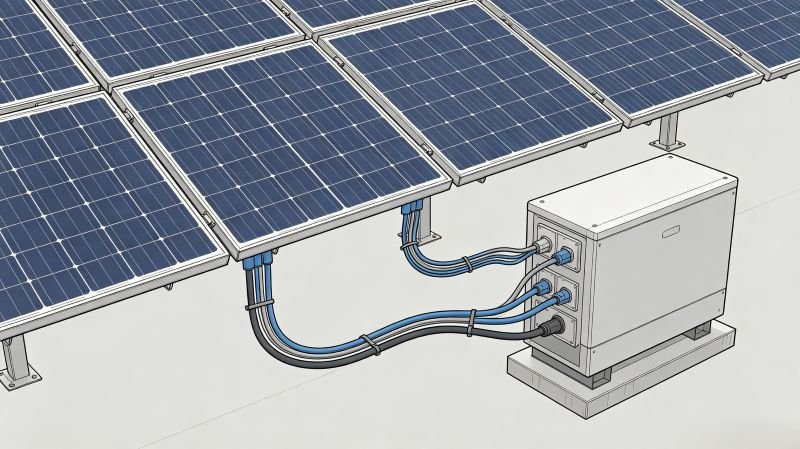
In parts of the Middle East, Africa, and South Asia, grid outages are not interruptions — they are the daily baseline. Factories lose production. Hospitals switch to diesel. Equipment gets damaged by voltage swings. PV + storage has shifted from an environmental choice to an operational necessity.
This guide is not about solar panels or inverters. It is about what connects them: the cables, transformers, and battery interconnects that keep the system running. The panels and batteries get the headlines. The cables and transformers keep the lights on.
Diesel backup is expensive. Generation cost runs $0.25–$0.45/kWh — roughly 5–8 times the levelised cost of a PV system. Add oil changes every 500 hours, carbon tax exposure, and ESG reporting pressure, and the financial case for solar-plus-storage becomes hard to ignore.
Voltage fluctuations are destructive. Sags and swells burn out VFDs, motors, and control electronics. Each production line restart can cost $5,000–$50,000 depending on the industry. A battery buffer absorbs these events before they reach sensitive equipment.
Operating modes depend on site needs: self-consumption during the day, islanded off-grid during outages, peak shaving when the grid is available, and grid support (reactive power injection) if the utility requires it.
Solar DC cables are the most failure-prone component in a PV system. Common issues: MC4 connector mismatch causing arc faults, UV degradation of inferior insulation within 5 years, and bare copper oxidising in hot-humid climates.
SORIVO H1Z2Z2-K addresses all three:
| Parameter | Specification | Why It Matters |
|---|---|---|
| Standard | EN 50618 / IEC 62930 | 1500 V DC rated, the most demanding international benchmark |
| Conductor | Tinned copper, Class 5 | Oxidation resistance in high-temperature rooftop and desert environments |
| Insulation | XLPE | 120 °C continuous rating — survives thermal cycling better than PVC |
| Jacket | XLPO (halogen-free) | LSZH for fire safety; UV stabilised for 25+ year outdoor life |
| System Size | Typical DC Voltage | String Current | Cable (≤50 m run) | Cable (>50 m run) |
|---|---|---|---|---|
| 5–10 kW | 400–600 V | 13–15 A | 4 mm² | 6 mm² |
| 10–50 kW | 600–1000 V | 13–15 A | 6 mm² | 10 mm² |
| 50–500 kW | 1000–1500 V | 15–20 A | 10 mm² | 16 mm² |
| >1 MW | 1500 V | 15–20 A | 16 mm² | 25–35 mm² |
Battery connections face challenges that solar DC cables are not designed for: high currents (100–300 A DC), electrolyte vapour exposure, and continuous charge-discharge thermal cycling.
TÜV 2PfG 2693 is the first global standard purpose-written for BESS cable. It mandates electrolyte immersion testing, Arrhenius-model thermal ageing (≥25 year life), and flame retardance per IEC 60332-1-2. SORIVO BESS cable carries this certification.
| Application | Recommended Cable | Key Property |
|---|---|---|
| Cell-to-module interconnect | SORIVO BESS flexible, halogen-free | Class 6 ultra-flexible conductor, electrolyte resistant |
| Module-to-PCS (battery rack to inverter) | SORIVO BESS XLPO 1×50–1×185 mm² | 1500 V DC, flame retardant (IEC 60332-1-2) |
| Rack earthing | SORIVO green-yellow 16–35 mm² | Low impedance, corrosion resistant |
A PV + storage transformer is not the same as a standard distribution transformer. Four differences matter:
| System Size | Transformer Type | Capacity | Key Feature |
|---|---|---|---|
| ≤100 kW commercial | LV isolation transformer | 50–100 kVA | Blocks DC injection from inverters |
| 100–500 kW | Oil-immersed Dyn11 | 200–630 kVA | Bidirectional, K-factor rated |
| >500 kW industrial | ONAN/ONAF oil-immersed | 800–2,500 kVA | ONAN preferred for off-grid (no fan dependency) |
| >5 MW utility | Power transformer | 5–63 MVA | On-load tap changer, SCADA ready |
For the AC side, from inverter to transformer use LV armoured cable (XLPE/SWA/PVC, 0.6/1 kV) — keep runs short to minimise voltage drop. From transformer to the grid interconnection point, specify MV cable (IEC 60840 for 33 kV, or BS 6622 / IEC 60502-2 for voltages up to 22 kV) with copper tape screening and SWA. Ensure anti-islanding protection and frequency/voltage ride-through are coordinated with the protection relay settings.
Procuring DC cable from one vendor, battery cable from another, and the transformer from a third creates interface risk. When a termination fails, each supplier blames the other.
| Factor | Multi-Supplier | SORIVO Single Source |
|---|---|---|
| Technical interface | Each supplier validates only their own component | SORIVO verifies compatibility across the full power chain |
| Test documentation | Inconsistent formats, slow lender review | Unified package — batch traceable, World Bank/IFC compliant |
| Shipping & customs | Multiple consignments, multiple clearances | One container, one clearance, one delivery window |
| Warranty & support | Finger-pointing at every failure | Single point of contact — SORIVO owns the interface |
| Application | PV Capacity | Storage | DC Cable | Battery Cable | Transformer | AC/MV Cable |
|---|---|---|---|---|---|---|
| Villa / small compound | 10–15 kW | 20–40 kWh | H1Z2Z2-K 1×6 mm² | BESS 1×25 mm² | 15 kVA isolation | LV 4×16 mm² |
| Small factory (no grid) | 50–100 kW | 100–200 kWh | H1Z2Z2-K 1×10 mm² | BESS 1×50 mm² | 200 kVA Dyn11 | LV 4×95 mm² |
| Large industrial park | 500 kW–2 MW | 1–4 MWh | H1Z2Z2-K 1×16 mm² | BESS 1×120 mm² | 1,250 kVA ONAN | MV 3×185 mm² 11 kV |
| Utility-scale plant | 10–50 MW | 20–100 MWh | H1Z2Z2-K 1×25–35 mm² | BESS 1×185 mm² | 20 MVA ONAN/ONAF | MV 3×300 mm² 33 kV |
| # | Check Item | Phase |
|---|---|---|
| 1 | Record grid data for ≥1 week — voltage range, frequency, outage count & duration | Pre-design |
| 2 | Determine worst-case outage duration to size storage capacity | Pre-design |
| 3 | PV DC cable: tinned copper + XLPO jacket confirmed (not bare copper / PVC) | DC side |
| 4 | Battery cable: TÜV 2PfG 2693 certified (not PV cable substituted) | DC side |
| 5 | System DC voltage matches cable rating (1000 V vs 1500 V) | DC side |
| 6 | Transformer: Dyn11 vector group + bidirectional power flow capable | AC side |
| 7 | Transformer cooling: ONAN preferred for off-grid / unreliable grid sites | AC side |
| 8 | MV cable: SWA armour + direct burial feasibility confirmed | AC side |
| 9 | Insulation coordination verified — cable BIL, transformer BIL, surge arrester ratings | System |
| 10 | Single-source supplier confirmed for unified test documentation package | Procurement |