Professional cable manufacturer

Professional cable manufacturer
Grid electricity bills never stop rising. Solar + storage + certified cables delivers 120%+ nominal ROI — and up to 560%+ when inflation-adjusted against rising grid rates. This is an asset that pays you back, not a bill that keeps growing.
Every year you stay on the grid, your electricity bill goes up. Every year you own solar + storage, your cost goes down. That simple math — rising utility rates vs. a fixed-cost asset — is why solar PV + battery storage + certified cables has evolved from an environmental choice into a wealth-building vehicle that consistently outperforms stocks, bonds, and savings accounts over its 25-year lifecycle. The specialized cable — the "vascular system" of the entire installation — is the critical foundation that ensures these returns are real and uninterrupted.
The global energy landscape is undergoing a profound transformation. Grid electricity prices continue their upward climb — households in high-cost U.S. states (California, Hawaii, etc.) face monthly bills of $500–600, exceeding $7,000 annually. Grid instability, blackouts, and extreme weather events have made energy security a top concern for both homes and businesses.
Grid electricity rates have historically risen 3–5% per year. At just 4% annual inflation, today's $595/month bill grows to $1,525/month by Year 25. That's not a prediction — it's the historical trend. Every year you delay switching locks in another year of escalating utility payments with zero asset to show for it.
Meanwhile, the cost of solar panels and battery storage continues to fall. All-in-one "solar + storage" solutions, championed by companies like Tesla, are rapidly gaining traction. Unlike solar-only systems (which generate but cannot store), solar + storage enables "generate, store, and consume on your own terms — avoid peak pricing and grid dependence entirely." And specialized solar and storage cables play the critical role of transmitting power reliably, determining system efficiency, safety, and service life.
Sorivo, as a professional cable manufacturer, supplies solar cables and BESS cables certified to EN 50618, TÜV 2PfG 2693, and other international standards, providing reliable power transmission for energy independence projects worldwide.
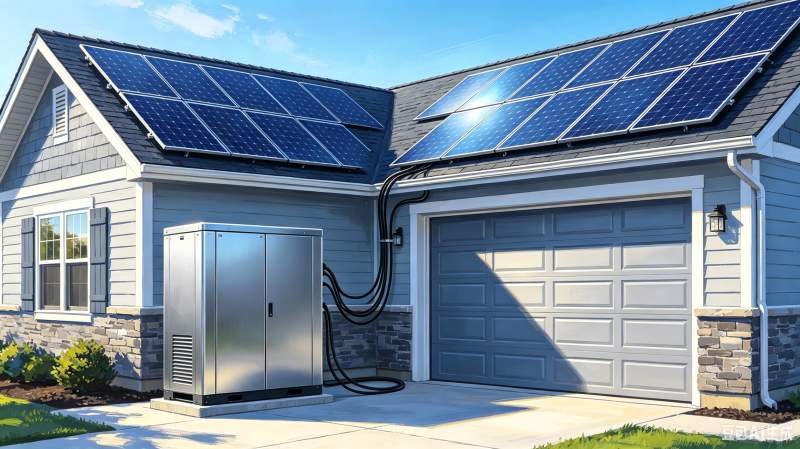
Solar panels convert sunlight into DC electricity — the system's "heart." Typical residential installations today range from 10–12 kW, suitable for larger homes (5,000+ sq ft / ~500 m²) with high consumption, generating 40–50 kWh per day and covering 70%+ of daily electricity needs.
Battery storage systems like the Tesla Powerwall store excess solar energy — "charge by day, discharge at night; store at low rates, use at peak rates" — solving the intermittency challenge of solar power. A typical high-consumption household installs 2–3 Powerwalls (13.5 kWh each), enough to cover 1,700 kWh/month of electricity usage.
The efficient operation of a solar + storage system depends on specialized cables — DC-side PV cables, AC-side storage and grid-tie cables — all of which must withstand outdoor UV exposure, extreme temperatures, high current, and harsh environmental conditions.
XLPE insulated, UV-resistant. Max. conductor temperature 120°C (per EN 50618). 4mm² rated ampacity: 55A (in free air, 30°C ambient). Optimized for module-level DC transmission.
High-conductivity copper + flame-retardant XLPO insulation. Rated for 1500V DC and instantaneous high current. Compliant with TÜV 2PfG 2693 for charging/discharging safety.
For inverter-to-grid connections. Flame-retardant LSZH sheath. Suitable for indoor, outdoor, and conduit installations.
High-purity oxygen-free copper conductors with cross-linked polyethylene insulation, produced to IEC 60228 Class 5 standard. Stable ampacity, low line loss. Full product range TÜV and CE certified, compatible with major global solar and storage systems. Browse the Sorivo solar cable range.
| Application | Recommended Cable | Key Parameters | Standard |
|---|---|---|---|
| PV Module → Combiner Box (DC) | H1Z2Z2-K / PV1-F | 4–6mm², DC 1500V, 120°C | EN 50618 / IEC 62930 |
| Combiner Box → Inverter (DC) | H1Z2Z2-K (larger cross-section) | 10–35mm², DC 1500V | IEC 62930 / TÜV 2PfG 1169 |
| Inverter ↔ Battery Storage (DC-coupled) | BESS Cable | 70–120mm², 1000V/1500V DC, High Current, Flexible | TÜV 2PfG 2693 |
| Inverter → Grid Tie Point (AC) | Power Cable (XLPE/SWA/PVC) | Per ampacity calculation | IEC 60502 / BS 5467 |
Never substitute standard building wire for certified solar or storage cables. Ordinary PVC wire is rated for just 70°C with no UV protection — in outdoor environments it becomes brittle and cracks within 2–3 years. Certified PV cables are verified for a 25-year thermal lifetime (IEC 60216), and BESS cables are tested for electrolyte resistance per TÜV 2PfG 2693. Saving a few dollars on cable today can wipe out your entire ROI tomorrow.
That inflation-adjusted $297,352 you hand to the utility over 25 years? With solar + storage, that same money could have built a $45,000–$55,000 asset that powers your home for free, increases property value by 4–6%, and keeps working for another 15–20 years after it's paid off. Staying on the grid locks you into a lifetime of rising bills.
Lease Model (Most Popular)
Loan / Purchase Model (Asset Ownership) — Battery Replacement Included
120% = nominal return on your total cash outlay (system + battery replacements). This is the apples-to-apples ROI. 560%+ = inflation-adjusted ROI that accounts for 4% annual grid rate increases — because grid power is not a static cost, it compounds upward every year. Your solar system is a fixed-cost asset; grid power is an escalating liability. The inflation-adjusted number reflects the real-world financial gap that grows over time.
| Year | Grid Monthly Bill (4% annual increase) | Grid Cumulative Paid | Solar (Lease) Cumulative Paid | Solar (Own) Cumulative Paid | Your Savings with Solar |
|---|---|---|---|---|---|
| Year 1 | $595 | $7,140 | $3,600 | $45,000 (setup) | Solar own: –$37,860 (investing) |
| Year 5 | $696 | $38,689 | $18,000 | $45,000 | Lease: $20,689 saved |
| Year 10 | $847 | $85,724 | $36,000 | $45,000 | Lease: $49,724 saved |
| Year 11.4 | $881 | $100,317 | $41,040 | $45,000 | Payback reached — free power begins |
| Year 15 | $1,030 | $142,968 | $54,000 | $45,000 | Own: $97,968 saved + asset |
| Year 20 | $1,254 | $212,616 | $72,000 | $45,000 | Own: $167,616 saved + asset |
| Year 25 | $1,525 | $297,352 | $90,000 | $45,000 | Own: $252,352 saved + free power forever |
* Grid inflation assumed at 4% annually compounded. Solar lease assumed flat $300/month. Solar own assumes $45,000 net investment after federal tax credit.
| Scenario | Initial Cost | Line Loss | Payback Period | 25-Year ROI | Risk |
|---|---|---|---|---|---|
| Substandard / ordinary wire | 20% lower | 3–5% higher loss | Extended to 13–15 yrs | ~50–60% (flat) Misses inflation hedge | Cracking, fault downtime |
| Sorivo certified PV/BESS cable | Standard (+$500–800) | 2–3% lower loss | Maintained at 11.4 yrs | 120%+ (flat) 560%+ with inflation | 25-yr thermal-life verified |
Cabling accounts for ~5–8% of a solar + storage system. Upgrading from standard wire to certified PV/BESS cable adds ~15–20% to the cable cost (~$500–$800 on a $50,000 system) but delivers 2–3% lower line loss, zero unscheduled downtime, and a verified 25-year thermal life (IEC 60216). The result? Your system's inflation-adjusted ROI stays at 560%+ instead of collapsing to ~50–60% with substandard wiring. Over 25 years, that $500–$800 cable upgrade protects over $200,000 in savings. For large-scale commercial or industrial BESS installations, standard residential wiring is insufficient — explore our heavy-duty industrial manufacturing cable solutions and commercial construction wiring to ensure grid-level safety and uptime. Choosing Sorivo certified cables is the highest-return decision you'll make on this entire project.
Here is the choice in plain numbers:
The difference is $549,704 — that is what choosing solar over the grid is worth to a California household over 25 years. Not "saving money." Building over half a million dollars of wealth from an asset that pays you back every single day.
"Solar + storage + cable" is not an energy purchase. It is a wealth-building vehicle that turns a necessary expense (electricity) into a cash-flow-positive asset. It outperforms the S&P 500, beats real estate in liquidity, and carries zero market risk — because the "returns" come from electricity you would have had to buy anyway.
The specialized cable — the system's vascular network — is the invisible guardian of those returns. Choosing Sorivo certified solar and storage cable solutions ensures your 25-year returns are predictable and uninterrupted.
For a project-specific cable proposal and quotation, contact Sorivo today with your project details (voltage, core count, length). Our engineering team will respond within 24 hours.
Data sources & disclaimers: Electricity rates based on U.S. EIA data for California (CA) tier-2 residential rates as of 2026. Grid inflation assumption of 4% annually is illustrative based on historical trends (EIA Annual Energy Outlook). System costs reflect 2026 U.S. market averages for a 12 kW solar array with 3x Tesla Powerwalls; actual pricing varies by installer, location, and configuration. Battery replacement costs estimated at $10,000–15,000 per replacement based on industry projections for 2037 and 2047. ROI calculations are illustrative examples; actual returns depend on local electricity rates, system sizing, financing terms, installation quality, and usage patterns. This article does not constitute financial or investment advice. Consult a licensed solar installer for a site-specific proposal.