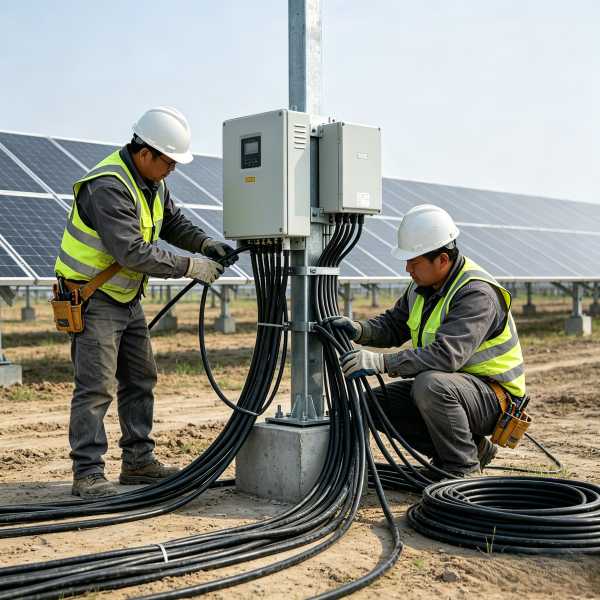
Choosing the Right Solar Cable Size for a 10kW System: A Practical Guide
Selecting the correct solar cable size is essential for ensuring the safety, efficiency, and long-term reliability of a 10kW solar installation. Undersized cables pose risks of overheating, voltage drop, and potential fire hazards, while oversized cables lead to unnecessary material costs. This guide outlines the key considerations—voltage, current, cable run distance, and installation environment—to help you make an informed and code-compliant decision.
1. Why Cable Sizing Matters
Solar cables serve as the critical link between panels, inverters, and the utility grid, carrying both DC and AC power. Incorrect sizing can result in:
- Energy Loss: Excessive voltage drop reduces overall system yield.
- Safety Hazards: Overcurrent conditions can cause insulation failure and fire.
- Code Violations: Non-compliance with standards such as NEC 690 or IEC 60364.
2. Key Sizing Factors
A. System Electrical Parameters
- System Power: 10kW (10,000 watts).
- DC Voltage Range: Typically 400V – 600V for residential and small commercial systems.
- Maximum Current (Ampacity): Current (A) = Power (W) / Voltage (V) Example: 10,000W ÷ 400V = 25A on the DC side.
B. Voltage Drop Considerations
To maintain optimal performance, voltage drop should be limited to less than 3%.
- Formula Reference: Cable Size (mm²) = (2 × Distance (m) × Current (A)) / (Voltage Drop (V) × Conductivity)
- Conductivity Values: Copper = 56 m/Ω·mm² | Aluminum = 35 m/Ω·mm².
C. Environmental Conditions
- Temperature: High ambient temperatures reduce cable ampacity. Use 90°C-rated PV wire for rooftop exposure.
- UV Exposure: Outdoor cables must feature UV-stabilized, weather-resistant insulation.
3. Recommended Cable Sizes for a 10kW System
Based on NEC 690 and IEC 60287 guidelines:
| Cable Segment | Current (A) | Distance | Recommended Size |
|---|---|---|---|
| PV Array to Inverter (DC) | 25 – 30A | ≤ 30 m | 6 mm² (10 AWG) |
| PV Array to Inverter (DC) | 25 – 30A | 30 – 50 m | 10 mm² (8 AWG) |
| Inverter to Grid (AC) | ~42A * | ≤ 20 m | 10 mm² (8 AWG) |
* AC Current Calculation: 10,000W ÷ 240V ≈ 42A (split-phase system).
Important Notes:
- For DC runs, use tinned copper PV wire (e.g., PV1-F or UL 4703) to prevent corrosion.
- For distances exceeding 50 meters, increase the cable cross-section to maintain voltage drop below 3%.
4. Applicable Standards & Certifications
- DC Cables: Must comply with TÜV 2 PfG 1169 or UL 4703 (UV, weather, and flame resistance).
- AC Cables: Must meet NEC 690 requirements for grid interconnection.
- Insulation: Minimum temperature rating of 90°C for rooftop installations.
5. Common Pitfalls to Avoid
- Neglecting Voltage Drop: A cable may have sufficient ampacity but still cause efficiency loss over long distances.
- Incorrect Cable Type: DC circuits require higher UV and insulation resistance than standard AC building wire.
- Ignoring Derating Factors: In high-temperature environments, derate cable ampacity by approximately 20%.
6. Installation Best Practices
- MC4 Compatibility: Use certified MC4 connectors for reliable, weatherproof DC terminations.
- Mechanical Protection: Install conduit or raceway in areas subject to foot traffic or physical damage.
- Clear Labeling: Identify all cable runs at both ends to simplify future maintenance and troubleshooting.
Conclusion
For a standard 10kW solar system, 6 mm² to 10 mm² (10 – 8 AWG) solar cable is recommended for DC runs, while 10 mm² (8 AWG) is suitable for AC connections. Always prioritize tinned copper conductors and UV-resistant insulation to ensure durability. Consult local electrical codes and a qualified installer to verify specific site requirements.