Professional cable manufacturer

Professional cable manufacturer
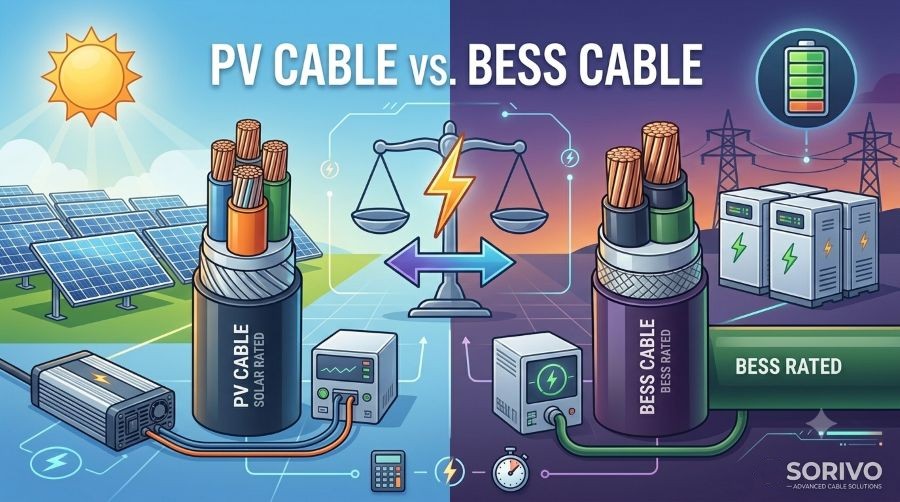
Let's face it—the global boom in battery energy storage has caught the supply chain off guard. Grid-scale BESS installations are doubling year on year, and procurement teams are under pressure to source cables fast. When a standard PV solar cable (H1Z2Z2-K or PV1-F) is sitting on the shelf at a familiar price, and a dedicated BESS cable needs a 6-8 week lead time, the temptation to substitute is real.
I've seen it happen on more projects than I can count: a 20 MW / 40 MWh BESS container arrives on site, and the internal DC cabling between battery racks is standard PV wire. The reasoning is always the same—"It's DC, it's 1500 V, it's double-insulated. What could go wrong?"
Here's the thing: using a PV cable in a BESS application is not just a corner cut. It is a decision that can void your system warranty, invalidate your TÜV certification, and—in the worst case—turn a battery container into a total loss during a thermal event. The two cable types look similar on paper, but the standards behind them test for fundamentally different failure modes.
This article walks through exactly what TÜV 2PfG 2693 requires that EN 50618 does not, and why the gaps matter for energy storage.
The easiest way to understand the difference is to put the two standards side by side and look at what each one tests.
A solar PV cable—whether H1Z2Z2-K per EN 50618 or PV1-F per TÜV 2PfG 1169—is designed for one primary mission: sit in direct sunlight at up to 90 °C conductor temperature, resist UV degradation, and carry DC power from the solar panel string to the inverter for 25 years.
The key tests are well established:
What is not tested: chemical resistance to battery electrolytes, thermal aging under daily charge-discharge cycling, salt fog corrosion, or flexibility for tight battery rack interconnects.
TÜV 2PfG 2693/03.23 (published March 2023), succeeding the original 2019 edition, is the world's first product standard designed specifically for cables in battery energy storage systems. It covers DC cables from battery modules to the inverter at voltages up to 1500 V DC.
Here is what 2PfG 2693 tests that PV cable standards do not:
| Test | PV Cable (EN 50618) | BESS Cable (2PfG 2693) | Why It Matters |
|---|---|---|---|
| Chemical resistance (electrolyte) | Not tested | Required — immersion in battery acid/glycol at 45 °C, 72 h | Battery electrolyte leaks are a known hazard in BESS containers; PV cables swell or crack on contact |
| Long-term thermal aging | Standard heat aging | Extended thermal life test per IEC 60216 | BESS cables experience daily temperature cycling from charge/discharge; accelerated aging is a real risk |
| Salt fog / salt spray | Not required | Required for outdoor coastal installations | Many BESS installations are in coastal industrial zones or offshore wind + storage hybrids |
| Damp heat (humid cycling) | Not required | Required — humidity and heat cycling | BESS containers experience condensation; moisture ingress into cable insulation is a creepage failure risk |
| UV resistance | Required (1000 h) | Required for outdoor cable runs | Both cover this, but PV cable UV testing is more stringent |
| Conductor temperature rating | 90 °C (standard), 120 °C (premium) | 125 °C (typical) | BESS cables run hotter due to enclosure effects and high charge/discharge rates |
| Flexibility (Class 5/6 conductor) | Class 5 (standard) | Class 5 or 6 (fine-strand) | Battery rack interconnects require tight bend radii in confined cabinet spaces |
| Grouped flame propagation | IEC 60332-1-2 (single) | IEC 60332-3-24/25 (grouped) | In a sealed BESS container, a cable fire propagating to adjacent cables is catastrophic |
It is worth going deeper on three specific failure modes, because these are the ones that cause real-world incidents.
Lithium-ion battery cells can vent or leak electrolyte during thermal runaway events, or even under normal aging in some chemistries. The electrolyte typically contains lithium hexafluorophosphate (LiPF₆) dissolved in organic carbonates—a chemically aggressive solvent that attacks standard XLPE and PVC insulation.
A PV cable jacket exposed to battery electrolyte can:
TÜV 2PfG 2693 requires a 72-hour immersion test at 45 °C in the specific electrolyte formulation used by the battery manufacturer. A standard PV cable is not tested against any electrolyte—it is tested against water immersion and common environmental chemicals only.
A solar PV system operates at relatively stable power output during daylight hours. The cable temperature follows the sun: it heats up during the day and cools at night. That is one thermal cycle per day.
A grid-scale BESS, by contrast, can go from full discharge to full charge in under an hour. The cable inside the battery rack heats up rapidly during a 1C charge, then cools during stand-by. In a frequency regulation application, a BESS can cycle 2-4 times per day—meaning the cable experiences 700-1,400 significant thermal cycles per year.
That difference in cycling frequency accelerates insulation aging through differential thermal expansion between the copper conductor and the insulation layer. After 5 years of daily cycling, a cable designed for solar duty (1 cycle/day) has aged roughly as much as a cable designed for BESS duty (4 cycles/day) ages in 15 months. The consequence is micro-cracking in the insulation that leads to partial discharge breakdown—a failure mode that is not tested in EN 50618.
PV cables are tested for single-cable flame propagation (IEC 60332-1-2). This test ensures that if one cable catches fire, it self-extinguishes within a specified time. That is sufficient for open-air solar arrays where cables are spaced apart on cable trays.
In a BESS container, cables are bunched together in enclosed cable trays inside a sealed metal box. If one cable ignites—whether from an electrical fault or thermal runaway in an adjacent battery module—the single-cable test is not representative. The fire needs to be contained within the bundle. This is why 2PfG 2693 requires grouped flame propagation testing per IEC 60332-3-24 (Category C) or 3-25 (Category D), which tests a vertical bundle of cables under a controlled flame for 20-40 minutes.
A genuine TÜV 2PfG 2693 certified BESS cable has a specific construction that distinguishes it from a PV cable:
| Component | BESS Cable (Typical 2PfG 2693) | PV Cable (EN 50618) |
|---|---|---|
| Conductor | Tinned copper, Class 5 or Class 6 fine-strand | Tinned copper, Class 5 |
| Insulation | XLPO or EPR, 125 °C rated, halogen-free | XLPO or XLPE, 90-120 °C rated, halogen-free |
| Sheath | LSZH, chemically resistant (electrolyte + oil + UV), 125 °C | LSZH or XLPO, UV resistant, 90-120 °C |
| Color coding | Orange (typical) or black; often printed "BESS" or "ESS" | Black or red; printed "PV" or "SOLAR" |
| Flame test | IEC 60332-3-24/25 (grouped) | IEC 60332-1-2 (single) |
| Chemical test | Electrolyte immersion (specific to battery chemistry) | Not tested |
| Temperature rating | −40 °C (min. ambient) to +125 °C (max. conductor) | −40 °C (min. ambient) to +90 °C (max. conductor) |
| Typical cross-sections | 4 mm² to 300 mm² | 2.5 mm² to 16 mm² (standard solar); up to 150 mm² available |
A standard H1Z2Z2-K 4 mm² PV cable costs roughly $0.45-0.65 per meter (depending on volume). A TÜV 2PfG 2693 certified BESS cable of the same size runs approximately $0.70-1.00 per meter—a premium of 40-60%.
On a 40 MWh installation, the total cable length for battery rack interconnects, rack-to-bus, and bus-to-inverter is roughly 8,000-15,000 meters. The upfront saving from using PV cable instead of BESS cable is about $2,500-5,000 on a total project cost that easily exceeds $5 million. The potential loss from a single BESS fire or warranty void exceeds $500,000.
| Application | Required Cable | Why |
|---|---|---|
| Battery module interconnect (within rack) | 2PfG 2693 (mandatory) | Electrolyte exposure risk, tight bend radius, vibration from cooling |
| Rack-to-rack DC bus (container interior) | 2PfG 2693 (mandatory) | Grouped fire propagation risk, thermal cycling, enclosed space |
| Rack-to-inverter/ PCS (DC side) | 2PfG 2693 (recommended) | High continuous DC current; grouped cables in tray |
| Inverter to transformer (AC side) | Standard AC power cable (XLPE) | No electrolyte or thermal cycling risk; standard AC cable is sufficient |
| Solar array to BESS (external DC) | H1Z2Z2-K (PV cable is acceptable) | External run, no electrolyte risk; UV resistance is the primary requirement |
| Auxiliary / control cables (BMS, monitoring) | LSZH control cable | Low smoke, halogen-free required inside container; 2PfG 2693 not required for signal cables |
PV cables and BESS cables look similar. They are both double-insulated, halogen-free, and rated for 1500V DC. But they are designed for fundamentally different operating environments, and the standards behind them test for different failure modes.
The deciding factor is not voltage. It is not even price. It is the specific risks of the application:
If you are sourcing cables for a BESS project in 2026, ask your supplier for the 2PfG 2693 certificate before you accept delivery. The cable that saves you two weeks of lead time could cost you the entire asset.
SORIVO's ESS cable range is TÜV certified to 2PfG 2642 and UL 4703. While 2PfG 2642 covers DC-side cables for PV and energy storage applications up to 1500V with LSZH sheath and IEC 60332-3 flame propagation, it does not include the specific electrolyte immersion test required by 2PfG 2693. If your project specification requires 2PfG 2693 certification, contact our engineering team—we will confirm coverage or arrange the necessary testing for your battery chemistry.
Request a certificate copy and technical datasheet for your next BESS project.
Email: sale@sorivocable.com | Tel: +86 192 8290 5529
Product page: SORIVO ESS Energy Storage Cable (2PfG 2642 / UL 4703) — review full specs and certificate