Professional cable manufacturer

Professional cable manufacturer
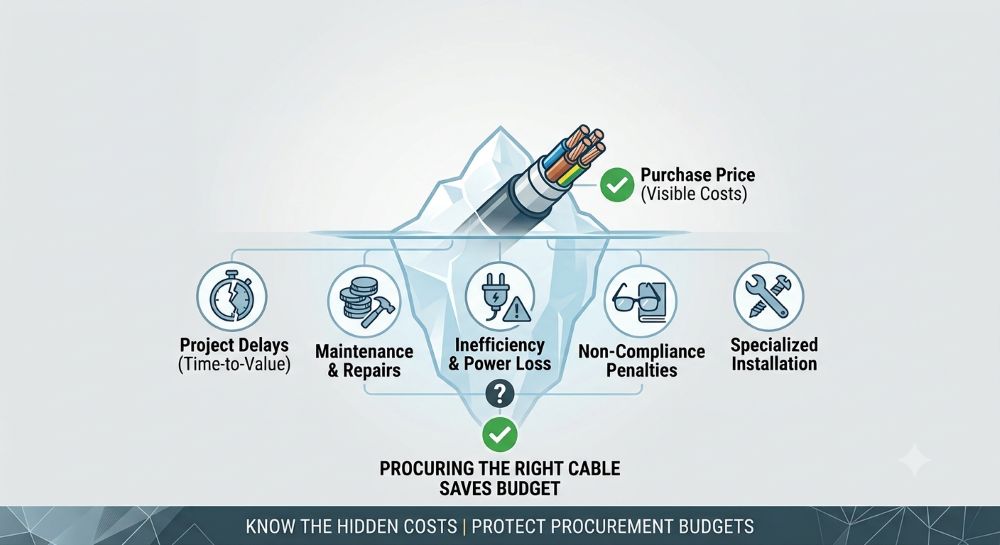
Let me start with a real story.
I once worked with a facilities manager at a mid-sized manufacturing plant who was proud of his procurement skills. He'd found a cable supplier offering prices 35% below the next bid. On a $108,000 cabling budget, that was about $38,000 in "savings" — more than enough to cover his end-of-year bonus target.
Three years later, that decision had cost his company more than $110,000 in unplanned repairs, production delays, and emergency rewiring. The cheap cable's jacket had cracked within 18 months. Connectors failed intermittently. Two production lines had gone down mid-shift. The real cost of his procurement "win" was nearly 3× the original project value.
Here's the thing: this story isn't unusual. I've seen it play out in factories, solar farms, and data centers across the world. The problem isn't that procurement teams buy cheap cable — it's that nobody calculates the downstream cost of that decision.
So let's fix that. This article breaks down the five hidden costs that turn a "cheap cable" into a budget disaster — with real numbers you can take to your next procurement review.
Here's something most buyers don't think about: cheap cable often costs more to install.
Think about it. A low-cost cable with thin, inconsistent insulation is harder to strip without nicking the conductor. A poorly manufactured jacket that's either too stiff or too soft makes routing through cable trays a nightmare. The terminations take longer, and the rejection rate is higher.
I've seen installation crews spend 30% more labor hours on cheap cable compared to a consistent, well-manufactured product. In one case, a data center installer had to re-terminate 40% of their connections because the cheap cable's outer diameter was out of spec and wouldn't seat properly in the connectors.
| Cost Factor | Economy Cable | Premium Cable |
|---|---|---|
| Installation labor per 100m | $350–$500 (12–16 hrs) | $250–$350 (8–10 hrs) |
| Termination rejection rate | 10–40% | <2% |
| Special tooling needed | Often — inconsistent dimensions | Standard tools only |
| Rework labor (typical project) | $800–$2,500 | $100–$300 |
The bottom line: a cable that's 30% cheaper per meter can easily end up costing more in total installed cost once you factor in labor and rework. The procurement team saves on materials — the project budget eats the difference.
Once a cheap cable is installed, the maintenance burden begins. And it's not trivial.
Industrial cable systems require regular diagnostic testing — thermography, partial discharge measurement, insulation resistance testing. These inspections cost real money: roughly $620 per kilometer per inspection cycle, based on utility maintenance data. Over a 25-year cable life, that adds up to roughly $6,200 per kilometer in preventive maintenance alone.
Cheap cables fail these inspections more often. They develop insulation weaknesses faster. They accumulate moisture ingress. Every failed inspection triggers a corrective maintenance event — and those cost an average of $5,100 each for a single cable failure.
Premium cables, by contrast, are designed to run maintenance-free for decades. A properly manufactured H1Z2Z2-K solar cable, for example, has a verified 25-year thermal life without insulation degradation. You don't need to inspect it every year — you know it's going to perform.
This is the big one. And I mean big.
Let's put some numbers on it:
Now compare those numbers to the cost of the cable itself. Even a premium cable, at maybe $2–$5 per meter for a good industrial power cable, is dwarfed by even 10 minutes of unplanned downtime.
The math is brutal: a single cable failure that shuts down a production line for 2 hours can cost 100× to 1,000× more than the entire cabling budget for that line.
This is the hidden cost that never appears on a purchase order — and it's almost always the biggest one.
Here's a scenario I see all the time:
A solar farm is built with budget-friendly PVC "solar cable" instead of certified H1Z2Z2-K solar cable. The installer saves maybe $0.30 per meter. Looks like a win.
Fast forward 4 years. The PVC jacket has turned brittle under UV exposure. Micro-cracks have let moisture in. Ground faults are popping up across the array. The inverter keeps tripping.
The operator has two options: live with constant downtime, or replace the entire DC cable network. Replacement costs — including the new certified cable, removal of old cable, labor, and lost generation during the re-cabling — run roughly 2.5× the original installation cost.
And here's the kicker: the original "savings" of $0.30/m on a 10km system was $3,000. The replacement bill? Easily $150,000–$250,000 for a utility-scale solar field.
This pattern repeats across every industry:
| Application | Cheap cable lifespan | Premium cable lifespan | Replacement cycles over 25 years |
|---|---|---|---|
| Solar farm (outdoor UV exposure) | 3–5 years | 25+ years (H1Z2Z2-K) | Cheap: 5–8× | Premium: 1× |
| Industrial control panel (oil, heat, vibration) | 3–7 years | 15–20 years | Cheap: 3–8× | Premium: 1–2× |
| Direct-buried power cable (moisture, thermal cycling) | 10–15 years | 30–40 years | Cheap: 2–3× | Premium: 1× |
| Robotic/track cable (continuous flexing) | 500K–1M cycles | 5M–10M+ cycles | Cheap: 5–20× | Premium: 1× |
Pay once for premium. Or pay two, three, or five times for cheap. Your call.
This one's invisible — no alarm bells, no failed inspections. But it costs you money every single day the system runs.
I²R losses — the power dissipated as heat in the conductor — are a permanent operating expense. The higher the resistance, the more energy wasted. Cheap cables often use:
Let's run the numbers for a typical industrial feeder:
| Parameter | Minimum-size cable (cheap) | Optimized cable (premium) |
|---|---|---|
| Conductor size | 95 mm² | 240 mm² |
| Load current | 200 A | 200 A |
| Route length | 100 m | 100 m |
| AC resistance at operating temp | ~0.247 Ω/km | ~0.098 Ω/km |
| Annual I²R losses (80% load factor) | ~22,700 kWh | ~9,000 kWh |
| Annual cost at $0.15/kWh | $3,405 | $1,350 |
| 10-year energy cost | $34,050 | $13,500 |
Based on IEC 60287 economic cable sizing methodology. The larger cable costs more upfront but pays back in 3–4 years through reduced losses alone.
The energy losses from an undersized or high-resistance cable are a permanent operating cost that compounds every year. Over a 10- to 25-year system life, the wasted electricity can exceed the cable's purchase price by a factor of 5 to 10.
| Cost Category | Economy / Untested Cable | SORIVO Premium Cable |
|---|---|---|
| Upfront price per meter (4mm² solar cable) | $0.80–$1.20 | $1.50–$2.20 |
| Installation labor per 100m | $350–$500 (higher rework) | $250–$350 (consistent quality) |
| Design service life | 3–5 years (UV exposed) | 25 years (EN 50618 verified) |
| Maintenance cost per km over 25 years | $15,000–$25,000 (frequent repairs) | $3,000–$6,000 (mostly preventive) |
| Likelihood of unplanned failure (10yr) | 40–60% | <2% |
| Conductor material | Bare copper or CCA (oxidizes, higher R) | Tinned copper IEC 60228 Class 5 (corrosion-resistant) |
| Insulation type | PVC (70°C max, UV sensitive) | XLPO (120°C rated, UV stabilized) |
| Third-party certification | Self-declared CE (no testing) | TÜV / UL / KEMA / BASEC verified |
| Batch traceability | None | Meter-marked, batch-coded |
| 25-year total cost per km | $120,000–$200,000 | $45,000–$70,000 |
25-year TCO includes: initial purchase + installation + planned maintenance + corrective repairs + 2 full replacement cycles for economy cable. Premium cable assumes 1 installation with no replacement. Details vary by application.
Here's a simple formula you can use to evaluate any cable purchase decision:
TCO = P + I + (M × Y) + (D × F × Y) + (R × N)
Where:
| Application | Recommendation | Rationale |
|---|---|---|
| Utility-scale solar farm (25-year PPA) | Premium only | One replacement cycle wipes out 5 years of generation revenue |
| Industrial production line | Premium only | 1 hour of downtime = entire cabling budget for the line |
| Commercial building riser (fire safety) | Premium only | LSZH required by code; liability from smoke/fire is immense |
| Temporary construction power | Budget acceptable | Short lifespan, supervised installation, low criticality |
| Residential indoor wiring | Standard grade sufficient | Protected environment, low mechanical stress |
| Data center / fiber backbone | Premium only | Signal integrity; re-cabling a live data center is extremely costly |
| Offshore / marine / subsea | Premium only | Replacement cost can be 100× the cable price per meter |
Here are practical checks you can use during supplier evaluation:
| Check | What to look for | Red flags |
|---|---|---|
| Jacket feel | Firm but flexible; consistent thickness | Too soft (under-cured) or too stiff (excess filler) |
| Print legibility | Sharp, permanent ink; 2–3m spacing | Smudges, rubs off easily, irregular spacing |
| Meter marking | Present and accurate | No meter marks or clearly wrong lengths |
| Conductor appearance | Bright, consistent stranding; tinned if specified | Dark spots, mixed gauges, aluminum showing through |
| Certification label | TÜV, UL, BASEC, KEMA logo with certificate number | Only "CE" (self-declared) or no marking at all |
| Diameter consistency | OD within ±0.1mm over entire length | Visible thick/thin sections; won't fit standard connectors |
How much more does premium cable cost upfront compared to economy cable?
Typically 30–80% more per meter, depending on the type and certification level. For example, a TÜV-certified H1Z2Z2-K solar cable might cost $1.80/m versus $1.00/m for an untested "solar-labeled" PVC cable. But as the TCO analysis above shows, that upfront premium is recovered many times over through longer life, lower maintenance, and avoidance of downtime. Think of it as an insurance premium — except this one has a positive ROI.
Our procurement policy requires the lowest bid. How do I justify premium cable to management?
Present a TCO analysis, not a price comparison. Use the formula in this article: calculate the 10-year or 25-year total cost including maintenance, expected failure rates (based on published data), and downtime cost. Most procurement departments can override "lowest bid" rules when presented with a proper lifecycle cost analysis showing that the cheapest option is actually 2–4× more expensive in the long run. I've seen this work — the key is framing it as financial risk management, not "better quality."
Is PVC cable really that bad for solar applications?
For indoor use with no UV exposure? PVC can last 15–20 years. But in direct sunlight — which is where solar cables live — standard PVC jackets become brittle within 3–5 years. The UV stabilizers in PVC are minimal compared to the carbon-black-stabilized XLPO used in EN 50618 solar cables. Field audits have found PVC "solar cables" that faded and cracked within 3 years, causing ground faults across entire arrays. If your solar project has a 25-year PPA, PVC cable is incompatible by design.
What's the single biggest TCO mistake procurement teams make?
Hands down: comparing unit prices only. I've seen teams celebrate "saving" $15,000 on a cable purchase, then spend $80,000 on emergency repairs and replacement within 5 years. The biggest mistake is not quantifying downtime risk. Most procurement templates simply don't have a row for "expected failure cost" — but that's the row that dwarfs all others. If your spreadsheet only compares $/m, you're not comparing costs at all. You're comparing prices. And price is not cost.
How do I verify that a premium cable will actually last 25 years?
Look for the test evidence. A genuine 25-year design life isn't a marketing claim — it's verified by Arrhenius thermal aging per IEC 60216. A certified cable will have test reports showing that the insulation retains >50% of its original elongation after accelerated aging equivalent to 25 years in service. Ask your supplier for the test report. If they can't provide one, the 25-year claim is just a number on a datasheet. If they can, you have engineering-grade evidence to back your procurement decision.
What's the payback period for upsizing to a more efficient cable?
For most industrial power cables operating at 50% load factor or higher, the payback period for upsizing 1–2 standard sizes above the minimum is typically 2–4 years. After that, the reduced I²R losses generate pure savings for the remaining cable life. At $0.15/kWh electricity, the undiscounted cumulative savings from upsizing from 95mm² to 240mm² for a 100m, 200A feeder are roughly $20,000 over 10 years — far exceeding the additional upfront cost.
Every cable purchase is a 25-year bet. Cheap cable isn't cheaper — it's just a deferred cost with interest. The five hidden costs we've covered — installation rework, endless maintenance, unplanned downtime, premature replacement, and continuous energy losses — turn that tempting upfront discount into a long-term financial drain.
At Sorivo, we've been manufacturing certified cables for over 15 years. Every reel we ship is tested to IEC, EN, TÜV, or UL standards — not self-declared, but third-party verified — with full batch traceability from extrusion to your site. When you specify Sorivo, you're not buying cable. You're buying a known, predictable lifecycle cost.
Professional customized cable solutions — 7×24×365 support
| Standard | Title / Purpose |
|---|---|
| IEC 60287-3-2 | Electric cables — economic optimization of conductor cross-section |
| IEC 60228 | Conductors of insulated cables — resistance limits and stranding classes |
| EN 50618 | Electric cables for photovoltaic systems — 25-year thermal life, mandatory tinned copper and LSZH |
| IEC 60216 | Electrical insulating materials — Thermal endurance properties (Arrhenius thermal aging) |
| TÜV 2PfG 1169 / 2693 | Photovoltaic and BESS cable certification — UV, thermal, and chemical resistance |