Professional cable manufacturer

Professional cable manufacturer
📅 Published: 2026-06-11 | 📁 Category: Solar Cable Guide | ⏱ 15 min read
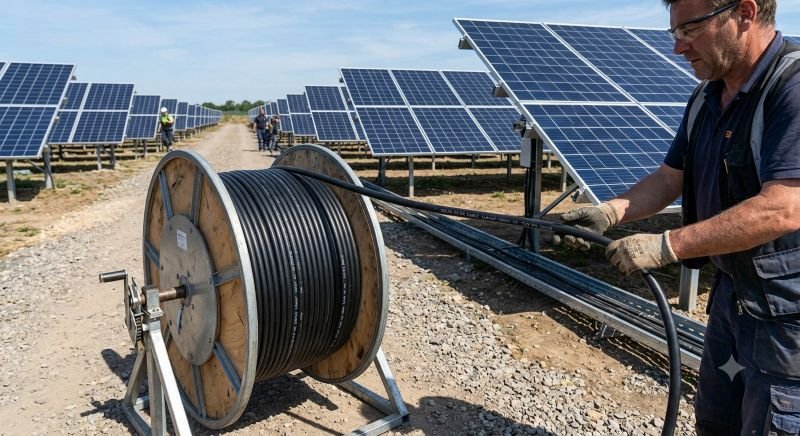
A solar PV system is only as reliable as its DC cabling. Undersized cables cause excessive voltage drop — which directly reduces energy harvest every day for 25 years. Oversized cables waste capital on copper you don't need. And in the worst case, a cable operating above its ampacity rating can overheat, accelerate insulation degradation, and create a fire risk.
Yet cable sizing is one of the most frequently overlooked aspects of PV system design. A 2023 field study by Fraunhofer ISE found that over 12% of installed PV systems had DC cable losses exceeding 3%, directly reducing annual yield by the same margin — a loss that compounds over the system's lifetime.
Whether you are designing a 10kW rooftop array or a 50MW utility-scale solar farm, correct DC cable sizing requires balancing three factors:
This guide walks through each factor with EN 50618 / H1Z2Z2-K cables, providing full ampacity tables, derating factors, step-by-step calculation examples, and a practical sizing chart from 2.5 mm² to 25 mm².
Not all cables are suitable for solar PV DC circuits. The European standard EN 50618 defines the construction requirements for photovoltaic cables — designated H1Z2Z2-K — which differ significantly from general-purpose PVC cables.
EN 50618 mandates tinned copper conductors to IEC 60228 Class 5 (fine-stranded). The tinning provides corrosion resistance against UV degradation and atmospheric pollutants over 25+ years of outdoor exposure. The Class 5 stranding ensures flexibility during installation — important when routing cables through tight conduit bends or tray turns on rooftops.
Unlike standard building wire (PVC or XLPE insulation), H1Z2Z2-K uses XLPO (cross-linked polyolefin) for both insulation and sheath. XLPO offers:
| Cross-section | Stranding | Conductor Ø (mm) | Outer Ø (mm) | Weight (kg/km) |
|---|---|---|---|---|
| 2.5 mm² | 50 × 0.256 mm | ~2.0 | ~5.4–5.9 | 45–46 |
| 4 mm² | 56 × 0.3 mm | ~2.5 | ~5.6–6.6 | 59–62 |
| 6 mm² | 84 × 0.3 mm | ~3.2 | ~6.3–7.4 | 80 |
| 10 mm² | 142 × 0.3 mm | ~4.0 | ~7.2–8.8 | 118–127 |
| 16 mm² | 228 × 0.3 mm | ~5.2 | ~9.0–10.1 | 182–190 |
| 25 mm² | 361 × 0.3 mm | ~6.5 | ~11.0–12.5 | 282–297 |
| Parameter | Economy / Generic PV Cable | SORIVO H1Z2Z2-K (EN 50618) |
|---|---|---|
| Conductor | Bare copper (prone to oxidation) | Tinned copper, IEC 60228 Class 5/6 |
| Insulation | PVC (rated 70°C, UV degrades in 5–8 years) | XLPO (halogen-free, −40°C to +120°C, 25-year design life) |
| UV resistance | Minimal or no stabiliser | Carbon black 2.6% ± 0.25% + stabiliser, HD 605 S1 tested, ≥85% retention |
| Voltage rating | Self-declared, often ≤ 1000V DC | TÜV-certified, 1500V DC (1.8 kV max) |
| Halogen-free | Not guaranteed (PVC contains ~38% chlorine) | IEC 60754-1/2 — HCl < 0.5% |
| Traceability | No metre marking | Metre-marked, batch-traceable |
| Warranty | 1–5 years | 25 years (matching module warranty) |
When a solar cable carries TÜV or UL certification, it means the product has passed a defined suite of tests — not just a one-time design review. Here is what the key standards verify:
The European standard for photovoltaic cables. It requires:
The international equivalent to EN 50618. Key differences:
The older German standard for PV cables, limited to 1000V DC. While still widely used, most new projects above 1000V specify H1Z2Z2-K.
This standard defines the method for calculating current-carrying capacity based on conductor temperature, ambient temperature, thermal resistance of insulation, and grouping effects. All ampacity values shown in this guide follow IEC 60287 methodology.
Ampacity — the maximum continuous current a cable can carry without exceeding its rated temperature — is the first filter in cable sizing. The following table gives full-load ampacities for H1Z2Z2-K cables under standard conditions (60°C ambient, 90°C conductor temperature).
| Cross-section | Free Air (A) | On Surface (A) | Two Cables Touching on Surface (A) | DC Resistance @ 20°C (Ω/km) |
|---|---|---|---|---|
| 2.5 mm² | 41 | 39 | 33 | 8.21 |
| 4 mm² | 55 | 52 | 44 | 5.09 |
| 6 mm² | 70 | 67 | 57 | 3.39 |
| 10 mm² | 98 | 93 | 79 | 1.95 |
| 16 mm² | 132 | 125 | 107 | 1.24 |
| 25 mm² | 176 | 167 | 142 | 0.795 |
Conditions: 60°C ambient, 90°C conductor temperature. Per EN 50618 Annex A.3.
When ambient temperature exceeds 60°C — common on rooftops in summer where surface temperatures can reach 70–80°C — multiply the base ampacity by the following factors per EN 50618:
| Ambient Temperature | Correction Factor |
|---|---|
| ≤ 60°C | 1.00 |
| 70°C | 0.92 |
| 80°C | 0.84 |
| 90°C | 0.75 |
Example: A 6 mm² cable rated 70 A in free air at 60°C can carry only 70 × 0.92 = 64.4 A at 70°C ambient, and 70 × 0.84 = 58.8 A at 80°C ambient.
When multiple DC cables run in parallel in a cable tray or trunking, mutual heating reduces ampacity. IEC 60287-2-2 provides grouping factors for cables in free air:
| Number of Circuits | Grouping Factor (touching) |
|---|---|
| 1 (single cable) | 1.00 |
| 2 circuits | 0.85 |
| 3 circuits | 0.77 |
| 4 circuits | 0.72 |
| 5 circuits | 0.67 |
| System Scale | Typical String Current | System Voltage | Recommended DC Cable |
|---|---|---|---|
| Residential rooftop (5–15 kW) | 9–12 A | 600–1000V DC | 4 mm² H1Z2Z2-K |
| Commercial rooftop (50–200 kW) | 12–15 A | 1000V DC | 6 mm² H1Z2Z2-K |
| Ground-mount utility (1–5 MW) | 15–20 A | 1500V DC | 6–10 mm² H1Z2Z2-K |
| Large utility-scale (>10 MW) | 20–30 A | 1500V DC | 10–16 mm² H1Z2Z2-K |
Always verify with full ampacity and voltage drop calculations for your specific run length and ambient conditions.
For a DC circuit, voltage drop is calculated as:
The factor of 2 accounts for the round-trip (positive + negative conductors). At 90°C conductor temperature, copper resistivity rises from 0.0175 Ω·mm²/m (at 20°C) to approximately 0.020 Ω·mm²/m — a 13% increase that should be included in sizing calculations.
| Limit | Application | Source |
|---|---|---|
| 1% | String cables (DC) — optimal energy harvest | IEC 62548 recommendation |
| 2% | Standard residential/commercial design target | Industry practice for PV circuits |
| 3% | Maximum for individual feeder circuits | NEC 215.2(A)(1) informatory note |
| 5% | Combined feeder + branch circuit total | NEC recommendation (upper limit) |
Our recommendation: Target ≤ 1.5% for DC string cables and ≤ 2.5% total DC side drop. Every 1% of voltage drop is 1% of system output lost permanently — for a 1 MW system at $0.10/kWh, that is approximately $1,000–$1,500 per year in lost revenue, or $20,000–$35,000 over 25 years (undiscounted).
The table below shows the maximum one-way cable length (in metres) to stay within a 1.5% voltage drop target at various system voltages and currents, using H1Z2Z2-K cables at 90°C conductor temperature.
| Cable Size | 30A @ 600V | 30A @ 1000V | 15A @ 1500V | 30A @ 1500V |
|---|---|---|---|---|
| 2.5 mm² | 18 m | 31 m | 94 m | 47 m |
| 4 mm² | 30 m | 50 m | 150 m | 75 m |
| 6 mm² | 44 m | 75 m | 225 m | 113 m |
| 10 mm² | 74 m | 125 m | 375 m | 188 m |
| 16 mm² | 118 m | 200 m | 600 m | 300 m |
| 25 mm² | 184 m | 313 m | 938 m | 469 m |
Formula: Lmax = (Vsys × %Vtarget × A) / (200 × I × ρ), where ρ = 0.020 Ω·mm²/m at 90°C.
Many procurement decisions focus on the upfront cable price per metre. But the dominant cost over a PV system's life is the energy lost to voltage drop — a cost that is invisible at purchase but compounds every day for 25 years.
| Scenario | System Size | Voltage Drop | Annual Loss (kWh) | 25-Year Loss (kWh) | Lost Revenue (≈ $0.10/kWh) |
|---|---|---|---|---|---|
| Optimised sizing | 100 kW | 1.0% | 1,500 kWh | 37,500 kWh | $3,750 |
| Marginal sizing | 100 kW | 2.5% | 3,750 kWh | 93,750 kWh | $9,375 |
| Undersized cable | 100 kW | 4.0% | 6,000 kWh | 150,000 kWh | $15,000 |
| Factor | Upfront Cost | 25-Year Cost | Notes |
|---|---|---|---|
| PV cable material (4 mm² vs 6 mm² per metre) | ~30% less for 4 mm² | ~40% more (lost energy) | The cheaper cable costs more over time |
| Replacement of degraded PVC cable (year 12) | — | Material + labour + downtime | H1Z2Z2-K avoids this entirely |
| Oversized cable (e.g., 16 mm² instead of 10 mm²) | ~60% more | Breakeven at ~year 8 | Worth it when voltage drop is critical |
Voltage drop is not just a "power loss" — it interacts with the inverter's MPPT (Maximum Power Point Tracking) window. If the DC voltage at the inverter input drops below the MPPT lower threshold due to cable losses, the inverter may curtail power or shut down on hot afternoons when you need it most. This clipping loss is rarely modelled but can cost 2–5% additional yield in real installations.
When sourcing PV cables, especially from unfamiliar suppliers, use these practical verification methods:
For a complete walkthrough, see our dedicated guide: How to Verify TÜV/UL Certification for Solar Cables.
Correct DC cable sizing for solar PV systems requires three checks, applied in order:
For almost all modern PV systems, we recommend H1Z2Z2-K tinned copper cables to EN 50618. At 1500V DC they are mandatory; at 1000V DC they provide future-proofing, wider MPPT margins, and proven 25-year UV durability.
Further reading:
Our technical team can provide ampacity calculations, voltage drop analysis, and cable recommendations tailored to your system voltage, string configuration, and installation environment. All SORIVO H1Z2Z2-K cables are TÜV-certified to EN 50618.
Contact SORIVO for a Cable Sizing Proposal📧 sale@sorivocable.com | 📞 +86 192 8290 5529
Let's calculate: Vdrop = 2 × 15 × 100 × 0.020 / 4 = 15 V → 15 / 1500 = 1.0%. This is within the 1.5% target. However, also check ampacity: 4 mm² rated 55 A free air is more than sufficient for 15 A. So yes, 4 mm² works. For a 30A string at 100 m on 1500V: Vdrop = 2 × 30 × 100 × 0.020 / 4 = 30 V → 2.0% — accept only if your total DC budget allows it; otherwise step up to 6 mm².
PV1-F (TÜV 2PfG 1169) is rated for 1000V DC; H1Z2Z2-K (EN 50618) is rated for 1500V DC. The H1Z2Z2-K has thicker XLPO insulation and is halogen-free by mandate. In practice, H1Z2Z2-K has become the default for new European installations, while PV1-F is still used for small residential 1000V systems. For a detailed comparison of solar cable types, see our full solar cable comparison guide.
For most installations, single-core cables (one positive + one negative) are preferred because they allow easier routing through conduit, better heat dissipation (air gap between cores), and simpler replacement. Twin-core cables save tray space and are often used in pre-fabricated harnesses or vertical drops where cable management is critical. SORIVO offers both twin-core H1Z2Z2-K and single-core variants.
Bifacial modules can produce 10–30% more current in high-albedo conditions (snow, white roofs, ground-mounted with reflector). This means the string current — and therefore voltage drop — may be higher than nameplate values suggest. For bifacial systems, design the cable for Isc × 1.25 per NEC 690.8 and target ≤ 1% voltage drop at the peak expected current (not just STC). A 6 mm² cable sized for 15A bifacial string at 1500V over 100 m gives Vdrop = 1.0% — safe. But the same cable at 20A bifacial current gives 1.33% — check against your budget.
Yes — all DC cable segments in a PV system should use UV-rated connectors (MC4 or compatible) at both ends for field connection. Never splice PV cables with standard wire nuts or junction boxes not rated for outdoor DC use. Pre-terminated cables with factory-crimped MC4 connectors (like our 4 mm² solar extension cables) ensure consistent crimp quality and avoid the most common source of PV connector failures — poor field crimping.