Professional cable manufacturer

Professional cable manufacturer
You've seen the headlines, right? June 2026, Rajasthan hit 51°C — the hottest place on the planet that day. Banda in Uttar Pradesh wasn't far behind at 48.2°C. And back in April, all 50 of the hottest cities on Earth happened to be in India at the same time. Not 49. All 50.
So naturally, every AC, every fan, every cooler in the country started running at full blast. On May 21, India's peak power demand hit 270.82 GW — an all-time record. For the fourth day in a row.
Here's the thing nobody stops to think about. All those cables — the ones running through your ceiling, tucked inside walls, buried underground — they've been carrying max load for hours, in ambient temps that would make most electronics give up. Are they actually built for this?
Let's be real. Most people pick a cable by asking one question: "Is it thick enough?" And honestly, that works fine — until summer hits. In 40°C+ conditions, that "thick enough" cable might be running way past what it can safely handle. You just don't know it yet.
I've been in this industry long enough to watch the same mistake play out year after year. So here's what I want to do: walk you through what actually happens to cables in extreme heat, how to pick ones that'll survive, and — more importantly — how to tell if yours are already in the danger zone.
Here's something a lot of people get wrong about cables: how much current they can safely carry isn't a fixed number. It changes with temperature. A cable that's perfectly fine in March might be running hot in July.
Best way I can explain it — imagine a drinking straw on a hot day. No problem, right? Now wrap that same straw in a thick blanket and try to drink. That's basically what high ambient temperature does to a cable. The heat can't escape fast enough, the insulation gets hotter than it was designed for, and suddenly your "fine in spring" cable is dangerously overloaded in summer.
Most cable ampacity ratings you'll see on spec sheets assume 30°C ambient (air installation). Go above that, and you have to apply a derating factor. In India's current heatwave, a lot of installations are seeing 45–50°C ambient. You can guess what that does to the numbers.
| Ambient Temp | PVC Insulated | XLPE Insulated |
|---|---|---|
| 30°C (baseline) | 1.00 (full rating) | 1.00 (full rating) |
| 35°C | 0.94 (6% loss) | 0.96 (4% loss) |
| 40°C | 0.87 (13% loss) | 0.91 (9% loss) |
| 45°C | 0.79 (21% loss) | 0.87 (13% loss) |
| 50°C | ~0.71 (29% loss) | ~0.82 (18% loss) |
~ Approximate values for copper conductors in free air, per IEC 60287 methodology. Actual derating depends on installation method, cable configuration, and conductor material.
Think about what that means. A PVC cable rated for 100A at 30°C can only handle about 79A at 45°C. You lose a fifth of your capacity without changing a thing. If someone sized that cable right at the limit during winter, it's running overloaded every single afternoon.
💡 Rule of thumb I use: Every 5°C temp rise costs PVC cable about 6–7% of its capacity, and XLPE about 4–5%. When you're speccing cables for a hot region, do your calculation based on the hottest month, not the annual average. That one decision alone can prevent a lot of problems.
A lot of insulation materials exist out there, but two of them do the heavy lifting: PVC and XLPE. They look pretty similar on the outside. Performance-wise? Completely different league.
Here's how I think about it. PVC is a cotton jacket. Fine for daily wear, but you wouldn't take it near a fire or into a freezer. XLPE is more like a proper shell jacket — it handles higher temperatures, resists aging way better, and if it does catch fire, it doesn't give off toxic HCl gas.
| Property | PVC | XLPE |
|---|---|---|
| Max conductor temp (normal) | 70°C | 90°C |
| Short-circuit temp (≤5s) | 150°C (IEC 60724) | 250°C |
| Design life | 15–25 years (degrades faster in heat) | 25+ years (better thermal aging) |
| Same-size ampacity | Baseline | 15–20% higher |
| Smoke toxicity in fire | Releases HCl gas (toxic) | Low smoke, zero halogen (LSZH option) |
| Flexibility at low temp | Gets hard and brittle | Stays flexible |
| Cost | Cheaper upfront | More expensive, better lifetime value |
The difference really matters in high-heat spots — attics, ceiling voids, cable trays near rooftops, outdoor runs in direct sun. PVC's 70°C limit disappears fast once ambient is 45°C and the cable is pulling load. Remember, the copper inside runs hotter than the outer jacket. At 45°C ambient under heavy load, you could already be at 65–70°C on the conductor. Push it one degree more and you're permanently degrading the insulation.
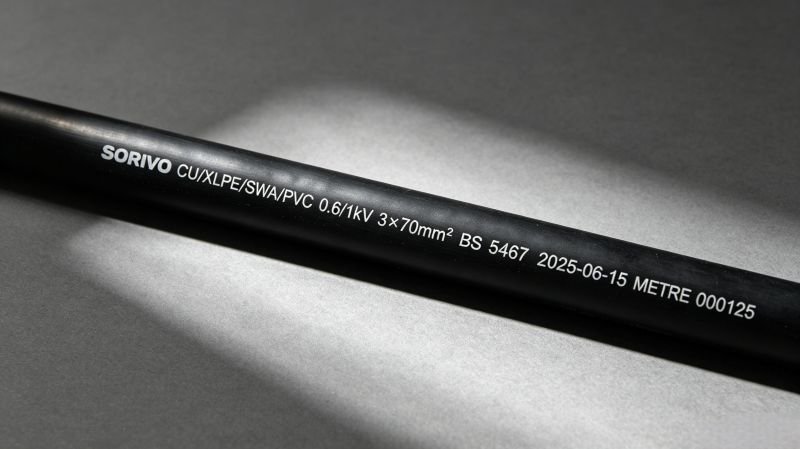
My take? If the budget allows, go XLPE. The price gap is smaller than you'd think, and the safety gap is enormous. Our CU/XLPE/SWA/PVC power cable range is built around this — 90°C rated conductors, exactly for conditions like this.
I know — "cable fire" sounds like something that happens to other people. But here's what's actually been happening in India this year:
In Lucknow, more than half of May's fire calls were linked to electrical infrastructure — poles catching fire, transformers blowing, AC circuits burning out. Delhi's fire service says roughly 70% of all emergency calls involve electrical faults during summer.
Not a coincidence that fire numbers go up exactly when the thermometer does. Researchers in Delhi found the correlation between temperature and electrical fires is 0.84 — meaning they move together, tightly.
When you look at what's driving it, it's really just three things hitting at once:
🔍 Quick check you can do (safely): Feel the main cable coming into your distribution board. If it's too hot to hold for more than a few seconds, you're probably looking at 55–60°C+ on the surface. For PVC cables, that's right at the edge. If you smell anything like burning plastic — don't wait, call an electrician.
After enough summers watching what holds up and what doesn't, here's what I've landed on:
If your ambient regularly goes above 35°C, I wouldn't even think twice — go XLPE. Look for YJV in the model code (copper) or YJLV (aluminum). You get 90°C conductor rating, which is 20°C more breathing room than PVC. Plus you pick up 15–20% more ampacity from the same wire size. A lot of safety for not much more money.
This might be the single most important thing I've learned: don't buy the exact size your calculation spits out. If your numbers say 95mm², spec 120mm². If it says 120mm², make it 150mm². That extra material cost is nothing compared to what you'd pay to replace a failed cable — let alone what a fire costs.
I've seen it happen over and over. Once you apply all the IEC 60287 corrections — temperature, installation method, grouping, altitude — the real-world capacity often ends up at 60–70% of the nameplate rating. Plan for that and you won't be caught out.
| Load (approx.) | Normal Sizing | Hot Climate (40°C+) Sizing |
|---|---|---|
| Main building supply (~60A) | 10–16mm² | 16–25mm² |
| AC unit dedicated circuit (~32A) | 4–6mm² | 6–10mm² |
| Small factory/workshop (~160kW) | 3×95+1×50mm² | 3×120+1×70mm² |
| Solar farm DC side (1500V) | 4mm² | 6mm² (plus UV derating) |
Honestly, I've seen good XLPE cables fail just because they were installed badly. Heat needs somewhere to go:
If the cables in your conduit feel unusually hot, don't blame the cable first. Check if the pipe is undersized, overstuffed, or sealed at both ends. You'd be surprised how often that's the real problem.
In my experience, the cable itself almost never fails. It's the joints, terminals, and sockets that cause trouble. A loose screw or a corroded contact can have 10 times the normal resistance — that tiny spot turns into a miniature heater. I've seen local temps at bad connections hit 100°C+ easily.
So when you're checking for hotspots, check the ends, not the middle. If the terminal is noticeably hotter than the cable run, you've found your problem.
Even after you've picked XLPE and upsized the cross-section, there's another layer. Not all XLPE cables are made the same. Here's the breakdown of what separates decent from dangerous:
| Feature | Economy / Commodity | Sorivo Premium Grade |
|---|---|---|
| Conductor | Bare copper (oxidises, contact resistance rises) | Tinned copper (IEC 60228 Class 5 stranded) |
| Insulation / Sheath | PVC (brittle after 5–8 years in heat) | XLPE insulation + LSZH XLPO sheath (25-yr design life, −40°C to +120°C) |
| UV resistance | Minimal stabilisers — cracks within months outdoors | Carbon black 2.6%±0.25% + UV stabilisers, HD 605 S1 passed |
| Certification | Self-declared CE (no third-party testing) | TÜV / UL / KEMA / BASEC verified |
| Traceability | No markings on cable | Metre-mark printing, batch traceable |
| Warranty | 1–5 years | 25 years |
The thing about cheap cable is — you won't notice the difference on day one. You notice it in year three, when the PVC jacket has gone stiff and started cracking. Or year five, when oxidation has eaten into the bare copper. Or that random Tuesday in July when the circuit finally gives out.
A properly made XLPE cable, by contrast, still feels flexible after a decade. The printing doesn't rub off with your finger. The sheath stays elastic. That's not marketing speak — that's just better materials and tighter process control.
⚡ Field test I always do: Squeeze the sheath between your fingers. Good XLPE has a firm-but-elastic feel. Cheap PVC is either rock hard or weirdly soft and sticky. And try scratching the printed marking — if it comes off that easily, that cable won't tell you who made it once the sun's been on it for a season.
If you're speccing cables for a hot-climate project, run through this before signing off:
Q: I already have PVC cables installed. Do I need to rip them out and replace?
Not necessarily — but don't ignore it either. Best first step: get a thermal camera or IR thermometer and check surface temps on your main circuits during peak load. Anything above 60°C surface on PVC needs attention. For critical circuits running continuously (pumps, compressors, AC feeders), I'd proactively swap to XLPE. For lightly loaded circuits, you're probably fine — just keep monitoring.
Q: What's the difference between YJV and VV cable types?
Pretty simple: YJV = XLPE insulation, VV = PVC insulation (this is the Chinese naming system, but the same logic applies globally). YJV is good for 90°C conductor temp, VV for 70°C. In hot climates, YJV is the safer pick. The price difference runs about 10–20% but the safety margin is way wider than that.
Q: Can I use aluminum cables in high-temperature environments?
You can, but you need to be careful. Aluminum's ampacity is about 75–80% of copper at the same cross-section (though it weighs about half as much). It also expands more with heat, so joints tend to work loose over time with temperature cycling. If you go with aluminum, upsize by 1.5–2 steps vs copper, use antioxidant compound on every connection, and re-torque after the first thermal cycle.
Q: How do I know if my solar farm cables can handle 50°C desert heat?
Look for cables meeting EN 50618 (H1Z2Z2-K) — it requires 90°C conductor rating, LSZH construction, and 25-year thermal service life. The 1500V DC rating helps too (higher voltage = lower current for the same power = less I²R heating). That said, even H1Z2Z2-K needs derating in 50°C ambient. A 4mm² that works fine in Europe may need upsizing to 6mm² in the desert.
Q: Is there a quick way to check if my cable supplier is cutting corners?
A few red flags I've learned to spot: no metre markings on the cable, printing that rubs off with your finger, a price that's 30%+ below market average, no third-party cert logos (TÜV, UL, BASEC, KEMA), and hesitation when you ask for test certificates. Reputable manufacturers share their test data freely. If they won't show you, walk.
Here's the short version: don't gamble on temperature margin.
This year's Indian heatwave isn't a one-off. Rajasthan hit 51°C. The grid hit 270 GW. Electrical fires jumped 34% in some regions. And all of those numbers trace back, one way or another, to the wires carrying the load.
The fix isn't complicated. Pick XLPE over PVC. Size up one step. Install with ventilation in mind. Pay attention to connections. And buy from suppliers who put their money where their mouth is — third-party certs, traceable production, transparent specs.
That last bit is where Sorivo comes in. We've been making cables for over 15 years, and we've seen every shortcut in the book. Our XLPE power cables and building wires are built for real-world conditions — not a nice 30°C lab. For full commercial installations, our commercial construction solutions page covers fire-resistant and LSZH options across the board.
Got a hot-climate project and not sure where to start? We're happy to help you get the spec right.
🔥 Don't Let Your Cables Be the Weakest Link This Summer
Browse certified XLPE cables → CU/XLPE/SWA/PVC 0.6/1kV Power Cable
Need technical support? sale@sorivocable.com | +86 19282905529
TÜV · UL · KEMA · BASEC Certified | 25-Year Warranty | Free Technical Consultation