Professional cable manufacturer

Professional cable manufacturer
Home » Products » Solar Cable » UL 4703 PV Wire
Sunlight-resistant XLPE photovoltaic wire in the 600 V, 1000 V and 2000 V classes, rated 90 °C wet and dry — the listing NEC Article 690 expects on a North American array.
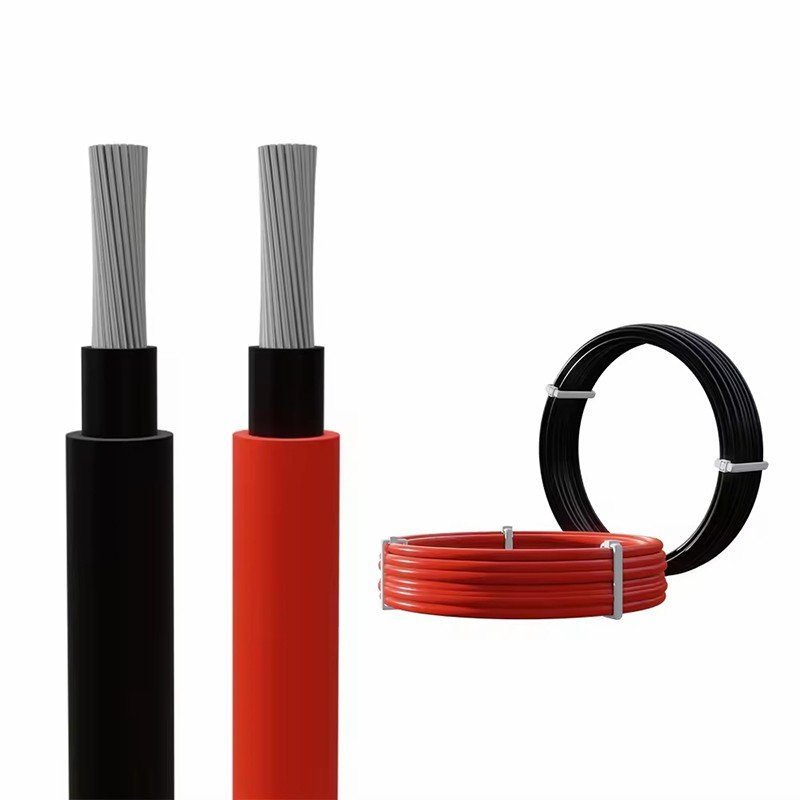
The numbers a North American PV installer checks first — and the one rating that decides whether the wire can sit in the sun.
UL 4703 covers single-conductor, sunlight-resistant photovoltaic wire rated 90 °C, 105 °C, 125 °C or 150 °C dry and 90 °C wet, at 600, 1000 or 2000 V, for the interconnection wiring of grounded and ungrounded PV systems as described in NEC Article 690, Part IV. That sentence is the whole product. If the project is reviewed against the NEC, this is the standard the reviewer opens.
The construction is a stranded annealed copper conductor under a single wall of cross-linked polyethylene. The wall is 1.90 mm (75 mil) at 1 kV / 2 kV for 14–12 AWG, 2.15 mm (85 mil) at 8–2 AWG and 2.66 mm (105 mil) at 1–4/0 — thicker than a building wire because the same insulation has to survive two decades of direct sun, thermal cycling and, on a floating array, permanent immersion risk. The 600 V version uses a 1.52 mm (60 mil) wall and is a different order line, not a derated one.
Two ratings are often confused. Sunlight resistance is not a coat of paint on the jacket; it is a test sequence on the finished wire, and UL 4703 requires it as part of the listing. Direct burial is a separate permission that comes from a USE-2 listing, not from UL 4703. A PV wire that is only UL 4703 can be exposed on a rack; it may not be buried. Most North American PV wire is therefore supplied triple-rated — PV to UL 4703, RHW-2 to UL 44 and USE-2 to UL 854 — one extrusion, three permissions.
Ampacity follows NEC Table 310.16 at the 90 °C column: 40 A for 10 AWG, 55 A for 8 AWG, 75 A for 6 AWG. The table is the starting point, not the answer. Conductors in a raceway on a roof take the ambient adder of 310.15(B)(2); conductors in free air take the correction of 310.15(B)(1); and NEC 690.8(B) requires the conductor to be sized at 125 % of the continuous current before any of that. The wire is not the constraint on most arrays — the correction stack is.
The line that matters commercially: a UL 4703 datasheet does not satisfy a European specifier, and an EN 50618 datasheet does not pass a US plan review. They are parallel systems that happen to look alike. If the destination is the US, Canada or Mexico, this is the page; if it is Europe, the H1Z2Z2-K range is the correct one, and we supply both.
More about the manufacturer: About SORIVO →
“PV cable” is a description; UL 4703 is a listing. The standard names the voltage classes, the temperature classes and the sunlight requirement, and a plan reviewer checks the print legend against it. A datasheet that says “PV cable, TÜV” is answering a different question.
UL 4703 lists sunlight resistance as part of the wire, not as an accessory. The insulation has to survive the exposure test on the finished construction — a black jacket and a UV stabiliser in the compound are not the same thing as a passing result.
The 2 kV class exists because a 1500 V DC string at −10 °C can sit well above its nominal voltage, and the NEC wants the conductor rated for the system, not for the label. Using a 1 kV wire on a 1500 V array is the mistake that gets a system red-tagged.
75 mil at 1 kV / 2 kV against 60 mil at 600 V. The extra wall is mechanical and environmental — abrasion on a rack, thermal cycling, and years of UV — not extra dielectric strength for its own sake.
PV (UL 4703), RHW-2 (UL 44) and USE-2 (UL 854) on one extrusion. The RHW-2 listing covers wet and dry raceway work; the USE-2 listing is what makes direct burial permissible. Confirm the print legend per size — not every maker lists all three.
Cold bend tested to −40°C. On a winter commissioning, wire that cracks at a bend radius fails the inspection before the array ever energises.
14 AWG to 4/0 AWG from stock tooling, and the same construction quoted to 1000 kcmil for combine and inverter runs. Aluminium is available in the same standard; we quote copper unless the design says otherwise.
Ampacity is published with the NEC stack that applies to it — 310.16 at 90 °C, the 125 % continuous rule of 690.8(B), and the ambient correction for a rooftop raceway. A bare “55 A” with no conditions is not usable on a drawing.
Every conductor in a North American array that is exposed, wet, or both.
Module-to-module and module-to-combiner leads on the rack, exposed to sun and weather, sized per NEC 690.8(B) at 125 % of continuous current.
Combiner-to-inverter runs in conduit or cable tray, where the ambient correction and the rooftop adder both apply and usually decide the size.
The worst case: high ambient, reflected heat from the membrane, and a raceway close to the roof surface.
Long exposed spans on single-axis trackers, where flexibility at the moving joint and UV resistance both matter.
Where the USE-2 rating is carried on the print legend — buried conduit-to-combiner runs with no raceway.
Continuous immersion risk means the wet rating and the wall thickness are the specification, not an afterthought.
DC-coupled storage interconnects in the same 1500 V class, run in the same tray as the array wiring.
Re-stringing an older array where the existing wire is 600 V PV cable and the new inverters run a higher DC voltage.
The complete parameter set — the same data our engineers quote from.
| AWG size | Strands count | Conductor dia. mm | XLPE insulation mm (mil) | Overall dia. mm | Weight kg/km | Max. DC resistance 20°C, Ω/km | Ampacity 90°C, A |
|---|---|---|---|---|---|---|---|
| 14 | 7 | 1.83 | 1.90 (75) | 5.6 | 53 | 8.61 | 25 |
| 12 | 7 | 2.16 | 1.90 (75) | 6.0 | 66 | 5.43 | 30 |
| 10 | 7 | 2.72 | 1.90 (75) | 6.5 | 88 | 3.41 | 40 |
| 8 | 7 | 3.40 | 2.15 (85) | 7.7 | 130 | 2.14 | 55 |
| 6 | 7 | 4.29 | 2.15 (85) | 8.6 | 183 | 1.35 | 75 |
| 4 | 7 | 5.41 | 2.15 (85) | 9.7 | 265 | 0.848 | 95 |
| 2 | 7 | 6.81 | 2.15 (85) | 11.1 | 391 | 0.534 | 130 |
| 1/0 | 18 | 8.53 | 2.66 (105) | 13.9 | 617 | 0.335 | 170 |
| 2/0 | 18 | 9.55 | 2.66 (105) | 14.9 | 754 | 0.266 | 195 |
| 3/0 | 18 | 10.74 | 2.66 (105) | 16.1 | 927 | 0.211 | 225 |
| 4/0 | 18 | 12.07 | 2.66 (105) | 17.4 | 1140 | 0.167 | 260 |
The highlighted 10 AWG row is the most common module lead. The 600 V version of the same sizes uses a 1.52 mm (60 mil) wall at 14–12 AWG — a thinner insulation and a different order line, not the same wire rated down. Ampacity is NEC Table 310.16 at the 90 °C column for not more than three current-carrying conductors in a raceway or cable at 30 °C ambient; on a PV circuit the 125 % continuous-current rule of NEC 690.8(B) and the ambient correction apply on top, and the corrected value is what goes on the drawing. Dimensions and weights are the manufacturer's published values and are nominal.
| General Information | |
| Product Name | UL 4703 PV Wire — photovoltaic cable, XLPE insulated |
| Product Type | Single-conductor, sunlight-resistant PV wire; available triple-rated PV / RHW-2 / USE-2 |
| Size Range | 14 AWG – 4/0 AWG copper (quoted to 1000 kcmil); aluminium in the same standard |
| Primary Standard | UL 4703 — Photovoltaic Wire (Ed. 2) |
| Further Standards | UL 44 (RHW-2) and UL 854 (USE-2) where the construction is triple-rated; ASTM B3 / B8 for the conductor; NEC Article 690 |
| Certification | UL 4703 listing for the size ordered — confirmed against the certificate before the order, not assumed from the family |
| Rated Voltage | 600 V / 1000 V / 2000 V classes, per the listing of the size |
| Conductor | |
| Conductor Material | Soft annealed stranded copper (bare or tinned); AA-8000 series aluminium on request |
| Stranding | 7-strand to 2 AWG; 18-strand at 1–4/0 (Class B / compact) |
| Max. DC Resistance @20°C (10 AWG) | 3.41 Ω/km |
| Max. DC Resistance @20°C (8 AWG) | 2.14 Ω/km |
| Insulation | |
| Insulation Material | XLPE — cross-linked polyethylene, single wall |
| Insulation Thickness | 1.90 mm (75 mil) at 14–12 AWG; 2.15 mm (85 mil) at 8–2 AWG; 2.66 mm (105 mil) at 1–4/0 — 1 kV / 2 kV class |
| Insulation Thickness (600 V) | 1.52 mm (60 mil) at 14–12 AWG — separate order line |
| Overall Diameter (10 AWG) | 6.5 mm (1 kV / 2 kV class) |
| Weight (10 AWG) | ≈ 88 kg/km (1 kV / 2 kV class) |
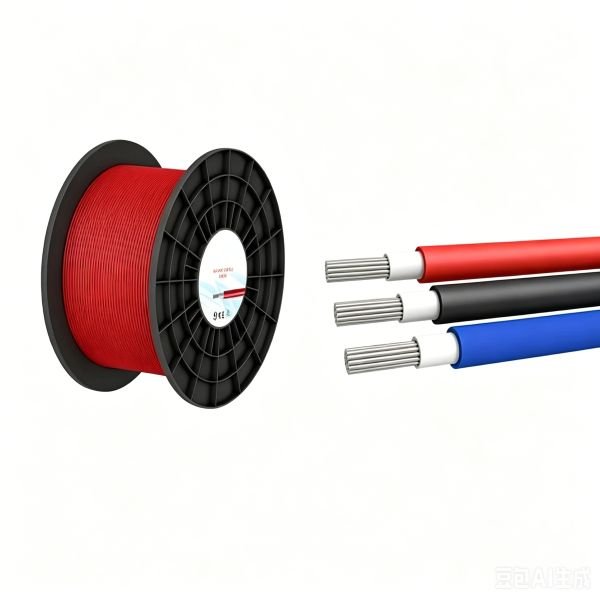
| Available Colours | Black standard; red, blue and other colours to order |
| Electrical Ratings | |
| Ampacity (NEC 310.16) | 10 AWG: 40 A at 90°C / 8 AWG: 55 A / 6 AWG: 75 A — not more than three current-carrying conductors in a raceway or cable, 30°C ambient |
| PV Circuit Sizing | NEC 690.8(B) — conductor sized at 125 % of the continuous current before ambient correction |
| Corrections | NEC 310.15(B)(1) ambient and 310.15(B)(2) rooftop adder; 310.15(C)(1) where more than three current-carrying conductors share a raceway |
| Referenced Article | NEC Article 690, Part IV — Wiring Methods (the scope clause of UL 4703 points here) |
| Temperature & Environmental | |
| Temperature Rating | +90°C wet and dry; UL 4703 also permits 105°C, 125°C and 150°C dry classes — this construction is the 90°C class |
| Cold Bend | −40°C |
| Sunlight Resistance | Required by UL 4703 and part of the listing — not an added jacket property |
| Direct Burial | Permitted only through a USE-2 (UL 854) listing on the same construction; UL 4703 alone does not authorise burial |
| Oil Resistance | Per the RHW-2 listing where the construction carries it |
| Packaging & Logistics | |
| Packaging | Coil / spool / reel; 500 ft, 1000 ft and 2500 ft reels standard |
| MOQ | 1 reel; cut lengths negotiable |
| Lead Time | 7–20 working days |
Final selection should be based on string voltage at the lowest expected temperature, continuous current, the installation method (free air, raceway, buried), the ambient at the array, and the listing actually held by the size ordered. Send us the string data and we will confirm the voltage class and the ampacity stack.
Photovoltaic wire to UL 4703, Ed. 2 — the listing a US plan review opens against NEC Article 690. Certificate of conformity available on request.
Request certificate copy →Where the print legend carries them, the same wire is a wet-location RHW-2 to UL 44 and a direct-burial USE-2 to UL 854. Confirm the legend for the size before a buried run is designed.
Request test report →Sunlight resistance is part of the UL 4703 listing; cold bend to −40°C and RoHS compliance apply to the construction. Reports provided with the quotation.
Request test report →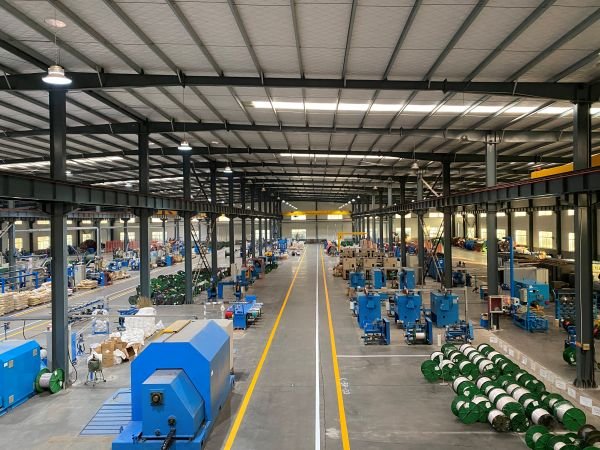
Every reel of PV wire is extruded, cross-linked and released against the applicable UL 4703 requirements.
Tell us the size, the system voltage (600 / 1000 / 2000 V), the length, and whether the run is exposed, in raceway or buried.
We confirm the wall thickness, whether the triple rating is available on that size, the print legend, and the quotation — within one working day.
Sample for qualification, with the print legend photographed on the actual wire.
7–20 working days lead time, with batch test documentation.
Reel packing, export documents and after-sales support on installation questions.
Tell us the size, voltage class and length — we reply within one working day.
The more detail you give, the faster and more accurate our quotation. Our engineers reply within one working day.
Thanks — our engineers will reply within one working day.