Professional cable manufacturer

Professional cable manufacturer
📅 Published: 2026-06-12 | 📁 Category: Armoured Cable Guide | ⏱ 13 min read
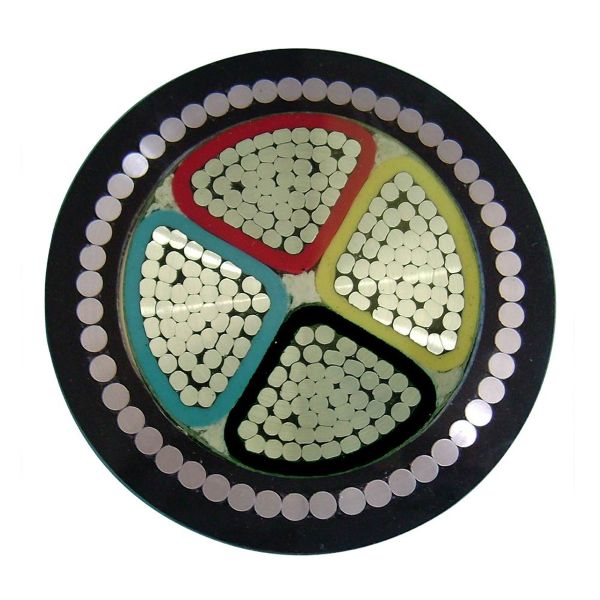
If you have ever specified steel wire armour (SWA) for a single-core cable and wondered why it runs hot, the answer is eddy currents. When an alternating current flows through a single-core conductor, it generates an alternating magnetic field around the cable. If that magnetic field encounters a ferromagnetic material — like the galvanised steel wires in SWA — it induces circulating currents (eddy currents) that generate heat, waste energy, and reduce the cable's current-carrying capacity.
Aluminium is non-magnetic. So aluminium wire armour (AWA) eliminates eddy current heating entirely. This makes AWA the mandatory armour type for all single-core armoured cables used on AC systems in the UK, as recognised by BS 7671 (the IET Wiring Regulations) and all UK Distribution Network Operators (DNOs).
This guide covers everything a UK electrical contractor or consultant needs to know about AWA cable: when it is required, the applicable British Standards (BS 5467 and BS 6724), DNO specification requirements, installation best practices, earthing considerations, and how AWA compares to SWA across common project scenarios.
AWA cable shares the same basic construction as SWA cable — the only difference is the armour wire material. Both are manufactured to the same British Standards and share identical electrical characteristics for the same conductor size.
| Layer | Material | Standard |
|---|---|---|
| Conductor | Plain annealed stranded copper, Class 2 | BS EN 60228 (formerly BS 6360) |
| Insulation | XLPE (cross-linked polyethylene) — 90°C rated | BS 7655 Type GP8 |
| Bedding (inner sheath) | PVC (BS 5467) or LSZH (BS 6724) | BS 7655 Type 9 / Type LTS1 |
| Armour | Aluminium wires (non-magnetic) — helically applied | BS 5467 / BS 6724 |
| Outer sheath | PVC (BS 5467) or LSZH (BS 6724) — black, UV-stable | BS 7655 Type 9 / Type LTS1 |
| Property | SWA — Steel Wire Armour | AWA — Aluminium Wire Armour |
|---|---|---|
| Magnetic | Yes (ferromagnetic) | No (non-magnetic) |
| Eddy current heating (AC single-core) | Significant — causes overheating and derating | None |
| Typical conductor size range | 1.5–400 mm² (multi-core) | 16–1000 mm² (single-core) |
| Standard applications | Multi-core circuits, three-phase balanced loads | Single-core AC circuits, DNO connections, transformer feeds |
| Relative armour weight | Heavier (steel density ~7.8 g/cm³) | Lighter (aluminium density ~2.7 g/cm³ — ~65% lighter) |
| Corrosion resistance | Galvanised — adequate for most soils | Good — natural oxide layer provides protection |
AWA cables are available under the same two British Standards as SWA cables:
| Standard | Armour | Sheath | Typical UK Application |
|---|---|---|---|
| BS 5467 | AWA (aluminium wire) | PVC | Industrial substations, transformer feeds, plant rooms |
| BS 6724 | AWA (aluminium wire) | LSZH | Public buildings, hospitals, data centres, tunnels |
The 18th Edition of BS 7671 addresses the requirement for non-magnetic armour in single-core AC cables:
UK DNOs — including UK Power Networks, SSE, SP Energy Networks, National Grid Electricity Distribution (formerly Western Power Distribution), and Northern Powergrid — all require AWA for single-core LV and MV connections. Key specification points include:
| Requirement | Detail |
|---|---|
| Armour type | Aluminium wire (AWA) for all single-core AC circuits |
| Standard | BS 5467 or BS 6724 — BASEC certification preferred |
| Cable formation | Trefoil formation for balanced impedance and reduced EMF |
| Gland plates | Non-ferrous material (brass, aluminium, or paxolin). If ferrous plates are unavoidable, slot between gland holes to break eddy current path. |
| Armour earthing | Single-point bonding at supply end to prevent circulating currents |
| Current rating | Derating factors apply for trefoil grouping, ambient temperature, and burial depth |
| Factor | Standard Market AWA Cable | SORIVO AWA Armoured Cable |
|---|---|---|
| Conductor | Copper, Class 2 — strand count may vary | BS EN 60228 Class 2 stranded copper, verified strand count |
| Insulation | XLPE (generic grade) | XLPE Type GP8 to BS 7655 — 90°C continuous, 250°C SC |
| Armour wire | Aluminium — gauge and uniformity unverified | Consistent aluminium wire diameter and lay length |
| Sheath | PVC or LSZH (grade unverified) | PVC Type 9 or LSZH Type LTS1 — carbon-black loaded |
| Traceability | May lack metre marking | Metre-marked, batch-traceable |
| Certification | Self-declared or no third-party verification | BASEC-certified, DNO-accepted |
| Warranty | 5–15 years | 25 years |
The following table covers the most common UK installation scenarios and the correct armour choice for each.
| Application | Cable Type | Armour | Reason |
|---|---|---|---|
| DNO LV supply (100A+ per phase) | Single-core — 3 phases + neutral | AWA ✓ | DNO mandatory. Single-core AC circuits require non-magnetic armour. Trefoil formation required. |
| Large commercial HVAC feeder | Single-core per phase | AWA ✓ | High current (200A+). Single-core runs between transformer and switchboard. |
| Data centre PDU supply | Single-core AWA in LSZH (BS 6724) | AWA ✓ | Fire safety (LSZH) + single-core AC requires AWA. BS 6724 recommended for public building. |
| Transformer secondary connection | Single-core per phase — high current | AWA ✓ | Transformers are the most common source of eddy current problems. AWA mandatory for each phase conductor. |
| Street lighting distribution | Multi-core 3-phase SWA | SWA ✓ | 3-core cable — magnetic fields cancel. SWA is standard and cost-effective. |
| Residential small service (60A) | Multi-core split concentric or SWA | SWA ✓ | Multi-core. No eddy current concern. SWA sufficient. |
| Industrial motor feeder (VFD) | Single-core per phase, screened | AWA ✓ | VFD harmonics increase eddy current risk. AWA + symmetrical trefoil essential. |
| Solar farm inverter-to-transformer | Single-core LV or MV | AWA ✓ | High current AC output from inverters. DNO typically requires AWA for grid connection. |
| If your circuit uses... | Armour type |
|---|---|
| Multi-core cable (all phases in one sheath) | SWA — steel wire armour (standard, cost-effective) |
| Single-core cables (one conductor per cable) | AWA — aluminium wire armour (mandatory for AC) |
| Single-core cables on DC circuit | SWA or AWA — no eddy current on DC, but AWA still preferred for consistency |
| Single-core cables, LSZH requirement | AWA to BS 6724 — aluminium armour + LSZH sheath |
Reference: BS 7671 Section 521.5.2. For DC circuits, eddy currents are not a concern.
Even with AWA cable, eddy currents can still be induced if the cable passes through a ferrous gland plate. The alternating magnetic field from each conductor induces currents in the steel plate around each gland hole. Mitigation measures:
Installing SWA on a single-core AC circuit instead of AWA may seem like a small oversight, but the consequences are quantifiable and severe.
Three single-core 240 mm² SWA cables (one per phase) carrying 400A at 0.6/1 kV can lose 2–5% of transmitted energy to eddy current heating in the steel armour. Over a 25-year design life, this is a significant operational cost:
| Scenario | Annual Energy Loss (3 phases) | 25-Year Loss (3 phases) | Lost Revenue (≈ £0.12/kWh) |
|---|---|---|---|
| Correct: AWA on single-core AC | Negligible | Negligible | £0 |
| Wrong: SWA on single-core AC (low loss scenario) | ~3,500 kWh | ~87,500 kWh | ~£10,500 |
| Wrong: SWA on single-core AC (high loss + overheating) | ~8,000 kWh | ~200,000 kWh | ~£24,000 |
When sourcing AWA cable for a UK project, use these checks to confirm you are getting a compliant product.
For a complete walkthrough, see our guide: How to Verify Cable Certification (methodology applies to BS standards).
The rule for AWA cable in the UK is straightforward: if your AC circuit uses single-core armoured cables, specify AWA (aluminium wire armour). Multi-core circuits can use standard SWA. This is not a design preference — it is a regulatory requirement under BS 7671 and DNO specifications.
When specifying AWA cable, remember:
At SORIVO, we supply single-core AWA cables to BS 5467 and BS 6724 with BASEC certification, metre-marked traceability, and full technical support for DNO connection applications.
Further reading:
We supply single-core AWA cables with full BASEC certification, suitable for DNO connections, transformer feeds, data centres, and industrial power distribution. Contact our team for project-specific cable sizing and specification support.
Request AWA Cable Specification📧 sale@sorivocable.com | 📞 +86 192 8290 5529
No — derating does not solve the underlying problem. Eddy current heating in steel armour is not a linear derating factor; it increases with the square of the current and varies with cable spacing and formation. BS 7671 Section 521.5.2 requires non-magnetic armour (AWA) for single-core AC cables regardless of load level. Using SWA on single-core AC is non-compliant, even if the load is light. The regulation exists because the magnetic field — and therefore the eddy current loss — exists whenever the circuit is energised, regardless of load magnitude.
DC circuits do not produce alternating magnetic fields, so eddy currents are not a concern. SWA is electrically acceptable for single-core DC cables. However, many specifiers still prefer AWA for consistency across a project, and some DNO standards require AWA regardless of AC or DC. If the circuit might ever be converted to AC in the future (e.g., solar farm reconfiguration), specify AWA from the start to avoid a future cable replacement.
Yes — AWA cables require aluminium-compatible glands (typically CW-type glands with aluminium body). Standard brass glands used for SWA are not suitable for direct contact with aluminium armour because of galvanic corrosion risk in the presence of moisture. The aluminium gland forms a corrosion-resistant connection with the aluminium armour wires. For BS 6724 (LSZH) cables, specify the LSZH version of the same gland range. Always earth the gland and armour securely — the armour is not qualified as a CPC (Circuit Protective Conductor) on its own.
AWA armour should be earthed at the supply end only (single-point bonding). Earthing at both ends creates a closed loop through the armour and earth path, which induces circulating currents from the alternating magnetic field — exactly the problem AWA is meant to solve. The armour is crimped into the CW gland using the armour ring, and the gland is bonded to the earth bar via an earth tag washer and a 10 mm² or 16 mm² earth conductor. The load end is left unbonded (or bonded via a surge arrester if lightning protection is required). For DNO connections, follow the DNO's specific earthing diagram.
Yes — AWA cable with a PVC or LSZH outer sheath is suitable for direct burial in the same way as SWA cable, provided the sheath is carbon-black loaded for UV resistance (standard for BS 5467 and BS 6724 black sheaths). The aluminium armour provides good mechanical protection. However, aluminium has lower tensile strength than steel — so maximum pulling tensions are lower for AWA than for equivalent SWA cables when pulling on the armour. When pulling on the armour, the maximum tension is calculated on the aluminium wire cross-section (typically 40–60 N/mm² of aluminium, compared to 100 N/mm² for steel). For long or complex pulls, use a pulling eye on the conductor instead.