Professional cable manufacturer
Professional cable manufacturer
Home » Products » Power Cable » Cu/XLPE/LSZH/SWA/LSZH 0.6/1 kV Armoured Power Cable
The same steel-wire-armoured 0.6/1 kV construction as BS 5467, but with a halogen-free bedding and a low-smoke zero-halogen over-sheath to BS 6724 — for tunnels, stations, basements and plant rooms where the fire performance is the design driver.
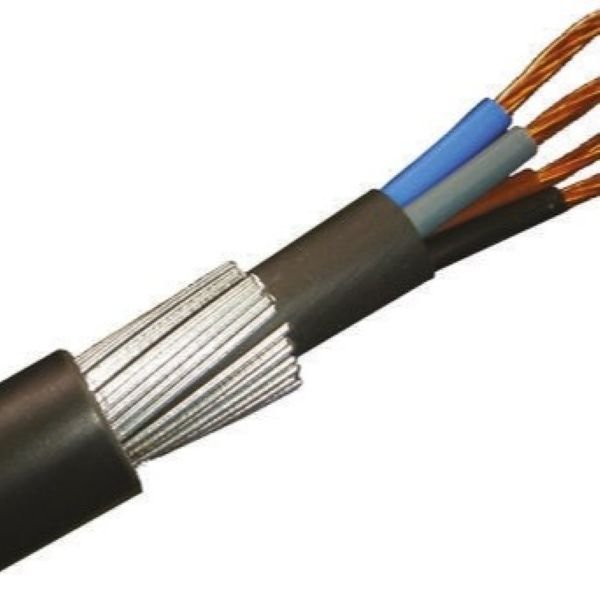
Three separate fire properties, three separate standards. Read what each one does and does not tell you before you put an LSZH cable into a fire strategy.
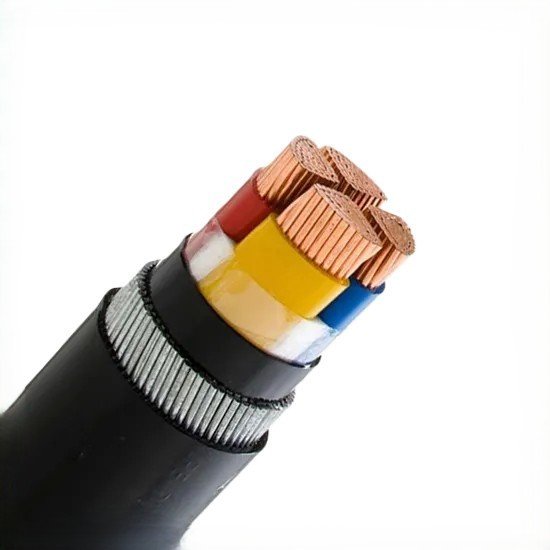
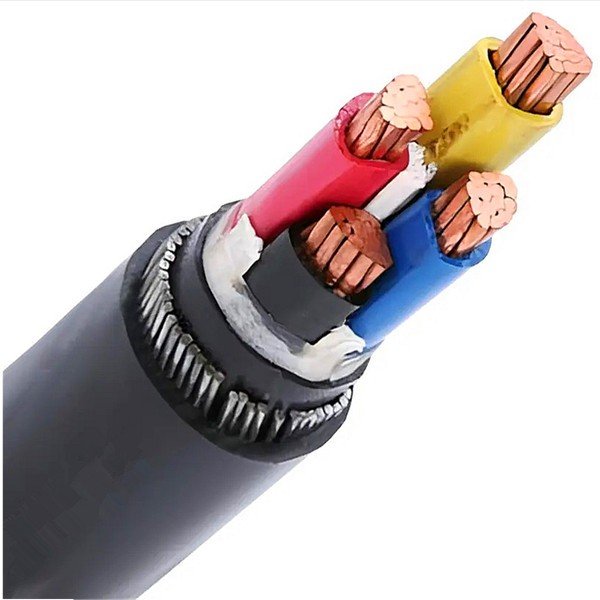
This cable is the BS 6724 cable: the same copper to IEC 60228 Class 2, the same extruded XLPE insulation, the same single layer of galvanised steel wires and the same 0.6/1 kV rating as the PVC version on this site. What changes is the layer above and below the armour: the bedding is a halogen-free filling compound and the over-sheath is LSZH. BS 5467 and BS 6724 are not two different cables — they are one construction with two sheath systems, and the standard number is what tells you which one you are buying.
Now the part that is usually glossed over. "LSZH" is three words and three independent test results, and they are not interchangeable. Halogen-free is IEC 60754-1: it measures how much halogen acid gas the compound releases when it burns. Acid gas corrosivity is IEC 60754-2: it measures the acidity and conductivity of the gases, which is what decides whether a fire in one room destroys the electronics in the next one. Low smoke is IEC 61034-2: it measures how much light gets through the smoke in a defined chamber. A cable can be halogen-free and still produce a great deal of dense smoke — so a page that cites 60754-1 and then claims "low smoke" has not shown you a smoke result at all. This cable is tested to all three, and each is named against its own standard in Table 3.
The flame test on this construction is also a different kind of test from the PVC version. The LSZH cable is tested to IEC 60332-3 Cat. C — a bunched-flame test on a tray of cables, which is the relevant test when a number of cables share a route and can feed each other. The PVC version is characterised by IEC 60332-1-2, a single-cable vertical flame test. Neither test is "better"; they answer different questions, and quoting the wrong one for the installation is a common and avoidable error. Note that Cat. C is the category this construction carries — if your specification asks for Cat. A or Cat. B, say so and we will quote against it rather than assume.
There is one more property worth naming because it is a genuine difference rather than a marketing one: this construction is rated for UV exposure. A halogen-free sheath normally behaves better outdoors than buyers expect, and the manufacturer data sheet rates this cable as UV resistant, which is why it is used on cable tray runs and in cable trench at solar and storage sites and not only indoors.
What the armour does here is unchanged from the PVC version: mechanical protection and rodent resistance, not EMC screening, with earthing at both ends as an installation decision rather than a property of the cable. What is genuinely different is what the cable adds to a fire — no halogen acid gas, controlled acid gas corrosivity, and a measured smoke density — and in a tunnel, a station, a basement plant room or a data hall, those three things are the whole reason for specifying it. For the electrical and dimensional data, Table 1 and Table 3 below carry the same parameter set as the PVC page, with the LSZH-specific dimensions.
More about the manufacturer: About SORIVO →
The compound releases no halogen acid gas on combustion. This is the property that protects people evacuating a confined space and the equipment in the adjacent room.
Acidity and conductivity of the combustion gases tested separately. It is the number a specifier of switchgear and control equipment should be asking for, and it is frequently missing.
Measured in the standard smoke chamber, on its own test. Halogen-free does not imply low smoke, so this is a separate result and not an inference.
IEC 60332-3 Cat. C applies to a tray of cables rather than a single cable, which is the condition a cable route actually sees.
The layer under the armour is a halogen-free filling compound, not PVC. A halogen-free over-sheath on a PVC bedding is a compromise the standard does not ask for.
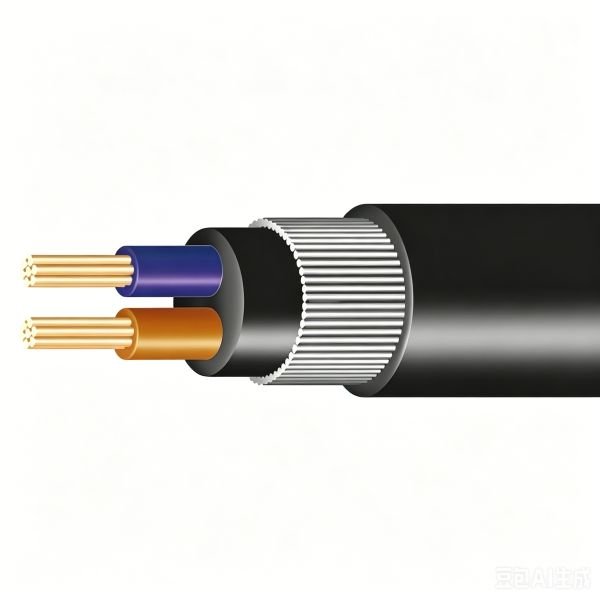
The same single layer of galvanised steel wires as the BS 5467 version — mechanical and rodent protection, and not an EMC screen in either version.
Usable on outdoor tray and in cable trench at solar, storage and industrial sites, where a sheath that chalked within two summers would be a maintenance problem.
Copper to IEC 60228 Class 2, XLPE at +90 °C continuous and +250 °C short-circuit for 5 s, 0.6/1 kV, 3.5 kV AC / 5 minute routine test.
Confined spaces, underground routes and anywhere the fire performance of the cable is part of a documented strategy rather than a preference.
Cable routes where evacuation and smoke visibility govern the design, and where a halogen-containing cable would be refused at the specification stage.
Station power and auxiliary supplies in enclosed public spaces, where low smoke and low acid gas are both requirements and the armour still has to be there.
Below-ground switchrooms and plant areas where smoke logging and corrosive gas damage to adjacent equipment are the two failure modes being designed out.
Power distribution feeding equipment rooms, where acid gas from a cable fire is a direct threat to the electronics in the next room, not just to people.
LV distribution in buildings where occupant evacuation is staged and the cable route passes through areas of refuge.
LV collection and auxiliary runs in cable trench and on outdoor tray, where the UV rating and the fire performance are both needed.
Routes where the cable may be exposed to a hydrocarbon fire environment and the acid gas contribution of the cable itself has to be minimised.
Large enclosed handling buildings and tunnels, where the cable density in the tray and the evacuation distance both push the design to a bunch-rated cable.
The complete parameter set — the same data our engineers quote from.
| Cores × size (mm²) | Overall dia. (mm) | Weight (kg/km) | R20 (Ω/km) | In air 30 °C (A) | Buried 20 °C (A) |
|---|---|---|---|---|---|
| 4 × 4 | 15.0 | 480 | 4.61 | 42 | 39 |
| 4 × 6 | 18.0 | 700 | 3.08 | 54 | 49 |
| 4 × 10 | 20.0 | 900 | 1.83 | 75 | 65 |
| 4 × 16 | 22.0 | 1200 | 1.15 | 100 | 84 |
| 4 × 25 | 27.0 | 1800 | 0.727 | 127 | 107 |
| 4 × 35 | 29.0 | 2250 | 0.524 | 158 | 129 |
| 4 × 50 | 31.0 | 2750 | 0.387 | 192 | 153 |
| 4 × 70 | 36.0 | 4000 | 0.268 | 246 | 188 |
| 4 × 95 | 41.0 | 5250 | 0.193 | 298 | 226 |
| 4 × 120 | 46.0 | 6750 | 0.153 | 346 | 257 |
The halogen-free construction carries the same current ratings as the PVC version at the same cross-section — 4 × 70 mm² is 246 A in air at 30 °C and 188 A direct buried at 20 °C in both — so the sheath choice is a fire-performance decision, not an electrical one. The overall diameter and weight are those published for this construction and differ slightly from the PVC version at some sizes (4 × 4 mm² is 15.0 mm nominal here against 16 mm on the PVC version) because the halogen-free compound and filling compound are specified differently. The 4 × 16 mm² row is highlighted as the section most often ordered for building and plant distribution. All dimensions and weights are nominal manufacturer values for this construction, and the two current columns are the manufacturer reference conditions rather than a single "rated current".
| Property | Standard | What it measures | What it does not tell you |
|---|---|---|---|
| Halogen-free | IEC 60754-1 | The quantity of halogen acid gas released by the compound on combustion | Nothing about smoke density or about flame propagation |
| Acid gas corrosivity | IEC 60754-2 | The acidity (pH) and conductivity of the gases produced, which is what attacks adjacent equipment | Not a halogen content result and not a smoke measurement |
| Smoke density | IEC 61034-2 | The light transmittance through the smoke in the standard test chamber | A halogen-free cable can still produce heavy smoke — the two are independent |
| Bunched flame propagation | IEC 60332-3 Cat. C | Vertical flame spread on a tray of bunched cables, the condition a real route presents | Not the same test as IEC 60332-1-2, which is a single cable |
| Single cable flame | IEC 60332-1-2 | Vertical flame propagation on one insulated cable | Says nothing about how a group of cables behaves together |
These are five separate tests and five separate results. IEC 60754-1 is frequently quoted on its own and then summarised as "low smoke", which the test does not establish — the smoke density result is IEC 61034-2 and it is run in a chamber, not inferred from the halogen content. The flame results are listed together here so the difference between a single-cable test and a bunched test is visible; a specification that names a bunched category is asking a question that IEC 60332-1-2 cannot answer.
| General Information | |
| Product Name | Cu/XLPE/LSZH/SWA/LSZH 0.6/1 kV Armoured Power Cable |
| Product Family | Copper conductor, XLPE insulated, steel wire armoured, halogen-free low-smoke sheathed low-voltage power cable to BS 6724 |
| Reference Standards | BS 6724 (0.6/1 kV thermosetting-insulated armoured cable, copper conductor, XLPE insulation, steel wire armour, halogen-free low-smoke over-sheath); IEC 60502 for the 0.6/1 kV construction; conductor to IEC 60228 Class 2; bunched flame propagation to IEC 60332-3 Cat. C. |
| Rated Voltage U₀/U | 0.6/1 kV |
| Conductor | Annealed copper, Class 2 stranded to IEC 60228 |
| Insulation | Extruded XLPE (cross-linked polyethylene) |
| Armour | Single layer galvanised steel wires, over the extruded bedding |
| Outer Sheath | Halogen-free low-smoke (LSZH) compound, black |
| Core Identification | Blue, brown for 2-core; blue, brown, black, grey for 4-core; confirmed on the drawing for the ordered construction |
| Electrical Ratings | |
| Max. Conductor Temperature | +90 °C continuous, the XLPE rating |
| Short-Circuit Conductor Temperature | +250 °C maximum, taken as the IEC 60502-1 short-circuit condition for XLPE-insulated copper cable, limited to 5 s. It is a calculated duty, not a temperature the cable may sit at. |
| Current Rating (reference) | 246 A in air at 30 °C and 188 A direct buried at 20 °C for 4 × 70 mm² — the reference conditions published for this construction. The figure that applies to a given route follows the installation method, grouping, soil and ambient; the per-size values are in Table 1. |
| DC Conductor Resistance | 0.268 Ω/km at 20 °C for 4 × 70 mm²; the per-size values are in Table 1 |
| Test Voltage | 3.5 kV AC for 5 minutes on the completed cable — the routine withstand test for 0.6/1 kV finished cable |
| Voltage Drop | A first-order estimate is 2 × R20 Ω/km for a single-phase circuit and √3 × R20 Ω/km for a balanced three-phase circuit, using the 20 °C resistance from the table. Add the reactance term and correct the resistance to the operating temperature before using it for a final design. |
| Fire Performance | |
| Halogen-Free | IEC 60754-1 — halogen acid gas content of the compound on combustion |
| Acid Gas Corrosivity | IEC 60754-2 — acidity and conductivity of the combustion gases |
| Smoke Density | IEC 61034-2 — measured in the standard smoke chamber |
| Bunched Flame Propagation | IEC 60332-3 Cat. C — bunched cable vertical flame test. Cat. A or Cat. B would be a different construction and is quoted separately. |
| UV Resistance | Rated UV resistant by the manufacturer data sheet |
| Environment | |
| Operating Temperature Range | −20 °C to +90 °C |
| Minimum Installation Temperature | 0 °C |
| Bending Radius when Laying | 8 × overall diameter (manufacturer figure for this construction) |
| Flame Retardance | IEC 60332-3 Cat. C, bunched cable vertical flame propagation — see the Fire Performance group above |
| Weather Resistance | Rated good for outdoor and buried service |
Halogen content, smoke density and acid gas corrosivity are three separate properties tested to three separate standards, and this page names each against its own standard instead of collapsing them into one "LSZH" claim — in particular, IEC 60754-1 establishes that the compound is halogen-free and does not establish that it produces little smoke, which is IEC 61034-2. The bunched-flame classification for this construction is IEC 60332-3 Cat. C; if your specification requires Cat. A or Cat. B, raise it in the inquiry and it will be quoted as a separate construction rather than assumed. The standard-based values on this page are otherwise limited to BS 6724 for the armoured halogen-free arrangement, IEC 60502 for the 0.6/1 kV construction, IEC 60228 Class 2 for the conductor and the 3.5 kV AC / 5 minute routine withstand test on completed lengths. Diameters and weights are nominal and re-confirmed on the drawing before production. Confirm the requirement against the fire strategy for the specific project.
The bedding and the over-sheath are halogen-free compounds, and the halogen acid gas content of the compound on combustion is tested to IEC 60754-1 rather than asserted. That is the property that keeps a confined space breathable and a neighbouring switchroom undamaged by the cable itself.
Request test report →Smoke density is a separate test against a separate standard from the halogen content, and this construction is tested to IEC 61034-2. We quote the smoke result rather than implying it from the halogen result, because a halogen-free cable is not automatically a low-smoke one.
Request test report →There is no CE certification for cable — CE marking is a manufacturer’s declaration of conformity, and which directive applies depends on the installation. We will not print "CE certified": a Declaration of Conformity and a RoHS declaration are provided on request for the construction supplied, together with whatever national approval documentation the destination market requires.
Request documentation →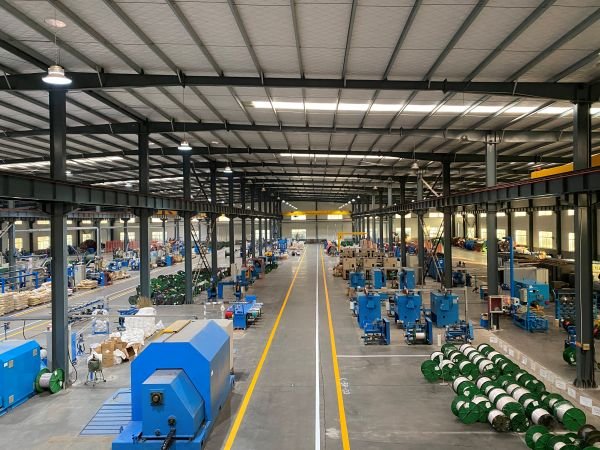
On a halogen-free cable the compound is half the product, so the records that matter include the material data sheet as well as the routine electrical tests.
Tell us the cross-section and core configuration, the project’s fire requirement and whether a bunched-flame category has to be declared.
We confirm the core configuration, cross-section and the fire requirement with you, send the construction drawing and the compound data sheet, and quote against the drawing — normally within one working day.
Sample for qualification — stocked configurations within a few working days.
Halogen-free compounds are held in fewer sizes than PVC, so production is scheduled against the confirmed drawing and the compound availability for the run; the window is confirmed in the quotation.
Drum schedule, shipping documents and the compound data sheet for the project fire file, plus pulling and bending guidance for the size and route.
Tell us the fire requirement, cross-section and quantity — we reply within one working day.
The more detail you give, the faster and more accurate our quotation. Our engineers reply within one working day.
Thanks — our engineers will reply within one working day.