Professional cable manufacturer

Professional cable manufacturer
Standards Referenced: BS 5467, BS 6724, BS 7671, IEC 60502-1, VDE 0276-603, IEC 60228, IEC 60332, IEC 60754
A buried cable failure is not a routine repair — it is a dig-up, a site closure, and often a project delay measured in weeks. In utility-scale solar farms, industrial parks, and municipal infrastructure, the cables laid underground are expected to deliver 25+ years of uninterrupted service. Choosing the wrong cable type, skipping armour protection, or ignoring soil chemistry can turn a cost-saving decision into a six-figure replacement expense.
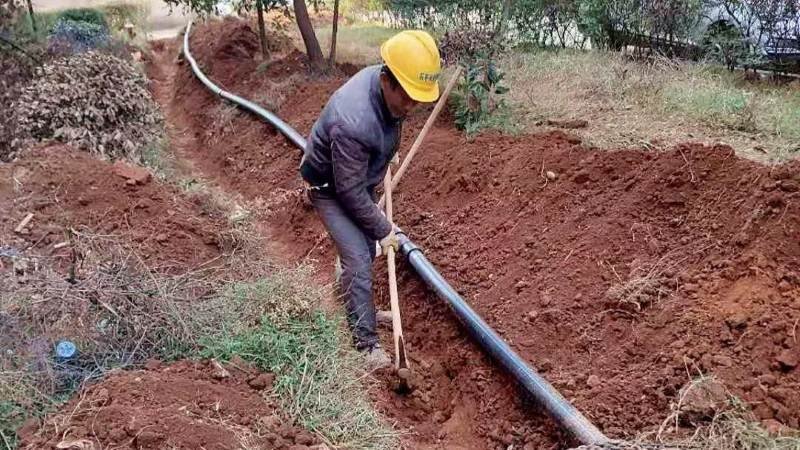
Direct burial — laying cable directly into a trench without a duct or conduit — is the most common method for low-voltage (0.6/1 kV) distribution, street lighting, solar farm arrays, and secondary feeder lines. It is faster and cheaper to install than ducted systems, but it exposes the cable to mechanical stress, moisture, soil chemicals, and thermal cycling for its entire service life.
This guide covers every factor you need to evaluate before specifying a direct buried cable: conductor and insulation materials, armour types, applicable standards (BS 5467, BS 6724, IEC 60502-1, VDE 0276-603), installation best practices (depth, sand bedding, warning tape), and a 25-year total cost of ownership comparison against conduit-based alternatives.
A direct buried cable is a multi-layer engineered product. Every layer — conductor, insulation, bedding, armour, outer sheath — must be matched to the installation environment. Cutting corners on any one layer shortens the whole system's life.
| Property | Copper (Cu) | Aluminium (Al) |
|---|---|---|
| Conductivity (IACS %) | 100% | ~61% |
| Weight (relative) | Heavier | ~50% lighter for equivalent ampacity |
| Cost | Higher | Lower — typically 30-40% less per amp |
| Strand class (typical) | Class 2 circular stranded per IEC 60228 | Class 2 circular or sector-shaped |
| Corrosion in wet soil | Good — forms stable oxide layer | Requires proper termination to prevent galvanic corrosion |
| Best suited for | Short runs, confined spaces, high-reliability circuits | Long feeders, cost-sensitive projects, utility distribution |
For direct burial in aggressive or poorly-drained soil, tinned copper conductors (IEC 60228 Class 2) provide additional corrosion resistance. Aluminium conductors (NAYY or NA2XY per VDE 0276-603) are an economical choice for large cross-section trunk feeders where weight and material cost drive the decision.
| Property | PVC (Type 8) | XLPE (Cross-Linked Polyethylene) |
|---|---|---|
| Max continuous operating temperature | 70°C | 90°C |
| Short-circuit temperature (1 s) | 160°C | 250°C |
| Current rating (same conductor size) | Baseline | ~15-20% higher |
| Moisture resistance | Moderate — absorbs water over time | Superior — minimal water absorption |
| Halogen content | Contains chlorine — toxic smoke in fire | Halogen-free formulations available |
| Design life in dry ground | 15-25 years | 25+ years |
| Design life in wet ground | 10-20 years — moisture accelerates degradation | 25+ years — proven field performance |
For direct burial, XLPE insulation is the clear choice for any installation requiring a 25-year design life. PVC-insulated cables (NYY, VV) remain in service in many older installations, but their lower operating temperature and susceptibility to water tree growth make them a higher-risk option for permanent buried infrastructure.
| Armour Type | Code | Construction | Direct Burial Suitability |
|---|---|---|---|
| Steel Wire Armour | SWA | Galvanised steel wires applied helically over bedding | Excellent — resists soil pressure, impact, rodents |
| Aluminium Wire Armour | AWA | Aluminium wires — for single-core cables (avoids eddy current losses) | Good — lighter than SWA, used for single-core HV/MV |
| Steel Tape Armour | STA | Two steel tapes applied helically | Moderate — primarily compressive strength, less flexible |
| No armour (unarmoured) | — | PVC or XLPE sheath only (e.g. NYY, N2XY) | Conditional — only in ducts, concrete encasement, or verified low-risk soil |
| Sheath Material | Standard Reference | Fire Behaviour | Direct Burial Suitability |
|---|---|---|---|
| PVC Type 9 (ST2) | BS 5467, VDE 0276-603 | Dense black smoke, HCl gas released | Yes — robust mechanical and moisture resistance |
| LSZH (Low Smoke Zero Halogen) | BS 6724, IEC 60754, IEC 61034, IEC 60332 | Minimal smoke, no halogen gas, ≥60% light transmittance; IEC 60332-3 Category A-C for flame spread | Yes — required for tunnels, public buildings, substations |
| MDPE (Medium Density PE) | IEC 60502-1 (special application) | Varies | Best for waterlogged ground — ~20× better water migration resistance than PVC |
When specifying a direct buried cable, the standard it is manufactured to is your primary quality guarantee. Below are the standards most commonly encountered in buried power cable specifications.
| Standard | Cable Type | Insulation | Sheath | Voltage | Key Features |
|---|---|---|---|---|---|
| BS 5467:2016 | XLPE/SWA/PVC | XLPE (90°C) | PVC Type 9 | 0.6/1 kV — 1.9/3.3 kV | General-purpose armoured; cost-effective for outdoor/burial |
| BS 6724:2016 | XLPE/SWA/LSZH | XLPE (90°C) | LSZH Type LTS1 | 0.6/1 kV — 1.9/3.3 kV | Fire-safe armoured; zero halogen, low smoke |
| IEC 60502-1 | XLPE/PVC armoured | XLPE (90°C) | PVC or LSZH | 0.6/1 kV | International standard for LV power cables |
| VDE 0276-603 | NYY / NAYY / N2XY | PVC (NYY) or XLPE (N2XY) | PVC | 0.6/1 kV | German standard; unarmoured; widespread in continental Europe |
| BS 7846:2015 | XLPE/SWA/LSZH (fire-resistant) | XLPE + mica tape | LSZH | 0.6/1 kV | Circuit integrity PH30-PH120; for emergency systems |
| Soil Condition | Recommended Cable | Rationale |
|---|---|---|
| Free-draining sandy / gravel soil | BS 5467 or BS 6724 — XLPE/SWA | Standard armoured cable; 25-year design life expected |
| Clay / poorly drained / waterlogged | BS 5467 + separate CPC; or MDPE-sheathed cable | Waterlogged ground accelerates PVC sheath degradation; add CPC for corrosion-safe earthing |
| Rocky / stony backfill | BS 5467 or BS 6724 SWA + 100 mm sand bedding both sides | SWA resists puncture; sand envelope distributes point loads |
| Chemically aggressive (industrial / coastal) | LSZH sheath (BS 6724) or MDPE; tinned copper conductor | LSZH and MDPE resist chemical attack better than PVC in some environments |
| Application | Typical Voltage | Cable Type | Key Consideration |
|---|---|---|---|
| Street lighting / amenity supply | 0.6/1 kV | BS 5467 2-core or 4-core XLPE/SWA/PVC | Depth 450-600 mm; warning tape required |
| Solar farm array interconnection | 0.6/1 kV — 1.8/3 kV | IEC 60502-1 XLPE/SWA/PVC or BS 5467 | UV resistance at above-ground transitions; AD8 rating if immersion risk |
| Industrial site secondary distribution | 0.6/1 kV | BS 5467 multi-core XLPE/SWA/PVC | Mechanical protection from site traffic; separate CPC recommended |
| Public building / tunnel supply | 0.6/1 kV | BS 6724 XLPE/SWA/LSZH | Fire safety — LSZH mandatory in enclosed public spaces |
| Temporary construction supply | 0.6/1 kV | BS 5467 XLPE/SWA/PVC (or HO7RN-F rubber for surface runs) | Armoured for mechanical protection; rubber cable for above-ground transitions |
| Road crossing / carriageway | 0.6/1 kV | BS 5467 XLPE/SWA/PVC in duct | Duct allows future replacement without breaking pavement |
Even a quality cable fails prematurely if installation practices are poor. The following parameters draw from BS 7671 (IET Wiring Regulations), NJUG guidelines, and N-SEP-E-004 (Netbeheer Nederland specification for underground cable installation, widely referenced in the Netherlands and Belgium).
| Location | Minimum Depth (LV, ≤1 kV) | Notes |
|---|---|---|
| Private garden / lawn | 450-600 mm | Reducing to 450 mm only if protected by concrete slab or duct |
| Footpath / pedestrian area | 600 mm | Standard for most municipal installations |
| Driveway / vehicle crossing | 600-900 mm | Additional mechanical protection (concrete tiles) recommended |
| Under roads (carriageway) | 600-900 mm (in duct) | Duct installation strongly advised — cable replacement without digging up the road |
| Agricultural / cultivated land | 1000 mm | Protection from ploughing and deep cultivation equipment |
A sand bedding envelope provides both mechanical protection and consistent thermal performance around the cable. The thermal resistivity of the backfill directly affects the cable's current-carrying capacity — a point often overlooked during trench reinstatement.
    Finished ground level
            |
    ~300 mm ← Warning tape (detectable, yellow)
            |
    ~100 mm ← Sand / screened soil (above cable)
            |
       [CABLE] ← Laid with slight "snaking" for thermal expansion
            |
    ~100 mm ← Sand / screened soil (below cable)
            |
    Trench bottom — free of sharp objects, stable subgrade
| Feature | Market Economy / Standard | SORIVO Premium Grade |
|---|---|---|
| Conductor | Bare copper (Class 2, prone to oxidation in wet soil) | Bare or tinned copper — IEC 60228 Class 2, strict resistance tolerance |
| Insulation | PVC (70°C max, 10-20 year life in wet ground) | XLPE (90°C continuous, 250°C short-circuit, 25-year design life) |
| Armour | Thinner galvanised wire, inconsistent coating | Full-spec galvanised SWA per BS 5467 / BS 6724 — verified mass and adhesion |
| Outer sheath | PVC Type 8 or recycled compound — uneven wall thickness | PVC Type 9 (BS 5467) or LSZH Type LTS1 (BS 6724) — strict concentricity control |
| Certification | Self-declared "complies with" statements | Third-party certified (BASEC / KEMA / TÜV; UL certification also available for North American projects) with traceable batch records |
| Traceability | No metre marking or batch code | Metre-marked at 1 m intervals — full batch traceability from raw material to dispatch |
| UV resistance (exposed sections) | Minimal carbon black — unpredictable long-term performance | Carbon black 2.6% ± 0.25% per GB/T 15065-2009 (equivalent to EN 50363-1 requirements for UV-stable compounds) — HD 605 S1 UV tested 1000 h |
| Warranty | 1-5 years | 25-year design life with quality guarantee |
A direct buried cable may appear cheaper upfront, but the total cost of ownership over a 25-year project life depends heavily on whether the cable lasts its full design life without failure. The table below compares a standard BS 5467 SWA cable installed directly buried vs. a cable-in-conduit (CIC) system.
| Cost Component | Direct Buried (BS 5467 SWA) | Cable-in-Conduit (CIC) |
|---|---|---|
| Initial cable + installation (per km, 4×16 mm²) | Lower — single-pass installation | ~15-20% higher — includes conduit material and laying |
| Replacement cost if cable fails | Very high — full re-excavation, sand bedding, site restoration | Low — pull out failed cable, pull in new through existing conduit |
| Replacement cost factor vs. initial installation | ~3-4× | ~0.3-0.5× |
| Failure likelihood over 25 years | Low with quality XLPE/SWA; moderate with PVC insulation | Very low — conduit adds mechanical and environmental protection |
| Estimated 25-year TCO (per km, 4×16 mm²) | ~€48,000–63,000 | ~€54,000–67,000 |
Key insight: Direct buried cable is economically preferable when it reliably achieves its 25-year design life. The breakeven point against CIC sits at approximately 20-25 years with a quality XLPE-insulated, SWA-armoured cable. If site conditions increase failure risk — waterlogged soil, heavy traffic, or poor backfill quality — CIC delivers a lower TCO despite the higher upfront investment.
For permanent buried infrastructure where future access is difficult (under roads, buildings, or landscaped areas), consider installing a spare empty conduit alongside the direct buried cable. The incremental cost is small, and it future-proofs the route for cable replacement or capacity upgrades without excavation.
Not all cables labelled "BS 5467" or "SWA" are manufactured to the same standard. Here are five practical checks to run before accepting delivery.
A quality PVC sheath (Type 9) has a smooth, uniform surface with consistent wall thickness. Run your hand along the cable — rough patches, pitting, or inconsistent diameter point to poor extrusion quality. For XLPE insulation, the surface should be smooth and free of scorch marks (over-curing) or voids.
BS 5467 and BS 6724 require the sheath to be marked at maximum 500 mm intervals with: manufacturer name, standard number, conductor size and core count, voltage rating, and year of manufacture. If the marking rubs off with moderate finger pressure, the ink or curing process is substandard. Metre marking at 1 m intervals is a hallmark of a quality manufacturer.
Galvanised steel wires should be evenly tensioned and free of rust spots, with a consistent bright finish. For a quick field test, cut a short sample and strip the bedding — the armour wires should spring apart slightly, indicating correct lay length and tension. Wires that lie flat or show uneven gaps suggest manufacturing defects.
Strip a short sample and verify:
Request the third-party test certificate (BASEC, KEMA, TÜV — or UL for North American projects) and verify the certificate number on the certification body's public database. A self-declaration "complies with" on a manufacturer's data sheet is not equivalent to independent certification — and in a dispute, it carries little weight.
NYY cable is technically suitable for direct burial in low-risk conditions — free-draining soil, no vehicle traffic, and depths below 600 mm. However, BS 7671 Regulation 522.8.10 requires that buried cables have adequate mechanical protection. In practice, SWA armoured cable is the safer choice unless the NYY is installed in a duct or concrete encasement. NYY is most commonly used in continental Europe (VDE 0276-603 standard) where ducted installation in concrete is standard practice.
Both standards cover XLPE-insulated, armoured cables suitable for direct burial. The sole difference is the outer sheath material: BS 5467 specifies PVC Type 9, while BS 6724 specifies LSZH (Low Smoke Zero Halogen, Type LTS1). For outdoor buried installations away from building entries, BS 5467 is cost-effective and widely used. BS 6724 is required for any buried cable that enters a building, tunnel, or enclosed public space where low smoke and zero halogen are safety-critical. See our detailed comparison: SWA vs AWA vs STA Armoured Cable Guide.
In waterlogged conditions, the steel wire armour may corrode over time, compromising its effectiveness as the sole protective conductor. Adding a separate copper CPC within the cable (or alongside it in the trench) ensures the earth fault path remains intact for the full service life. Even though the armour's cross-sectional area typically exceeds CPC requirements when new, corrosion in aggressive soil can significantly increase its resistance within 10-20 years. A separate CPC is relatively inexpensive insurance.
For vehicle crossings and driveways, the minimum burial depth is 600 mm, with 900 mm recommended for heavy vehicle traffic. Additional mechanical protection — concrete slabs, protective tiles, or laying the cable in a duct — must be placed above the sand bedding layer. A duct is strongly recommended under driveways because it allows cable replacement without breaking up the paved surface. See our Complete Guide to Cable Laying Methods for more detail.
Voltage drop for buried cables follows the same formula as any power cable: ΔV = (√3 × I × L × (R cosφ + X sinφ)) / 1000 for three-phase systems. BS 7671 limits voltage drop to 5% for power circuits and 3% for lighting. For long buried runs (over 100 m), the reactance (X) of SWA cables becomes significant — typically 0.08-0.12 Ω/km for multi-core SWA at 50 Hz. Always use manufacturer-specific R and X values rather than generic tables. Refer to our Cable Current Carrying Capacity Guide for reference charts.
Yes — XLPE-insulated SWA cable (BS 5467) is suitable for frozen ground down to approximately -15°C, which covers most temperate and cold-climate installations. The cable's mechanical properties remain intact at low temperatures, but two precautions apply: (1) cable handling and bending should be done at temperatures above -5°C — cold cable becomes stiff and can crack the sheath if forced around tight bends; (2) frost heave can shift buried cables over time — laying the cable below the local frost line (typically 600-1200 mm depending on region) prevents movement damage. For arctic installations (below -30°C), special low-temperature sheath compounds (e.g. PVC Type 10 or special LSZH formulations) are required — standard PVC Type 9 becomes brittle at these temperatures.
| If your site has… | …choose | Why |
|---|---|---|
| Free-draining soil, no vehicle traffic | BS 5467 XLPE/SWA/PVC 4-core | Cost-effective, 25-year life, standard armoured cable |
| Fire-sensitive environment (tunnel, public building) | BS 6724 XLPE/SWA/LSZH | Low smoke, zero halogen for life safety |
| Waterlogged / clay soil | BS 5467 + separate CPC; consider MDPE sheath | Corrosion risk management; water-resistant sheath option |
| Long feeder >500 m, cost-sensitive | NA2XY (aluminium/XLPE, unarmoured in duct) | Aluminium conductor saves cost; duct provides protection |
| High current, restricted trench width | XLPE/SWA/PVC single-core (AWA) — parallel runs | XLPE gives 15-20% higher rating than PVC; AWA prevents eddy current losses |
| Future capacity upgrade likely | Install spare empty conduit alongside direct buried cable | Low incremental cost; avoids full re-excavation later |
Direct buried cable is the backbone of underground power distribution — from solar farms to industrial plants to municipal infrastructure. The selection decision balances upfront cost against long-term reliability, and the margin for error is narrow: a cable that fails at year 10 costs 3-4 times its original installation to replace.
Your checklist before specifying:
Need certified direct buried cable for your next project? Sorivo manufactures BS 5467, BS 6724, and IEC 60502-1 armoured power cables with third-party certification and full batch traceability. Our engineers provide free technical selection support — send us your project parameters for a custom quotation.
CU/XLPE/SWA/PVC 0.6/1 kV Armoured Cable → | CU/XLPE/LSZH/SWA/LSZH 0.6/1 kV Armoured Cable →
Email: sale@sorivocable.com | Tel: +86 19282905529 | sorivocable.com