Professional cable manufacturer
Professional cable manufacturer
Here's a question I hear from cable manufacturers and procurement teams almost every week: "We have TÜV certification for our solar cable. Do we need another certificate to sell in the US? What about China?"
The short answer is almost always yes. A TÜV certificate issued under EN standards won't get you through Chinese customs — they require CCC. A UL-listed cable won't automatically satisfy the EU's Construction Products Regulation. And since Brexit, CE marking no longer works in Great Britain — you need UKCA instead.
But here's the thing: it's not as chaotic as it looks. There's an underlying structure — the IECEE CB Scheme — that connects most of the world's major certification systems. Understanding how these systems relate to each other is the difference between spending $100,000 on redundant testing and spending the same money once for global coverage.
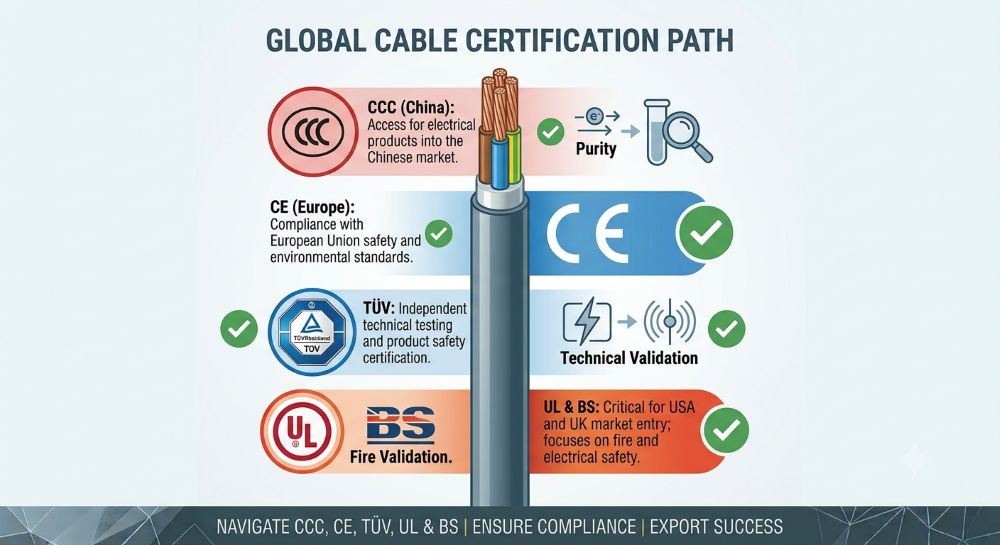
This guide maps the five major certification systems that matter for cable exporters — CCC, CE, TÜV, UL, and BS — and shows you how the CB Scheme can reduce the cost and time of entering multiple markets.
Before we dive into each system, you need to understand the IECEE CB Scheme. It's the closest thing the cable world has to a universal translator.
The CB Scheme is a mutual recognition system operated by the International Electrotechnical Commission (IEC). Its core principle: "one test, one certificate, global acceptance." When your cable is tested by an accredited CB Testing Laboratory (CBTL) in one member country, the test results are recognized by all other 54 member countries — without retesting the same parameters.
Important: a CB Certificate is not a market access permit itself. It's a passport that you use to obtain local certifications (CE, UL, CCC, etc.) by supplementing only the national difference tests — the specific tests each country requires beyond the base IEC standard.
| CB Scheme Feature | What It Means for Cable Exporters |
|---|---|
| Member countries | 54, covering all major markets (EU, US, China, Japan, Korea, India, Brazil, etc.) |
| Cable category code | CABL — Cables and wires are explicitly covered |
| Core IEC standards for cables | IEC 60227 (PVC insulated), IEC 60245 (rubber insulated), IEC 60502 (power cables) |
| What CB does NOT cover | EMC testing, national fire tests, local voltage ratings — these are separate |
| Typical timeline | 4-12 weeks for CB test + certificate |
For a cable manufacturer exporting to five different countries, a CB-first strategy can cut certification costs by 50-70% compared to testing from scratch in each market.
If you want to sell cables in China, CCC (China Compulsory Certification) is non-negotiable. Cables covered by the CCC catalog cannot be imported, sold, or used in China without a valid certificate.
| Parameter | Details |
|---|---|
| Scope for cables | PVC insulated (450/750V), rubber insulated, mining cables, power cables up to 35kV |
| Key GB standards | GB/T 5023 (PVC), GB/T 5013 (rubber), GB/T 12706 (power cables up to 35kV) |
| Certification body | Primary: CQC (China Quality Certification Centre) |
| Timeline | 3-6 months typical; simple PVC cables ~3 months, complex cables 6-9 months |
| Certificate validity | 5 years, with annual surveillance audit |
| Factory inspection | Mandatory on-site audit for all manufacturers — including foreign factories |
| Estimated cost (simple cable) | ~9,000-12,000 RMB (~$1,200-1,700) |
| Estimated cost (complex cable) | 20,000-60,000+ RMB (~$2,800-8,500+) |
For cables sold in the European Union and European Economic Area, CE marking under the Construction Products Regulation (CPR) is the legal requirement. The CPR was updated in 2024 — Regulation (EU) 2024/3110 replaced the original EU 305/2011, entering into force on 7 January 2025, with phased applicability as implementing acts are adopted.
The key harmonized standard for cables under CPR is EN 50575:2014+A1:2016, which classifies cables by reaction to fire into seven Euroclasses:
| Euroclass | Fire Performance | Typical Application |
|---|---|---|
| Aca | Non-combustible (mineral insulated) | Emergency circuits, escape routes |
| B1ca | Very limited flame spread | Highest-risk buildings (hospitals, tunnels) |
| B2ca | Limited flame spread | High-rise escape routes, airports |
| Cca | Moderate flame spread | Commercial buildings, offices, hotels |
| Dca | Moderate flame spread (lower) | General residential |
| Eca | Difficult to ignite by small flame | Low-risk / temporary installations |
| Fca | No performance determined | Not recommended for permanent installation |
For classes B1ca to Dca, additional sub-classifications are required: s (smoke production), d (flaming droplets), and a (acidity). A full declaration might look like Cca-s1a,d1,a1 — moderate flame spread, very low smoke, limited droplets, low acidity.
| CPR Requirement | Details |
|---|---|
| Harmonized standard | EN 50575:2014+A1:2016 |
| Testing body | Notified Body (for classes B2ca and above; System 1+) |
| Required documents | Declaration of Performance (DoP) + CE mark on label |
| Factory control | Factory Production Control (FPC) mandatory for all classes |
| Cables in scope | All power, control, communication cables permanently installed in buildings |
| Timeline (typical) | 8-16 weeks depending on Euroclass and testing backlog |
| CB to CE pathway | CB report covers safety; CPR fire testing is an additional national/EU requirement |
TÜV certifications are voluntary (not legal requirements) but are the de facto market standard for photovoltaic and energy storage cables in Europe and beyond. Project owners, insurers, and financiers almost always require TÜV-certified cables for solar farms and battery storage systems.
| TÜV Standard | Application | Key Requirements |
|---|---|---|
| EN 50618 | H1Z2Z2-K solar cable (1500V DC) | Mandatory tinned copper, 25-year thermal life verified by IEC 60216, cross-linked polyolefin jacket, severe UV resistance (HD 605 S1) |
| TÜV 2PfG 1169 | PV1-F solar cable (1000V DC) | Legacy standard; UV resistance, 90°C continuous rating, LSZH, -40°C cold bend. Largely superseded by EN 50618 for new installations. |
| TÜV 2PfG 2693 | BESS / energy storage cable | Electrolyte immersion, salt fog, thermal aging, 1500V DC |
In the United States, UL (Underwriters Laboratories) certification is not a government mandate — but it's practically impossible to sell cables to US buyers without it. Most US electrical codes (NEC) reference UL standards, and inspectors look for the UL mark.
| UL Standard | Application | Key Requirements |
|---|---|---|
| UL 83 | THHN/THWN building wire | PVC/nylon insulation, 90°C dry / 75°C wet, 600V |
| UL 44 | Rubber-insulated wire (RHH/RHW) | Thermoset insulation, 90°C wet/dry, 600V |
| UL 4703 | Photovoltaic wire (US solar) | XLPE insulation, 90°C wet / 105°C, 125°C, or 150°C dry (depending on insulation class), 600-2000V |
| UL 1277 | Tray cable (TC/TC-ER) | Power & control cable for cable tray, 600V |
| UL 13 | Power-limited circuit cable (PLTC) | Control & instrumentation, 300V |
| UL Certification Parameter | Details |
|---|---|
| Certification body | UL LLC (primary); also ETL/Intertek, CSA (for Canada) |
| Timeline | 12-20 weeks typical, including UL factory inspection |
| Typical cost | $15,000-40,000 depending on cable types and number of models |
| Factory inspection | UL Follow-Up Service (FUS) — unannounced inspections 2-4x per year |
| CB to UL pathway | US participates in CB Scheme but UL applies strict national differences — expect additional fire and mechanical tests |
| Canada (CSA) | Separate CSA certification needed, though UL + CSA combined programs exist |
The UK market has its own set of standards, now enforced under UKCA (UK Conformity Assessed) marking. While many BS standards are harmonized with IEC or EN, British standards have specific testing requirements that differ from their European equivalents.
| BS Standard | Application | Notes |
|---|---|---|
| BS 5467 | XLPE/SWA/PVC armoured power cable 0.6/1kV | Most common LV power cable standard in UK; harmonized with IEC 60502 but with UK-specific voltage designation and SWA requirements |
| BS 6724 | XLPE/SWA/LSZH armoured power cable | LSZH version of BS 5467; required for public buildings and tunnels |
| BS 6387 | Fire-resistant cable (CWZ rating) | 950°C flame for 3 hours + water + mechanical shock; unique to UK |
| BS 7629-1 | Fire-resistant LSZH cable for alarms | 300/500V, circuit integrity for emergency systems |
| BS 5308 | Instrumentation cable | Type 1 (PVC) and Type 2 (XLPE); widely used in UK oil & gas and process industries |
| BS EN 50288 | Data/control cables for instrumentation | Multi-element metallic cables for analog and digital transmission |
The key difference for exporters: while most BS cable standards are technically aligned with IEC or EN, the UK now requires UKCA marking (not CE) for most products. This means testing by a UK Approved Body, not an EU Notified Body. However, the UK participates in the CB Scheme, so a CB certificate can still serve as the foundation.
| Certification | Market | Legal Status | Timeline | Estimated Cost | Factory Audit? |
|---|---|---|---|---|---|
| CCC | China | Mandatory | 3-6 months | $1,200-8,500 | Yes |
| CE (CPR) | EU + EEA | Mandatory | 8-16 weeks | $4,000-15,000 | Yes (for B2ca+) |
| TÜV (PV/BESS) | Global (de facto) | Voluntary (market standard) | 8-16 weeks | $8,000-25,000 | Yes |
| UL | USA + Canada | De facto mandatory | 12-20 weeks | $15,000-40,000 | Yes (FUS) |
| BS / UKCA | United Kingdom | Mandatory (UKCA) | 8-20 weeks | $5,000-20,000 | Depends on class |
| Parameter | Market / Budget Grade | Sorivo Certified Grade |
|---|---|---|
| Conductor | Bare copper or CCA — oxidizes, higher resistance | Tinned copper IEC 60228 Class 5/6 — corrosion-resistant |
| Insulation | PVC (limited UV life) or ungraded XLPE | XLPE or XLPO per applicable standard (EN 50618, UL 4703, BS 5467) |
| Certification approach | Self-declared CE or counterfeit marks | Third-party tested: TÜV / UL / BASEC / KEMA / CCC / CB |
| Factory traceability | No meter marks, no batch records | Meter-marked every meter, batch-coded, raw material lot traceable |
| Design life (solar) | 3-7 years (UV degradation) | 25 years (verified per IEC 60216 Arrhenius aging) |
| Fire performance | IEC 60332-1 (single vertical) — no CPR class | IEC 60332-3 (bunched) + CPR Euroclass Cca/B2ca + IEC 60754 zero halogen |
| Global compliance | Single-market focus | Multi-certified: CB Scheme foundation + market-specific certifications |
| Target Market | First Priority | Second Priority | Optional (Competitive Edge) |
|---|---|---|---|
| China | CCC | CB (foundation for CCC) | TÜV (for PV/BESS exports) |
| European Union | CE (CPR) + DoP | CB (base for CE safety) | TÜV (solar/BESS), BASEC (UK) |
| United Kingdom | UKCA + BS standard compliance | CB (base for BS) | BASEC, LUL (rail) |
| USA & Canada | UL or ETL / CSA | CB (partial foundation) | TÜV (for international projects) |
| Southeast Asia / Middle East | CB (foundation) | Local IEC-based certification | TÜV or UL (brand differentiation) |
| Global (multiple markets) | CB Scheme first | Market-specific conversions | Full certification suite |
Here's a practical strategy I've seen work for mid-sized cable manufacturers expanding internationally:
Do I need separate certifications for every cable type I export?
Not necessarily. Most certification bodies allow family certification — one test report covering multiple models if they share the same conductor type, insulation material, and construction method. For example, a 4mm² and 6mm² H1Z2Z2-K solar cable from the same family can share one TÜV certificate. The key requirement: the only difference must be conductor cross-section; any change in materials or construction requires separate testing. Plan your product families carefully before applying — it's the single biggest cost-saving lever.
Can a CB certificate really replace local certification?
No. A CB certificate is not a market access permit. It is an internationally recognized test report that local certification bodies accept as proof of compliance with the base IEC standard. You still need to obtain the local certification (CCC, CE, UL, etc.) by submitting your CB report and completing the local national difference tests. Think of it this way: CB gets you 70-80% of the way there for each market; you still need to cover the last 20-30% locally.
What is the cheapest certification to start with for a new cable manufacturer?
For most cable types, the most cost-effective first certification is CB through a body like SGS or TÜV Rheinland, at roughly $5,000-10,000 for a typical product family. From there, you can convert to CE/CPR most efficiently. Avoid starting with UL if budget is tight — UL certification typically costs $15,000-40,000 and requires ongoing factory inspection fees. Start with CB, add CE for the European market, and invest in UL or CCC when you have confirmed orders in those regions.
How long does certification last? Do I need to renew?
It varies by system: CCC certificates are valid for 5 years with annual surveillance audits. CE marking has no fixed expiry — it's valid as long as the product and the relevant harmonized standards don't change. TÜV certificates typically need renewal every 5 years. UL certification requires ongoing Follow-Up Service inspections (2-4 unannounced visits per year) and the listing continues as long as the product passes inspections. CB certificates themselves have no fixed validity — but most NCBs apply a 5-year expiry on the test report. Budget for ongoing surveillance costs of roughly $2,000-5,000 per year per certification system.
If I have TÜV certification for a solar cable, can I sell it in the US without UL?
Practically speaking, no. US electrical inspectors look for the UL mark on cables used in permanent installations. NEC 2023 and 2026 both reference UL standards for solar cables (UL 4703) and building wire (UL 83). While TÜV certification is well-respected globally, it's not legally recognized by US authorities. You would need either UL listing or a UL-recognized alternative (ETL/Intertek or CSA). The testing overlap between TÜV 2PfG and UL 4703 is significant — roughly 60-70% of the tests measure similar parameters — but you still need to go through the full UL process. A CB certificate can help, but expect to pay for most UL tests separately.
What certification do I need for cable accessories like glands and lugs?
Cable accessories generally face less stringent requirements than the cables themselves. For China, cable glands and lugs typically aren't in the CCC catalog — you need a type test report from a CNCA-accredited lab but not a full CCC certificate. For the EU, cable glands fall under the Low Voltage Directive (LVD) rather than CPR, requiring CE marking but not fire classification. For UL, connectors and glands are typically assessed under UL 514B (outlet boxes and fittings) or through product-specific evaluation. UL does not have a dedicated cable gland standard. Always verify with your specific product — the accessory category is less standardized than cables themselves.
The global certification landscape for cables is complex, but it's navigable with the right strategy. The CB Scheme provides a proven foundation for multi-market access, and understanding which certifications matter for each target market lets you avoid paying for testing you don't need.
At Sorivo, every cable we manufacture is certified to the standards required for its target market — whether that's TÜV for European solar farms, UL for North American projects, CCC for the Chinese market, BASEC for UK infrastructure, or CB as the foundation for global distribution. All our certifications are third-party verified, not self-declared, with full batch traceability from extrusion to your site.
Professional customized cable solutions — 7×24×365 support
| Standard / Regulation | Purpose |
|---|---|
| IECEE CB Scheme | Global mutual recognition — 54 member countries, "one test, one certificate" |
| CCC / GB/T 5023, GB/T 5013, GB/T 12706 | China Compulsory Certification — PVC, rubber, and power cable standards |
| EU CPR 2024/3110 + EN 50575 | EU Construction Products Regulation — cable Euroclasses Aca to Fca |
| TÜV 2PfG 1169 / EN 50618 | PV1-F and H1Z2Z2-K solar cable certification |
| TÜV 2PfG 2693 | BESS / energy storage cable certification |
| UL 83 / UL 4703 / UL 44 / UL 1277 | US safety standards for building wire, solar cable, rubber cable, tray cable |
| BS 5467 / BS 6724 / BS 6387 / BS 7629-1 | UK armoured power cable, LSZH, fire-resistant, and alarm cable standards |
| UKCA marking | UK Conformity Assessed — mandatory for GB market (replaces CE post-Brexit) |