Professional cable manufacturer

Professional cable manufacturer
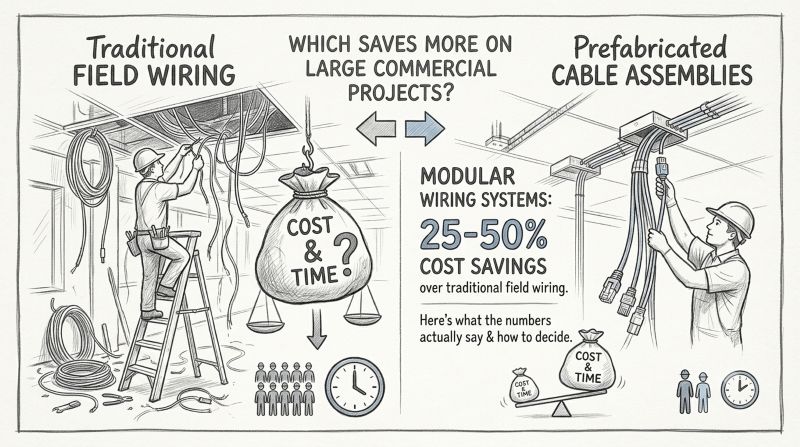
Modular wiring systems claim 25–50% cost savings over traditional field wiring. Here’s what the numbers actually say and how to decide which approach fits your project.
★ Construction Methods — Commercial ElectricalIf you’ve been on a large commercial project site, you know the rhythm: electricians cutting, stripping, pulling, and terminating cables for weeks on end. It works, but it’s expensive, slow, and every termination is a potential failure point.
Prefabricated cable assemblies — also called modular wiring — take a different approach. Cables are pre-cut, pre-terminated, and factory-tested, then delivered to site as plug-and-play components. Installation is a matter of clicking connectors together rather than pulling and terminating.
The promise is compelling: 25–50% reduction in total installed cost and 70–90% faster installation. But the reality depends on project type, floor-plan complexity, and labour rates. Let me walk through the trade-offs.
Modular wiring is not a single product — it’s a family of approaches that share one feature: the cable arrives on site ready to connect.
The three most common forms are:
For large commercial projects, the plug-and-play modular approach is the most relevant. The system consists of:
This is where the two approaches diverge dramatically — and where most of the confusion comes from, because the cost profiles look very different on paper.
| Cost Factor | Traditional Field Wiring | Prefabricated Modular Wiring |
|---|---|---|
| Material procurement | Bulk cable + conduit + fittings + connectors — multiple suppliers | Factory-assembled system — single supplier, just-in-time delivery per floor/zone |
| Material cost (direct) | Baseline (cable is cheap, fittings add up) | ~30% higher |
| On-site labour | Cut, strip, terminate, pull, test — all skilled electrician time | ~50–75% less — semi-skilled staff can install plug-and-play |
| Installation time | Weeks per floor for a typical commercial fit-out | Days per floor — 70–90% faster |
| Testing & commissioning | Each termination tested individually; faults require re-termination on site | Factory-tested assemblies; on-site testing limited to continuity and polarity checks |
| Waste | 10–15% cable waste from off-cuts and rework | <2% waste — exact lengths, no cutting on site |
| Rework / changes | Requires new cable runs, re-termination — expensive and disruptive | Order new pre-terminated segment — plug in, remove old segment |
| Total installed cost | Higher | 25–50% lower |
A 27-storey office tower refurbishment in the City of London provides a striking example. The original estimate for traditional field wiring was several hundred days of electrical installation time. By switching to a prefabricated modular wiring system, the actual installation was completed in roughly 35 days — a reduction of over 80% in programme time. The overall cost saving was estimated at around 40% against the traditional approach (project team data, not independently published).
That’s not a theoretical projection. It’s a real project where the combination of factory production speed and on-site plug-and-play installation transformed the construction schedule.
Beyond cost, prefabricated assemblies offer quality benefits that are harder to quantify but equally important.
Every termination in a prefabricated system is made under factory conditions: controlled crimping force, correct strip length, proper insertion depth. On site, a termination quality depends on the individual electrician’s skill, fatigue level at 3 PM on a Friday, and whether they used the correct tooling. Factory termination eliminates this variability entirely.
Modular wiring assemblies are typically 100% tested before leaving the factory: continuity, insulation resistance at 500 V or 1000 V DC, high-voltage withstand, and connector pull-out force. Field-wired systems rely on sample testing or end-of-line checks, which can miss intermittent faults.
Cutting and stripping cable generates debris (small wire off-cuts, insulation scraps) that can cause short circuits if they enter equipment. Modular wiring eliminates almost all on-site cable preparation, reducing both debris-related faults and the risk of cuts and eye injuries from cable preparation tools.
| Quality Metric | Traditional Field Wiring | Prefabricated Modular Wiring |
|---|---|---|
| Termination consistency | Variable — depends on individual electrician | Controlled — factory crimping with verified force |
| Testing coverage | Sample testing or end-of-line only | 100% factory tested (IR, HV, continuity, pull-out) |
| Fault rate at commissioning | 5–10% of terminations need rework (industry average) | <1% — faults are factory-detected before shipment |
| Site waste | 10–15% cable off-cuts, packaging waste | <2% — cut to exact length in factory |
| Health & safety risk | Moderate — cutting tools, stripping blades, debris | Low — no on-site cable preparation |
| Training required | Skilled electrician (3+ years apprenticeship) | Semi-skilled (1–2 days on-system training) |
While Sorivo is primarily a cable manufacturer rather than a modular wiring system supplier, we support prefabrication in two ways: supplying cables optimised for factory termination and offering custom pre-assembly services.
| Application | Recommended Cable | Prefab-Ready Features |
|---|---|---|
| Modular wiring for lighting / small power | Flexible PVC or LSZH cables (single- and multi-core) | Class 5/6 flexible conductors per IEC 60228 — easier to terminate in factory jigs, consistent insulation stripping behaviour |
| Pre-assembled distribution cables | CU/XLPE/SWA/PVC | SWA cable pre-cut to exact lengths with lugs or glands factory-fitted — eliminates site cutting and termination for large cables |
| Control and instrumentation harnesses | YY / CY / SY control cables | Multi-core cables pre-terminated with D-sub, M12, or custom connectors — ready to plug into control panels and field devices |
| Solar farm string extensions | H1Z2Z2-K with MC4 connectors | Pre-assembled PV cables with MC4 connectors factory-crimped — 100% pull-tested, eliminates field crimping errors |
| Feature | Market Generic / Economy | Sorivo Premium Grade |
|---|---|---|
| Conductor | Variable stranding — inconsistent stripping, difficult to automate | IEC 60228 Class 5/6 flexible stranding — consistent diameter, predictable stripping and crimping in automated factory jigs |
| Insulation strip force | Inconsistent — some batches too tight (nicking conductor), some too loose (sliding) | Controlled strip force (typically 5–15 N for 2.5 mm²) — optimised for automated stripping equipment |
| Connector compatibility | No guarantee of outer diameter tolerance → connector fit issues | OD tolerance ±0.1 mm — guaranteed fit with IEC 61535 and similar modular connectors |
| Fire performance | PVC standard — not suitable for all commercial applications | LSZH / FR options available — meets CPR and building code requirements |
| Traceability | None → unknown batch makes fault tracing difficult | Metre-marked, batch traceable — full material certification for factory assembly records |
| Lead time / custom orders | Standard stock items only — no custom lengths or pre-termination | Custom lengths, pre-termination, and pre-assembly available on request — contact Sorivo for lead times |
Need cables optimised for prefabricated assembly?
Sorivo can supply flexible control cables, SWA power cables, and solar cables pre-cut and pre-terminated to your project specifications. Contact our team for a quote on custom prefabricated cable assemblies.
sale@sorivocable.com | +86 19282905529
Flexible Control Cables → Pre-Assembled PV Cables → Request Custom Assembly Quote →