Professional cable manufacturer

Professional cable manufacturer
Home » Products » EV Charging Cable » Portable EV Charger 16A 3.5kW Type 2
Mode 2 portable EV charger with the IC-CPD built into the cable — adjustable 6 / 8 / 10 / 13 / 16 A, Type 2 vehicle connector to IEC 62196-2, and integral residual current protection with 6 mA DC detection.
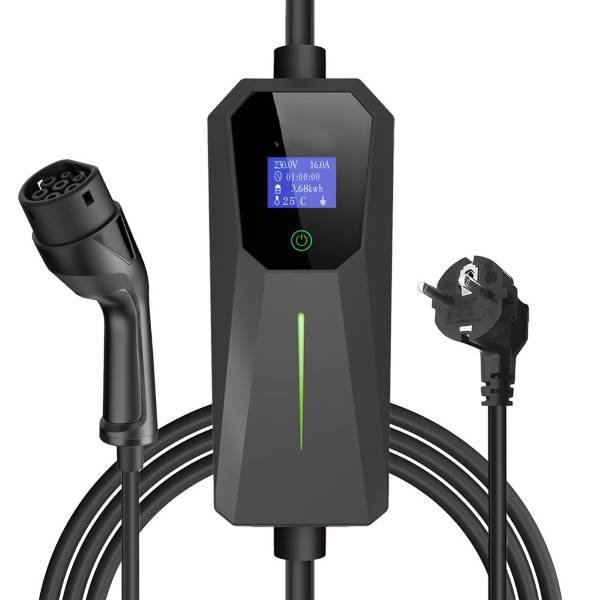
What a fleet buyer or a distributor checks first on a portable charger — before reading the full specification below.
A Mode 2 charger is defined by where it plugs in: into an ordinary household socket, not a dedicated charging point. Because the socket upstream was never designed for EV charging, the residual current protection, the over-current protection and the control pilot interface all have to travel with the cable — which is exactly what an IC-CPD is, and why IEC 62752 exists. This charger is built around that standard: designed and tested to IEC 62752:2024, the second edition, which replaced the 2016 edition and its amendments.
Charging current is selectable in five steps — 6 / 8 / 10 / 13 / 16 A — so the same unit works on a hotel socket, a friend’s garage or a properly installed 16 A circuit. The honest part of that sentence matters: a CEE 7/3 socket and CEE 7/7 plug are rated 16 A / 250 V, but “rated 16 A” describes short-duration appliance loads, not eight hours at full current. On an ordinary domestic socket, with older wiring or a worn outlet, the practical limit is often 10–13 A. We therefore recommend the 10 A setting as the default on household sockets and reserve 16 A (3.5 kW at 220 V, about 3.7 kW at 230 V) for a dedicated 16 A circuit. The plug carries a temperature sensor — charging stops at approximately 75 °C and resumes at about 65 °C, a requirement that IEC 62752:2024 added for household plugs.
The car is told how much current it may draw over the control pilot: a 1 kHz, ±12 V PWM signal on the CP contact, per IEC 61851-1 Annex A. The duty cycle announces the available current — inside the 10 % to 85 % band the relationship is I = D × 0.6 A — so the 16 A setting is a 26.7 % duty cycle and the 10 A setting is 16.7 %. The CP voltage states (A through F) tell the charger whether a vehicle is connected, ready, or reporting a fault. This is the layer that lets a portable charger be a charger and not just an extension lead, and it is why a Mode 2 device cannot be replaced by a length of cable.
Residual current protection is integral, and it is worth stating precisely: 30 mA AC (Type A) plus 6 mA DC detection. The 6 mA DC part is not decoration — a Type A device responds to alternating and pulsating residual current but a smooth DC residual current can saturate its sensing core and blind it, which is a real failure mode when a vehicle’s on-board electronics are the load. The DC detection function is what closes that gap. Do not read that as “Type B RCD”: a true Type B device also covers mixed AC+DC and higher-frequency residual currents, so unless the supplied unit is declared as Type B, the accurate description is Type A AC protection with 6 mA DC detection.
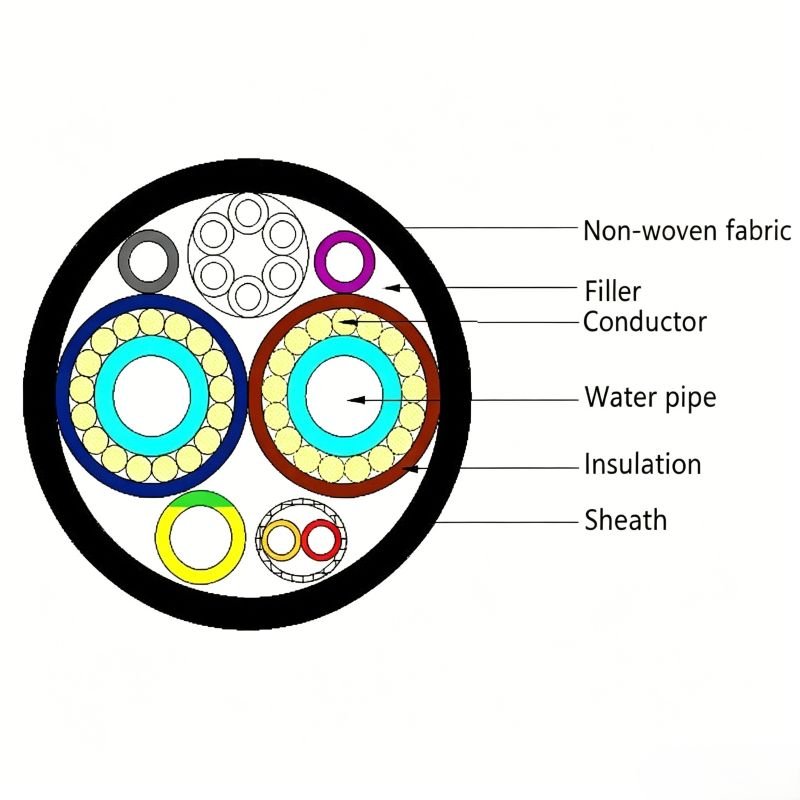
The cable is a 3 × 2.5 mm² power plus 2 × 0.5 mm² signal construction with a TPU jacket and a standard length of 5 m, in the cable class covered by the IEC 62893 series for EV charging cables. The control box is IP65. For a permanently installed home charge point rather than a portable unit, see our Type 2 32A IEC 62196 EV Charging Cable, and for DC fast charging, our Liquid-Cooled 600 A DC Charging Cable.
More about the manufacturer: About SORIVO →
The in-cable control and protection device standard for mode 2 charging, in its 2024 second edition — the edition that made household-plug temperature detection a requirement.
Five current steps (6 / 8 / 10 / 13 / 16 A) selected on the control box. On an ordinary household socket we recommend the 10 A setting rather than full current.
Integral residual current protection of 30 mA AC (Type A) with 6 mA smooth-DC detection, closing the failure mode that blinds a Type A device.
A sensor in the household plug stops charging at approximately 75 °C and resumes at about 65 °C — protection against exactly the worn-socket case that causes most Mode 2 incidents.
A 1 kHz, ±12 V PWM signal on the CP contact announces the available current by duty cycle (I = D × 0.6 A), so the vehicle matches the setting.
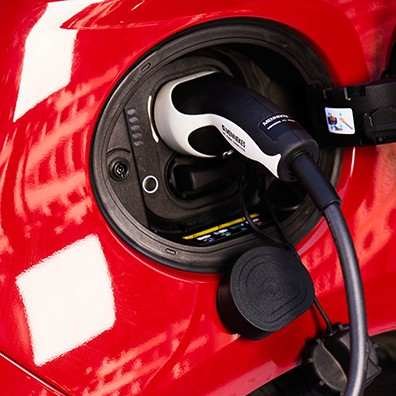
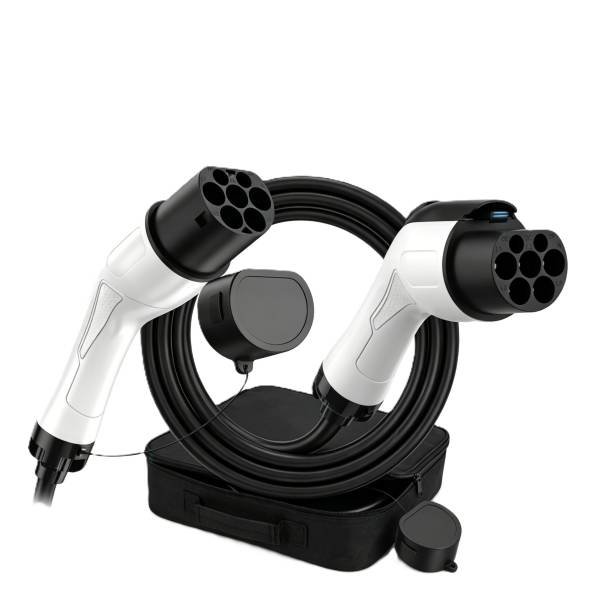
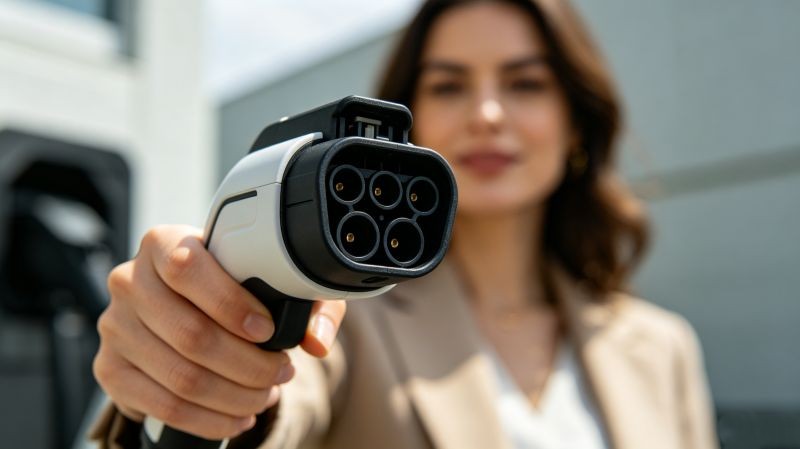
Type 2 (Mennekes) to IEC 62196-2:2022, the standard European AC interface, using L1 + N + PE with the CP and PP signal contacts.
Dust-tight and protected against water jets, so the unit can be left on a wall bracket or used outdoors in rain without being brought inside.
3 × 2.5 mm² power plus 2 × 0.5 mm² signal cores in a TPU jacket, in the EV charging cable class covered by the IEC 62893 series.
Portable units are bought for the sockets a fixed charge point cannot reach — and for the markets where a fixed point is not the customer’s decision to make.
A charger that follows the driver between depots, hotels and home addresses instead of being tied to one parking bay.
New EV owners who need to charge now and will install a fixed point later — one unit covers the gap.
Units issued with the vehicle, so the charging equipment travels with the car rather than staying with the property.
Diagnostic and delivery charging on a standard socket, including for vehicles arriving with a depleted pack.
Overnight charging wherever a household socket exists, with the current stepped down to match a weak supply.
Private-label supply with customer branding, packaging and market-specific mains plugs.
Buildings where the socket circuit cannot support a dedicated charge point, and the current limit has to be set conservatively.
One control platform with market-specific plugs — CEE 7/7 for Europe, other national plugs on request.
The complete parameter set — the same data our engineers quote from.
| Duty cycle D | Available current | Charger setting | |
|---|---|---|---|
| 10 % | 6 A | 6 A step | |
| 13.3 % | 8 A | 8 A step | |
| 16.7 % | 10 A | 10 A step — recommended default on household sockets | |
| 21.7 % | 13 A | 13 A step | |
| 26.7 % | 16 A | 16 A step — dedicated 16 A circuit |
Duty cycle and available current follow the relationship I = D × 0.6 A inside the 10 %–85 % band of the IEC 61851-1 control pilot table. Below 3 % and between 7 % and 8 % charging is not permitted; between 3 % and 7 % the vehicle must use high-level communication; above 85 % a different relationship applies. The 16 A row is highlighted because it is the maximum rating of this charger, and it is the row that requires a dedicated circuit rather than an ordinary household socket.
| General Information | |
| Product Name | Portable EV Charger 16A 3.5kW Type 2 |
| Product Type | Mode 2 portable EV charger with in-cable control and protection device (IC-CPD) |
| Charging Mode | Mode 2 per IEC 61851-1 — charging from a standard household socket with the control and protection functions carried in the cable |
| Product Standard | Designed and tested to IEC 62752:2024 — in-cable control and protection device for mode 2 charging of electric road vehicles |
| Connector Standard | IEC 62196-2:2022 — a.c. pin and contact-tube accessories (Type 2 / Mennekes) |
| Control Interface | PWM control pilot per IEC 61851-1 Annex A — 1 kHz, ±12 V; the duty cycle announces the available current (I = D × 0.6 A in the 10 %–85 % band) |
| CE Marking | EU Declaration of Conformity — LVD 2014/35/EU, EMC 2014/30/EU, RoHS. CE marking is a manufacturer’s declaration of conformity, not third-party certification |
| Electrical Ratings | |
| Rated Input | 220–240 V AC, 50/60 Hz, single-phase |
| Mains Plug | CEE 7/7 (Type E+F compatible, fits both CEE 7/3 “Schuko” and CEE 7/5 French sockets), 16 A / 250 V — national plug variants available |
| Rated Current | 16 A maximum, adjustable in five steps: 6 / 8 / 10 / 13 / 16 A |
| Recommended Default | 10 A on ordinary domestic sockets; 16 A only on a dedicated 16 A circuit in good condition |
| Output Power | 3.5 kW at 16 A / 220 V; approximately 3.7 kW at 16 A / 230 V |
| Vehicle Connector | Type 2 (Mennekes), single-phase L1 + N + PE, with the CP (control pilot) and PP (proximity pilot) signal contacts |
| Residual Current Protection | Integral IC-CPD protection — 30 mA AC (Type A) plus 6 mA smooth-DC detection. Where the supplied unit is declared as Type B (30 mA AC + 6 mA DC), the Type B description applies |
| Other Protections | Over-current, over-voltage, under-voltage, over-temperature, earth / PEN fault and surge protection, with the thresholds confirmed for the delivered firmware version |
| Plug Temperature Control | Charging stops at approximately 75 °C measured in the household plug and resumes at approximately 65 °C — the household-plug temperature detection requirement introduced in IEC 62752:2024 |
| Construction | |
| Enclosure | Control box in PC + ABS, flame retardant to UL 94 V-0 |
| Control Box Protection | IP65 — dust-tight and protected against water jets |
| Vehicle Connector Protection | Confirmed with the selected coupler; the IEC 62196-1 baseline for a vehicle connector is IP44, and the protection of the mated pair is stated on the coupler documentation |
| Charging Cable | 3 × 2.5 mm² power cores plus 2 × 0.5 mm² signal cores, in the EV charging cable class covered by the IEC 62893 series |
| Cable Jacket | TPU — flexible, abrasion-resistant and UV-stabilised |
| Cable Length | 5 m standard; 3 m to 15 m to order |
| Control Box Dimensions | Confirmed by measurement for the selected variant; comparable Mode 2 control boxes measure in the region of 224 × 90 × 48 mm |
| Net Weight | Confirmed by measurement with the cable supplied — quoted per configuration rather than as a catalogue figure |
| Environment | |
| Operating Temperature | −30 °C to +50 °C |
| Storage Temperature | −40 °C to +80 °C |
| Operating Humidity | 5 % to 95 % RH, non-condensing |
| Display and Indication | Control box with status indication for power, charging, current setting and fault states |
| Configuration & Logistics | |
| Mains Plug Options | CEE 7/7 for Europe; other national plug types to order. For China the plug is GB 1002 (10 A / 16 A, 250 V) and the IC-CPD applies GB/T 41589-2022 |
| Customization | Cable length, cable and housing colour, logo, packaging and market-specific plug |
| Included | Carry bag, user manual and wall-mount bracket |
| Packaging | Individual carton; custom retail packaging per request |
| MOQ | 100 units; sample orders negotiable |
| Lead Time | 15–30 working days; stocked configurations may be available sooner |
A Mode 2 charger cannot exceed what the socket circuit can deliver continuously. The 16 A / 3.5 kW rating requires a dedicated 16 A circuit and a socket in good condition; on an ordinary domestic socket use the 10 A setting. Ingress protection, dimensions and weight are confirmed for the delivered configuration, and the protection thresholds are confirmed against the firmware version supplied. Certification scope should always be confirmed against the certificate for the selected configuration.
The standard for in-cable control and protection devices used for mode 2 charging. The 2024 second edition added the household-plug temperature detection requirement that this charger implements.
Request test report →The dimensional and interchangeability standard for the Type 2 vehicle connector used on the vehicle side, with the CP and PP signal contacts that carry the control pilot and cable coding.
Request test report →A manufacturer’s declaration of conformity to the Low Voltage Directive 2014/35/EU, the EMC Directive 2014/30/EU and RoHS — supplied as a declaration with the shipment rather than presented as a certificate.
Request declaration copy →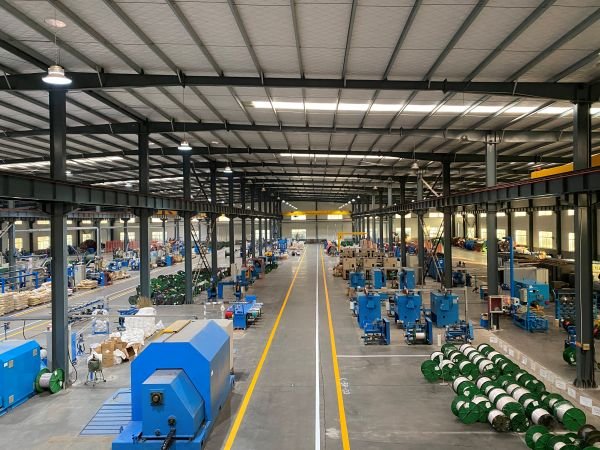
Portable chargers are safety devices as much as they are chargers, so the release checks cover the protection functions and not only the power path.
Tell us the market, the mains plug type and the current range you need.
We confirm connector variants, cable construction and quotation within one working day.
Sample for qualification — stocked configurations within a few working days.
15–30 working days with function-test documentation and private-label packaging if required.
Carton packing, shipping documents, market-specific plug versions and support through distributor qualification.
Tell us the market, plug type and volume — we reply within one working day.
The more detail you give, the faster and more accurate our quotation. Our engineers reply within one working day.
Thanks — our engineers will reply within one working day.