Professional cable manufacturer

Professional cable manufacturer
Home » Products » Solar Cable » PV1-F 2.5mm² Solar Cable
Single-core flexible PV1-F photovoltaic cable with a Class 5 tinned-copper conductor and halogen-free XLPO insulation — for module, string, combiner box and inverter wiring, indoors, outdoors, in cable tray and in conduit.
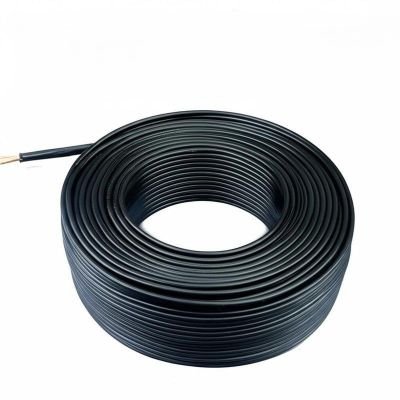
Everything a solar engineer checks first — before diving into the full datasheet below.
The PV1-F 2.5mm² is a single-core flexible photovoltaic cable designated to TÜV 2PfG 1169/08.2007, the TÜV specification for PV module connection cables. It is the cable that links module to module, runs along the string, enters the DC combiner box and continues to the inverter. The same construction is also available under the EN 50618 / IEC 62930 H1Z2Z2-K designation where a project specifies the European standard instead.
The conductor is Class 5 flexible stranded tinned copper to IEC 60228. Tinning keeps the strand surface stable in humid, coastal and polluted conditions, while the fine stranding makes the cable easy to route around module frames and into junction boxes. The 2.5mm² size carries 41 A in free air at 60°C ambient and its maximum DC resistance is 8.21 Ω/km at 20°C, giving a loop voltage drop of about 16.42 V/A/km.
Insulation and sheath are both electron-beam cross-linked XLPO, halogen-free and low smoke, tested to IEC 60754-1 and -2 for halogen acid gas and to IEC 61034 for smoke density with light transmittance above 70%. The cross-linked structure supports a +120°C conductor temperature for up to 20 000 hours and a permanent 90°C rating on the 30-year IEC 60216 basis.
Rated 0.6/1.0 kV AC and 0.9/1.8 kV DC, the cable covers 1500V DC string architectures, and it is tested at 6.5 kV AC or 15 kV DC for 5 minutes. It is specified from −40°C to +90°C ambient, withstands 1 000 hours of damp heat at 90°C and 85% relative humidity, and it is designed for cable tray, conduit and free-air installation. A buried run needs additional mechanical protection and a higher water rating, agreed for the construction ordered and checked against your local regulations.
More about the manufacturer: About SORIVO →
Designated PV1-F to the TÜV 2PfG 1169/08.2007 specification for photovoltaic module connection cables; EN 50618 / IEC 62930 available as an alternative designation.
Class 5 flexible stranded tinned copper to IEC 60228 — flexible routing plus a corrosion-resistant strand surface, with a maximum DC resistance of 8.21 Ω/km at 20°C for 2.5mm².
Insulation and sheath are cross-linked by electron beam, giving a thermally and mechanically stable compound rather than a thermoplastic jacket.
Rated 600/1000 V AC and 900/1800 V DC maximum permissible operating voltage, proof-tested at 6.5 kV AC or 15 kV DC for 5 minutes — matched to 1500V DC string architectures.
IEC 60754-1 for halogen content, IEC 60754-2 for corrosive gases, IEC 61034 for smoke density with light transmittance above 70%.
+120°C conductor operating temperature per IEC 60216 for up to 20 000 hours, a permanent 90°C rating on the 30-year basis, and +200°C for a maximum of 5 seconds under short circuit.
UV tested to ISO 4892-2 method A and UL 1581, ozone resistance to EN 50396 test type B, and 1 000 hours of damp heat at 90°C and 85% relative humidity.
The published minimum bending radius is 4 × overall diameter, so the cable can follow tight module and conduit routes.
From a rooftop string to a long array feeder — one construction, sized per project.
String and array DC cabling between module rows, combiner boxes and central inverters, including long sub-array feeders.
Module-to-module and string runs on large rooftops, where tight bends, tray exposure and long service life all matter.
Panel-to-inverter DC wiring in home systems, including hybrid, retrofit and solar-plus-storage installations.
String inputs and DC distribution inside combiner boxes and the DC input side of string and central inverters.
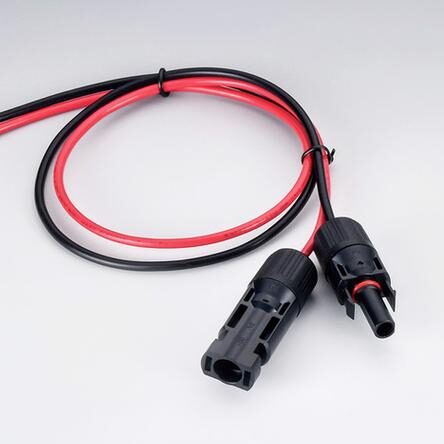
Factory and field terminations in MC4, MC4-Evo 2, Stäubli and Amphenol H4 connectors — 4mm² and 6mm² are the sizes these connectors are normally specified in, so confirm the body before a 2.5mm² termination.
Building-integrated PV, where halogen-free, low-smoke and low-toxicity performance is part of the specification.
Floating plants and agricultural or fishery PV, where 1 000 h damp-heat performance and hydrolysis resistance are decisive.
Underground DC runs between arrays, combiner boxes and inverter stations, laid in conduit or duct where additional mechanical protection is provided.
The complete parameter set — the same data our engineers quote from.
| Cross-section mm² | Conductor dia. max. mm | Overall diameter min. – max. mm | Weight approx. kg/km | Min. bending radius published, mm | Max. DC resistance at 20°C, Ω/km | Current in free air at 60°C, A | Short-circuit current 1 s, kA |
|---|---|---|---|---|---|---|---|
| 1.5 | 1.6 | 4.4 – 4.8 | 29 | 14.4 | 13.7 | 29 | 0.19 |
| 2.5 | 1.9 | 4.7 – 5.1 | 43 | 15.3 | 8.21 | 41 | 0.32 |
| 4 | 2.4 | 5.2 – 5.6 | 58 | 16.8 | 5.09 | 55 | 0.50 |
| 6 | 2.9 | 5.7 – 6.1 | 76 | 18.3 | 3.39 | 70 | 0.76 |
| 10 | 4.0 | 6.8 – 7.2 | 120 | 21.6 | 1.95 | 98 | 1.26 |
| 16 | 5.5 | 8.3 – 9.0 | 178 | 36 | 1.24 | 132 | 2.01 |
| 25 | 6.4 | 10.0 – 10.7 | 273 | 43 | 0.795 | 176 | 3.15 |
| 35 | 7.5 | 11.1 – 11.8 | 364 | 47 | 0.565 | 218 | 4.41 |
The 2.5 mm² row is highlighted — it is the size this page covers; sizes from 1.5 mm² to 35 mm² are produced on the same construction, with larger sizes to order. Dimensions and weights are the published nominal figures for cable to TÜV 2PfG 1169 and are subject to manufacturing tolerance; the values stated on the order confirmation take precedence. Current ratings are a single cable in free air at 60°C ambient and must be derated for higher ambient temperature, grouping, enclosure and other installation conditions — our engineers confirm the figure for your installation method. Maximum DC resistance values are the IEC 60228 Class 5 tinned-copper limits.
| General Information | |
| Product Name | PV1-F 2.5mm² Solar Cable (single core) |
| Type Designation | PV1-F — TÜV 2PfG 1169/08.2007 |
| Primary Standard | TÜV 2PfG 1169/08.2007 — cables for photovoltaic systems (PV1-F) |
| Further Standards | EN 50618 / IEC 62930 (H1Z2Z2-K designation, same construction); IEC / EN 60228 |
| Rated Voltage AC | U0/U 0.6/1.0 kV AC (600/1000 V), maximum permissible operating voltage 0.7/1.2 kV |
| Rated Voltage DC | Maximum permissible operating voltage 0.9/1.8 kV DC — intended for 1500V DC PV strings |
| Test Voltage | 6.5 kV AC or 15 kV DC (alternative tests), 5 minutes |
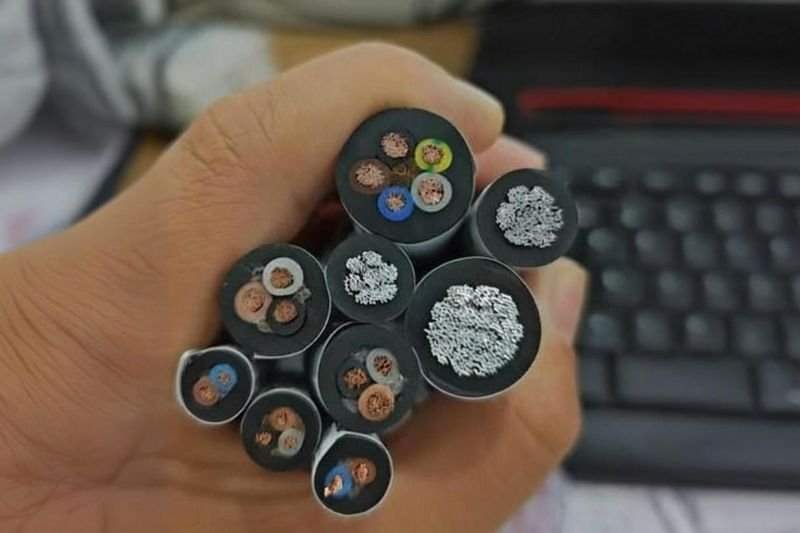
| Cable Structure | Single core, 1 × 2.5 mm²; the same construction is available from 1.5 mm² to 35 mm², with larger sizes to order |
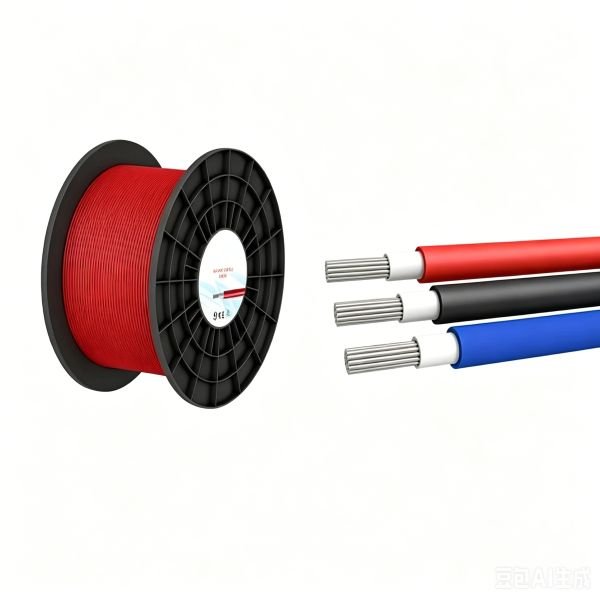
| Core Identification | Natural core insulation; sheath black (standard), red or other colours on request |
| Conductor | |
| Conductor Material | Electrolytic tinned copper — corrosion-resistant strand surface |
| Conductor Type | Class 5 flexible stranded conductor, per IEC 60228 / EN 60228 (VDE 0295) |
| Max. DC Resistance | 2.5 mm²: 8.21 Ω/km at 20°C (other sizes in Table 1) |
| Conductor Diameter | 2.5 mm²: 1.9 mm maximum |
| Insulation & Sheath | |
| Insulation Material | XLPO (cross-linked polyolefin), electron-beam cross-linked, halogen-free |
| Sheath / Jacket | XLPO (cross-linked polyolefin), LSZH, UV and ozone resistant, solidly bonded to the insulation |
| Halogen-Free | IEC 60754-1; no corrosivity per IEC 60754-2 |
| Smoke Density | IEC 61034 / EN 61034 — light transmittance > 70% |
| Halogen & Corrosivity | Halogen-free per IEC 60754-1; low corrosivity per IEC 60754-2 |
| Sheath Marking | SORIVO PV1-F 1 × <size> mm² 0.6/1 kV AC TÜV 2PfG 1169 <year> — or per customer requirement |
| Electrical Ratings | |
| Current Carrying Capacity | 2.5 mm²: 41 A in free air at 60°C ambient; permissible short-circuit current 0.32 kA for 1 s (other sizes in Table 1) |
| Voltage Drop (2.5 mm²) | ≈ 16.42 V/A/km for the complete circuit loop at 20°C conductor temperature, calculated from the maximum conductor resistance |
| Insulation Resistance | ≥ 800 MΩ·km at 20°C — in-house routine test value |
| Long-Term DC Stability | 10 days (240 h) at 85°C in 3% NaCl solution at 0.9 kV DC — TÜV 2 PfG 1169 Annex D. The equivalent test under EN 50618 / EN 50395 clause 9 is run at 1.8 kV DC |
| Temperature & Environmental | |
| Ambient Temperature | −40°C to +90°C for fixed and flexible installation |
| Max. Conductor Temperature | +120°C per IEC 60216 for up to 20 000 h; permanent 90°C on the 30-year service-life basis |
| Max. Short-Circuit Temperature | +200°C for a maximum of 5 seconds per TÜV 2PfG 1169; +250°C for constructions also qualified to EN 50618 |
| Cold Performance | Cold bend and impact tests at −40°C |
| Damp Heat | 1 000 h at 90°C and 85% relative humidity per TÜV 2PfG 1169 |
| UV Resistance | ISO 4892-2 method A and UL 1581 xenon-arc; HD 506/A1-2.4.20 |
| Ozone Resistance | Per EN 50396, test type B |
| Chemical Resistance | Mineral oil 24 h at 100°C per EN 60811-2-1; acid and alkaline 7 days at 23°C per TÜV 2PfG 1169 |
| Water / Burial | Tray, conduit and free-air installation; gravimetric water absorption tested to EN 60811-1-3. A buried run requires additional mechanical protection — confirm with us for the construction ordered |
| Flame Performance | IEC / EN 60332-1-2, single cable vertical flame propagation |
| Minimum Bending Radius | 4 × overall diameter per TÜV 2PfG 1169; per-size published values in Table 1 |
| Design Life | Minimum 25 years; 30 years at 90°C continuous conductor temperature on the IEC 60216 / Arrhenius basis |
| Reaction to Fire (CPR) | Classified under EN 50575 — the declared class for the selected construction is stated on the Declaration of Performance |
| RoHS | Compliant with the EU RoHS directive |
| Packaging & Logistics | |
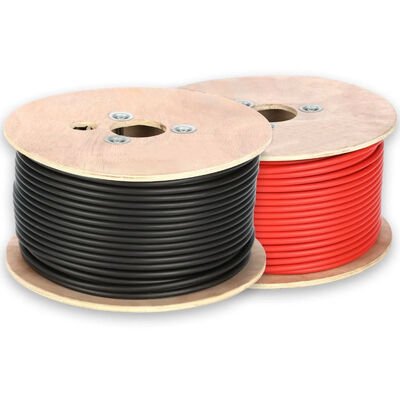
| Packaging | Wooden drum / coil / reel / custom packaging per request |
| Standard Length | 100 m / 200 m / 500 m per roll, customizable |
| MOQ | 1,000 meters for this size; the MOQ is set per cross-section and construction, so it differs across the size range — sample orders are negotiable in every case |
| Lead Time | 7–15 working days; stocked sizes may be available in 3–5 days |
Final cable selection should be based on string current, system voltage, run length, short-circuit conditions, installation method and applicable local requirements. Our engineers confirm the exact construction and certification scope with your project data.
The TÜV specification this cable is designated to as PV1-F. Type test and batch test documentation available on request.
Request test report →The European standard for cables in photovoltaic systems and its IEC equivalent — available as the H1Z2Z2-K designation on the same construction. Certificate of conformity on request.
Request certificate copy →IEC 60754-1 and 60754-2, IEC 61034 with light transmittance above 70%, IEC 60332-1-2 — the fire performance set required for rooftops and enclosed installations.
Request test report →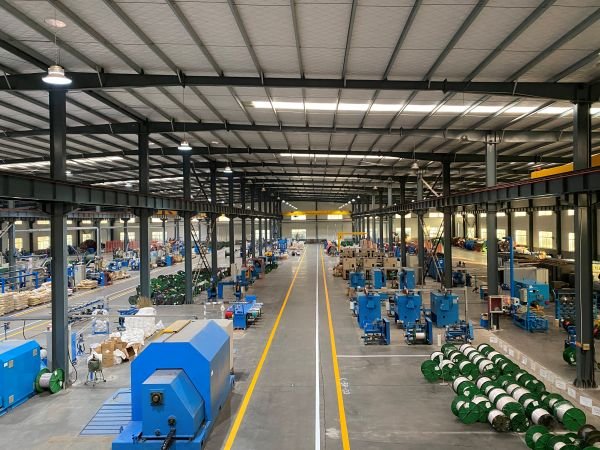
Every drum of PV1-F solar cable is produced under controlled processes and released against the applicable TÜV 2PfG 1169 requirements.
Tell us cross-section, sheath colour, quantity and destination market.
We confirm designation, construction, certification scope and quotation within one working day.
Sample for qualification — stocked sizes within a few working days.
7–15 working days lead time with batch test documentation.
Drum or coil packing, shipping documents and after-sales support.
Tell us the cross-section, colour and quantity — we reply within one working day.
The more detail you give, the faster and more accurate our quotation. Our engineers reply within one working day.
Thanks — our engineers will reply within one working day.