Professional cable manufacturer
Professional cable manufacturer
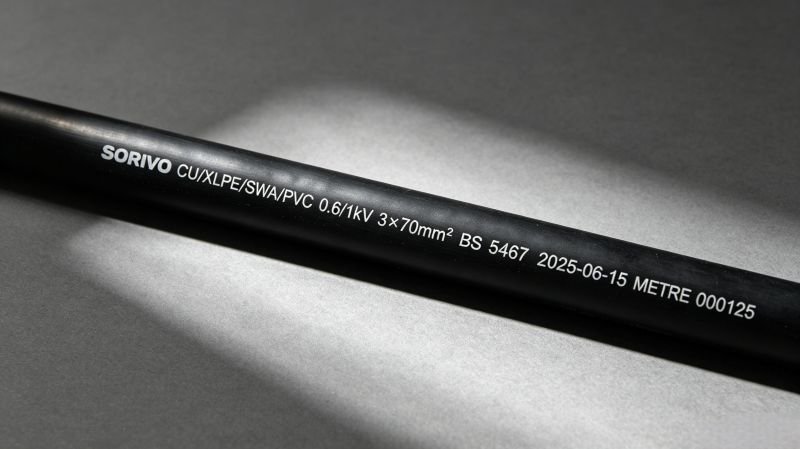
The printing on a power cable is a fast way to identify the manufacturer, the intended construction, the rated voltage, the conductor size, the claimed product standard and traceability information such as batch and metre marks. What it is not is a universal code. The fields a standard requires on the sheath differ from one cable family to the next, and some standards leave the marking format largely to the manufacturer.
A marking should therefore be read against the applicable product standard and the manufacturer’s technical documentation. For procurement and site inspection, the practical checks are these five:
One caution on the last item. Metre marks are useful for locating positions along a run and for a first check on delivered length, but their accuracy and their marking interval are product- and manufacturer-dependent. Treat them as a check, not as proof of the quantity delivered; for commercial verification, use the manufacturer’s stated marking system together with the drum documentation and, where necessary, independent measurement.
If a project specifies CU/XLPE/SWA/PVC 0.6/1 kV armoured power cable, or a BS 6724 LSZH armoured cable, then the construction and standard printed on the delivered drum should be checked line by line against the purchase specification and the certificate or test documentation.
A cable printed with a material name or a standard number is not, by itself, proof of third-party certification. Claims such as BASEC, TÜV, KEMA or LUL should be verified against the certificate itself, the certification body’s database, the scope of certification and the exact product reference — never against the sheath printing alone.
Consider this illustrative string. It is a realistic composite, not a prescribed format:
SORIVO CU/XLPE/SWA/PVC 0.6/1 kV 3C x 70 mm² BS 5467 2026-06 METRE 000125
The order and the fields vary between manufacturers and standards. The reading below is an engineering shorthand, not a mandatory universal marking sequence.
| Field | Typical meaning | Verification point |
|---|---|---|
SORIVO | Manufacturer or brand identification | Check against the purchase order and the certificate. |
CU/XLPE/SWA/PVC | Conductor / insulation / armour / outer sheath construction shorthand | Confirm against the construction drawing or datasheet. The sheath field is the outer sheath only — bedding is not named here. |
0.6/1 kV | Rated voltage designation U0/U | For IEC 60502-1, Um is 1.2 kV. Voltage rating is not current rating. |
3C x 70 mm² | Three cores, each with nominal 70 mm² conductor cross-section | Verify conductor material, class and maximum DC resistance in the datasheet. |
BS 5467 | Claimed product standard | Verify the exact edition and the scope it covers. |
2026-06 | Possible date or batch information | Do not assume the date format without manufacturer documentation. |
METRE 000125 | Running length or metre reference | Confirm marking interval and tolerance with the manufacturer. |
Table 1 note: the example is illustrative. Marking requirements are product- and standard-specific, and no single sequence is mandatory across all standard families.
Do not state that every certified cable must carry the same complete sequence of manufacturer, construction, voltage, size, standard, date and metre mark. Some standards prescribe a minimum set of fields; others leave the arrangement to the manufacturer.
Most reading errors come from treating the code as a flat list of words. It is better understood as a stack. A full description of a power cable has up to six functional layers, and a code string names some of them while silently omitting others.
| Code | Meaning | Reference | Engineering note |
|---|---|---|---|
Cu | Copper conductor | IEC 60228 where applicable | Check conductor class and maximum DC resistance, not just nominal area. |
Al | Aluminium conductor | IEC 60228 where applicable | Lower density than copper; size and resistance must be designed separately, not substituted by area. |
| Tinned Cu | Tinned copper | Product standard / manufacturer | Surface corrosion resistance. Tinning does not by itself change the conductor class. |
Table 2 note: IEC 60228 classifies conductors by construction and flexibility — in simplified terms Class 1 solid, Class 2 stranded for fixed installations, Class 5 flexible and Class 6 more flexible again.
Do not identify conductor class from strand count alone. Compacting and different stranding patterns change the strand arrangement without changing the class. For acceptance inspection, compare resistance, material, nominal cross-section and class against the standard or the approved datasheet.
| Code | Material | Typical maximum conductor temperature | Qualification |
|---|---|---|---|
XLPE | Cross-linked polyethylene | 90°C for common 0.6/1 kV IEC designs | Short-circuit temperature and duration are design- and standard-dependent. |
PVC | Polyvinyl chloride | 70°C for common PVC/A compound designs | Current capacity also depends on installation conditions. |
EPR | Ethylene-propylene rubber compound | Often 90°C | Check the exact compound and the product standard. |
XLPO | Cross-linked polyolefin | Product dependent | Common in PV cable systems; verify EN 50618 or IEC 62930 documentation. |
Table 3 note: a higher insulation temperature class does not automatically raise the usable current. Ampacity depends on installation method, ambient conditions, grouping and the reference conditions of the rating table — see the cable ampacity and cross-section guide.
Between the insulation and the bedding sits a layer that the four-layer shorthand usually forgets: the metallic screen. It is standard practice on medium-voltage cable and appears on some low-voltage designs too. It performs two jobs that armour does not: it shapes the electric field across the insulation, and it provides a defined low-impedance path for earth fault current so that protection can operate quickly.
| Code | Construction | Primary function | Where you meet it |
|---|---|---|---|
CTS | Copper tape screen, helically wound with overlap | Field grading and earth fault current path | MV cable designs; compact cores |
CWS | Copper wire screen, laid over the insulation screen and held by a binder tape, often with a counter-helix of copper tape | Field grading and earth fault current path, with higher fault-current capability than tape alone | MV cable and screened LV designs, including LSZH versions |
| None named | No metallic screen | — | Most LV 0.6/1 kV armoured power cable, where the armour handles the earthing function instead |
Table 4 note: this is the layer most often misread. A cable coded CU/XLPE/CWS/LSZH does not necessarily have armour at all — the metallic screen is not the armour. See section 04.
The bedding sits between the cores and the armour. Its job is partly mechanical — it stops the armour wires or tapes from bearing directly on the insulation — and partly geometric, because on a multicore cable it also fills the interstices so the assembly is round enough for the armour to be applied evenly.
| Code | Material | Behaviour in fire | Standard family |
|---|---|---|---|
PVC | Polyvinyl chloride bedding | Halogen-containing; emits dense smoke and corrosive gases when burnt | BS 5467 |
LSZH | Low smoke zero halogen bedding compound | Low smoke emission and reduced corrosive gas evolution | BS 6724 |
Table 5 note: the bedding is a distinct layer from the outer sheath. A cable can have a PVC bedding and an LSZH outer sheath, or the reverse, depending on the standard and the manufacturer’s design. Always read the full construction, not one word of it.
| Code | Typical armour | Typical application | Key limitation |
|---|---|---|---|
SWA | Steel wire armour | Multicore power cables requiring mechanical protection, including direct burial | Magnetic. Requires specific design consideration on single-core AC circuits. |
AWA | Aluminium wire armour | Single-core AC cables where non-magnetic armour is required | Mechanical and fault-current requirements must still be checked case by case. |
STA | Steel tape armour | Applications where tape armour is specified; better crush resistance in some designs | Mechanical performance depends on construction and the standard. |
Table 6 note: the armour is normally required to be earthed, both as a fault-current path and to prevent the armour reaching a dangerous potential under fault conditions. Earthing method and gland selection (BW, CW, CX type) form part of the design.
For single-core AC circuits, magnetic metallic armour can produce additional losses and local heating because the alternating field induces currents in the steel. Aluminium wire armour, or another suitable non-magnetic arrangement, is therefore commonly selected. The exact design still has to be checked against the cable standard, the current-rating calculation, the installation arrangement and local regulations. Our SWA vs AWA vs STA armoured cable comparison works through the losses and the application matrix in more detail.
| Code | Description | Environmental consideration |
|---|---|---|
PVC | Polyvinyl chloride sheath | Halogen-containing. Fire behaviour depends on the compound and the overall cable construction. |
LSZH | Low smoke zero halogen sheath compound | Used where low smoke and reduced corrosive or halogen acid gas emissions are required. |
PE | Polyethylene sheath | Good environmental properties in many applications; fire behaviour is product dependent. |
PUR | Polyurethane sheath | Selected for particular mechanical, oil or abrasion requirements. |
Table 7 note: the outer sheath is the layer a code string most often names last. It is also the layer most often confused with the bedding — they are separate extrusions.
Cable life is not a fixed value such as “15 years” or “25 years” simply because the sheath is PVC or LSZH. Actual life depends on conductor temperature, loading, UV exposure, chemicals, moisture, mechanical stress, installation quality and compound design.
A string such as CU/XLPE/LSZH/SWA/LSZH looks like a typographic error. It is not. Reading it against the six-layer stack resolves it immediately:
CU — Layer 1, copper conductorXLPE — Layer 2, cross-linked polyethylene insulationLSZH — Layer 4, the bedding or inner sheath between insulation and armourSWA — Layer 5, steel wire armourLSZH — Layer 6, the outer sheathBoth non-metallic layers are specified as low smoke zero halogen. This is the standard construction of an LSZH armoured power cable, and the same pattern produces CU/XLPE/LSZH/AWA/LSZH on the single-core version. It also explains a family of search strings we see frequently, where the same letters appear twice in slightly different order — people are copying what is printed on a drum or a datasheet, not mistyping it.
This is the single most common misreading of an LSZH cable code, and it is worth stating plainly:
CWS (copper wire screen) and SWA (steel wire armour) are not two competing options for the same job. CWS is a metallic screen sitting over the insulation; SWA is an armour sitting outside the bedding. A screened low-voltage cable coded CU/XLPE/CWS/LSZH may have no armour whatsoever.
| Attribute | Metallic screen (CWS / CTS) | Armour (SWA / AWA / STA) |
|---|---|---|
| Position in the stack | Over the insulation, under the bedding | Over the bedding, under the outer sheath |
| Primary function | Electric field grading across the insulation; earth fault current path | Mechanical protection against impact, crushing and rodent damage; tensile strength during pulling |
| Typical fault-current duty | Designed as the earth fault current path on screened designs | May serve as the circuit protective conductor on armoured designs |
| Magnetic behaviour | Copper — non-magnetic | Steel armour is magnetic; aluminium armour is not |
| Where it appears | MV cable as standard; some LV screened designs | LV and MV armoured cable for burial, ducts, risers and harsh routes |
| Can they coexist? | Yes. CU/XLPE/CWS/LSZH/AWA/LSZH is a real, catalogued construction — screen first, then bedding, then aluminium wire armour, then outer sheath. | |
Table 8 note: construction sequences are confirmed against published manufacturer datasheets, including LSZH single-core MV cable and LSZH screened LV cable.
The practical consequence is simple. When a specification or a search string pairs CWS with SWA, the pair is not a choice between alternatives — it is a question about whether the cable has a screen, an armour, or both. Ask for the construction drawing before quoting.
Split any code string into the six layers before interpreting a single word of it. Most “which is better” questions about cable codes dissolve once the layers are separated, because the two terms were never in the same layer to begin with.
British practice names the construction in English letters — CU, XLPE, SWA, PVC, LSZH. Much of continental Europe, Turkey and the Middle East uses a coded designation instead, and the same cable ends up with two or three different names depending on who is quoting it. This is why a specification written in one system can look unrecognisable when it comes back as a quotation from the other.
| Conductor | Insulation / sheath | IEC-style designation | British-style naming |
|---|---|---|---|
| Copper | XLPE / PVC | N2XRY | CU/XLPE/PVC |
| Copper | XLPE / LSZH | N2XRH | CU/XLPE/LSZH |
| Aluminium | XLPE / PVC | NA2XRY | AL/XLPE/PVC |
| Aluminium | XLPE / LSZH | NA2XRH | AL/XLPE/LSZH |
Table 9 note: the designation family is used across Europe, Turkey and the Middle East for cable made to IEC 60502-1. The armour is not encoded in the core designation — it must be added separately.
Two points about this table are worth carrying into a procurement conversation. First, the “2X” element signals cross-linked polyethylene insulation, and the trailing letter signals the sheath family — Y for PVC and H for halogen-free. Second, and more importantly, the armouring is not part of the core designation. A quotation for N2XRH and a quotation for N2XRH with SWA are two different cables, and the difference will not be visible in the short code.
When a tender document mixes the two naming systems — an IEC-style designation in the bill of quantities and a British-style construction note in the specification — the safest step is to restate the requirement in all six layers and ask every bidder to confirm against that restatement. This costs one email and prevents a delivery of the wrong armour.
| Standard | Scope | Typical engineering use |
|---|---|---|
| BS 5467:2016 | Thermosetting insulated, armoured cables rated 600/1,000 V and 1,900/3,300 V for fixed installations; PVC bedding and PVC outer sheath | The common armoured power cable family. Construction depends on the cable type. |
| BS 6724:2016 | Thermosetting insulated, armoured cables rated 600/1,000 V and 1,900/3,300 V with low emission of smoke and corrosive gases under fire; LSZH bedding and LSZH outer sheath | Applications where low-smoke, low-corrosivity fire performance is specified. |
| BS 7846:2015 | Thermosetting insulated, armoured, fire-resistant cables rated 600/1,000 V with low emission of smoke and corrosive gases under fire | Essential circuits requiring fire-resistant cable performance and circuit integrity. |
Table 10 note: BS 5467 and BS 6724 cover the same two voltage ratings. The difference between them is the bedding and sheath material system, not the voltage class.
Two statements we see repeatedly are wrong. First, BS 6724 should not be described as “BS 5467 with a different sheath” — its scope requires low emission of smoke and corrosive gases under fire, which is a performance requirement, not just a material swap. Second, BS 7846 should not be equated with a generic “PH30 / PH60 / PH120” label; the applicable fire-resistance classification and test evidence must be checked for the specified cable and its supporting system.
UK buyers frequently use the phrase booklet armoured cable, and occasionally booklet power cable, when they mean an ordinary BS 5467 or BS 6724 armoured power cable. Published distributor guidance lists “booklet power” and “booklet armoured” among the trading names for these cable families, alongside the more common “SWA” and “mains power”.
What we could not establish is the origin of the term. We searched for a formal definition in the standards themselves and in manufacturer technical literature and did not find one that explains why this construction acquired the name. So we will not offer an etymology. What can be said with confidence is the practical point: if a specification, a requisition or a search string says “booklet armoured”, the cable being asked for is in the BS 5467 / BS 6724 armoured power family, and the rest of the requirement should be pinned down in the six layers described above.
A cable marked LSZH is not automatically compliant with any particular building fire class, because LSZH is a description of the material system, not a declared reaction-to-fire performance. In European construction projects the declared performance comes from a different place entirely: the Construction Products Regulation.
Regulation (EU) 305/2011 — the CPR — brought permanently installed power, control and communication cables into a harmonised system, and EN 50575:2014+A1:2016 sets out the reaction-to-fire classification. The requirement has applied since July 2017. Declared performance is expressed as a class from Aca to Fca, qualified by three groups of sub-ratings.
| Class | Reaction-to-fire performance | Typical use | Sub-ratings |
|---|---|---|---|
Aca | No contribution to fire | Rarely commercially available for cables | Not applicable |
B1ca / B2ca | Very limited / limited contribution to fire | Tunnels, hospitals, high-rise buildings, escape routes | s1–s3, d0–d2, a1–a3 |
Cca | Some contribution to fire | Offices, public and commercial buildings | s1–s3, d0–d2, a1–a3 |
Dca | Acceptable contribution to fire | Residential and lower-risk applications | s1–s3, d0–d2, a1–a3 |
Eca | Single-cable vertical flame test only | Low-risk, low-density installations | Not tested |
Fca | No performance determined | Outside performance-driven scopes | Not tested |
Table 11 note: ca denotes cable. The sub-ratings describe smoke production (s), flaming droplets (d) and acidity of evolved gases (a). They are declared together with the main class as a single string.
The classification is built from four test methods, and knowing which one produces which sub-rating is what allows a declared class to be challenged intelligently:
| Test standard | What it measures | Feeds |
|---|---|---|
EN 50399 | Flame spread, peak heat release rate, total heat release, smoke production on bunched cables | The main class for Aca through Dca |
EN 60332-1-2 | Vertical flame propagation on a single insulated wire or cable | Minimum test for every class, including Eca |
EN 61034-2 | Light transmittance during combustion in a 3-metre cube | The s smoke sub-rating |
EN 60754-1 / -2 | Halogen acid gas content, and conductivity and pH of evolved gases | The a acidity sub-rating |
Table 12 note: the class and its sub-ratings are a single declared performance string, not independently selectable options. The test programme has to cover them together.
Two published declarations make the point better than any description. An LSZH screened low-voltage cable rated 0.6/1 kV is declared Dca-s1,d2,a1. A single-core LSZH screened and aluminium-wire-armoured cable rated 6.35/11 kV from the same family is declared Cca-s1,d2,a1. Both are LSZH cables. They are not the same fire class, because the class is a declared test outcome and the material description is not.
Under the CPR assessment and verification system, a declaration up to Dca can rest on a single test regime, while Cca and above require continuous notified-body surveillance (system 1+). When a supplier claims a high Euroclass, the supporting Declaration of Performance and the notified body reference should be part of the document set.
Single-cable flame spread (EN 60332-1-2), bunched flame spread (EN 60332-3 series), smoke and corrosive gas behaviour (EN 61034, EN 60754) and the declared CPR class (EN 50575) answer four different questions. A cable can perform well on one and poorly on another. Ask for all four when the application justifies it, and do not let a single word stand in for any of them.
IEC 60502-1:2021 covers power cables with extruded insulation for rated AC voltages of 1 kV (Um = 1.2 kV) and 3 kV (Um = 3.6 kV). The three values in the designation mean different things:
This is more precise than saying “the cable can carry 1 kV”. A voltage rating and a current-carrying capacity are separate design parameters, and the second one is not on the sheath at all.
A 690 V AC industrial system can fall within the normal application range of a 0.6/1 kV cable, but final selection must also consider the earthing arrangement, installation method, short-circuit conditions, ambient temperature and the applicable installation standard.
The IEC fire and smoke standards are frequently quoted as if they were interchangeable. They are not, and a marking reference to one of them should not be read as evidence of another.
| Standard | What it tests | What it does not mean |
|---|---|---|
IEC 60332-1 series | Vertical flame propagation on a single insulated wire or cable | Not a complete definition of LSZH performance |
IEC 60332-3 series | Vertical flame spread for vertically mounted bunched cables, by category | Not the same as circuit integrity or fire resistance |
IEC 60754-1 | Determination of halogen acid gas content from cable materials | A test method; pass criteria come from the applicable cable specification |
IEC 60754-2 | Conductivity and pH of evolved gases | Not a standalone certification of “zero halogen” |
IEC 61034-2 | Smoke density and light transmission from burning cables in a 3-metre cube | Not a generic LSZH certification by itself |
Table 13 note: ISO/IEC equivalents are frequently cited under both the IEC and the EN numbering; the EN versions (EN 60754-1, EN 61034-2 and so on) carry the same test content under the European designation.
When sheath printing is damaged or worn, document-based verification comes first and physical checks follow, restricted to a suitable and de-energised access point.
| Check | Preferred method | What to look for |
|---|---|---|
| Manufacturer / product identity | Drum label, purchase order and datasheet | Exact product reference and batch information |
| Conductor material | Inspect an accessible approved end | Copper, aluminium or tinned copper as specified |
| Armour present, and its material | Visual inspection of an approved cut end; a magnet only as a supplementary check | Steel versus non-magnetic aluminium — remembering that a copper screen is neither |
| Screen present | Construction drawing; visual inspection of the cut end | Copper wires or tape over the insulation screen, under the bedding |
| Insulation and sheath material | Manufacturer documentation or a laboratory identification | Do not rely on colour, smell or a burn test alone |
| Standard compliance | Certificate, declaration, test report and standard edition | Exact product scope, size and construction |
Table 14 note: the screen row is included because a magnet test will not find a copper screen. Where a screened design is specified, the cut end is the only field check that answers the question.
Do not burn cable samples or heat insulation to “see what melts”, particularly on installed or energised cables. Burning cable compounds can produce hazardous gases. If material identity is disputed, use manufacturer documentation or a competent test laboratory.
The code follows from the installation requirement, not the other way round. The matrix below maps common installation situations to the constructions they typically produce, together with the item that most often needs verifying before the order is placed.
| Installation requirement | Typical construction | Verification priority |
|---|---|---|
| General fixed power distribution, multicore | CU/XLPE/SWA/PVC | Confirm BS 5467 or the specified IEC product standard, and the sheath material actually offered. |
| Buildings and public infrastructure where low smoke is required | CU/XLPE/LSZH/SWA/LSZH | Confirm BS 6724 scope, both LSZH layers, and the declared fire class required by the project. |
| Single-core AC feeder | CU/XLPE/AWA/PVC or CU/XLPE/LSZH/AWA/LSZH | Check armour losses, cleating arrangement, earthing method and the current rating for the actual formation. |
| Screened LV circuit where field control or a defined fault path is required | CU/XLPE/CWS/LSZH | Confirm the screen type (CWS or CTS), screen cross-section and the fault-current duty. Do not assume armour is present. |
| MV distribution, single core | CU/XLPE/CWS/LSZH/AWA/LSZH | Confirm screen and armour together, the metallic screen cross-section for fault duty, and the CPC arrangement. |
| Fire-resistant essential circuit | Project-specified fire-resistant cable | Check BS 7846 and the required fire or circuit-integrity evidence, including the supporting system. |
| PV DC wiring | H1Z2Z2-K or equivalent PV cable | Check EN 50618 or IEC 62930, DC voltage class, UV and environmental ratings. |
| Corrosive or chemically aggressive environment | Project-specific sheath and armour construction | Verify chemical compatibility with the actual compound rather than selecting by acronym. |
| Direct burial, multicore | CU/XLPE/SWA/PVC or LSZH equivalent | Confirm armour type, bedding integrity and the burial depth and protection agreed for the route. |
Table 15 note: constructions shown are typical, not prescriptive. Every row still requires the six-layer restatement, and the rating must come from a calculation for the actual installation conditions.
Choose the cable from the complete design requirement — voltage, load current, installation method, short-circuit duty, ambient conditions, mechanical protection, fire performance and environmental exposure. The marking is a verification tool. It is not a substitute for cable sizing, and it never contains the current rating.
If the matrix points to a code the current quotation does not clearly match — a screened LV design, or an LSZH armoured cable with a declared CPR class — send us the installation conditions and the standard the project names. We will confirm the construction we build, layer by layer, against the requirement before you order. Ask us to confirm a construction.
| Incorrect shortcut | Why it is risky | Better practice |
|---|---|---|
| “CWS and SWA are two armour options” | They sit in different layers and do different jobs; a screened cable may have no armour at all | Split the code into the six layers before comparing anything |
| “LSZH means one specific material” | LSZH compounds can use different material systems, and the term covers both bedding and sheath | Check the actual compound and the test requirements for each layer |
| “BS 6724 is just BS 5467 with a different sheath” | The standards have different scopes, including a fire performance requirement | Check the full product standard, construction and declared performance |
| “LSZH means the cable has passed a fire class” | LSZH describes materials; the declared class comes from EN 50575 and its test programme | Ask for the Declaration of Performance and the class string |
| “SWA can never be used on single-core AC” | The real issue is magnetic-armour losses and heating; the design determines the answer | Use a suitable non-magnetic arrangement where required and verify the design |
| “IEC 60754 means zero-halogen certification” | IEC 60754 is a gas-emission test method; pass criteria come from the product specification | Check the cable standard and the full fire test evidence |
| “CE marking means third-party approval” | CE marking is not equivalent to BASEC, TÜV or KEMA certification | Verify third-party certificates independently, including scope and product reference |
| “Cable life is always 25 years” | Service life is application- and material-dependent | Use manufacturer design-life information and the actual installation conditions |
| “The second LSZH in the code is a typo” | It names a second non-metallic layer — bedding or sheath — and its omission changes the cable | Read every occurrence of the code before accepting a quotation |
Table 16 note: each row corresponds to a question we are asked often enough to treat as a pattern rather than an exception.
It is the rated voltage designation U0/U. For the IEC 60502-1 1 kV class the full designation is 0.6/1 (1.2) kV: 0.6 kV between conductor and earth or metallic screen, 1 kV between conductors, and 1.2 kV as Um, the maximum system voltage for the class. It says nothing about current-carrying capacity.
Both cover thermosetting insulated armoured cables at 600/1,000 V and 1,900/3,300 V. BS 5467 uses PVC bedding and a PVC outer sheath. BS 6724 uses LSZH bedding and an LSZH outer sheath, and its scope requires low emission of smoke and corrosive gases under fire. The difference is the material system and the fire performance requirement, not the voltage class.
No. CWS stands for copper wire screen. It sits over the insulation and under the bedding, and its job is electric field control and providing a path for earth fault current. Armour — SWA, AWA or STA — sits further out and provides mechanical protection. A cable coded CU/XLPE/CWS/LSZH may have no armour at all, while a cable coded CU/XLPE/CWS/LSZH/AWA/LSZH has both a screen and an armour.
Because two separate non-metallic layers are specified as low smoke zero halogen. In CU/XLPE/LSZH/SWA/LSZH, the first LSZH is the bedding between the insulation and the armour, and the second is the outer sheath. Reading the code against the six construction layers resolves the apparent repetition.
Steel is magnetic. Around a single AC conductor, magnetic armour experiences additional losses and local heating, which can reduce usable capacity. Aluminium wire armour is non-magnetic and is commonly selected for single-core AC designs. Final selection still depends on the cable standard, the earthing arrangement and the current-rating calculation for the actual formation.
No. LSZH describes the material system. The declared reaction-to-fire class comes from EN 50575 under the CPR, expressed as a class from Aca to Fca with smoke, droplet and acidity sub-ratings. Two LSZH cables can carry different declared classes — published declarations range from Dca-s1,d2,a1 on a screened LV cable to Cca-s1,d2,a1 on an MV armoured cable.
If a marking, a datasheet and a tender specification disagree with one another, the disagreement is usually traceable to one of the layers above — and it is cheaper to resolve it in an email than on site.
Paste the print string from the drum, the voltage designation, core count and conductor size, the installation environment and the standard the project specifies. Our technical team will restate the requirement in all six construction layers and confirm the construction against the project requirement before you commit to an order.

Technical note: this article is an engineering identification guide. It is not a substitute for the applicable product standard, the project specification, local electrical regulations, the manufacturer’s datasheet, or the certificate and test report. Standards and certification requirements change; verify the current edition and the certification status before procurement or installation.
Standards and editions referenced, reviewed September 2026: IEC 60228:2023; IEC 60502-1:2021; BS 5467:2016; BS 6724:2016; BS 7846:2015; BS 7671; IEC 60332-1 and -3 series; IEC 60754-1 and -2; IEC 61034-2; EN 50399; EN 50575:2014+A1:2016; EN 50618; IEC 62930:2017.
What this guide does not do: it does not rank cable brands, does not certify any product, and does not offer customs, tax or legal advice. Where a term could not be traced to a verifiable definition — “booklet armoured” is one — we say so rather than supply an explanation we cannot support.