Professional cable manufacturer

Professional cable manufacturer
Home » Products » Control & Instrumentation » EtherCAT / PROFINET Industrial Ethernet Cable SF/UTP PUR High-Flex
Four-core star-quad data cable for continuous flexing in cable carriers — AWG22/19 tinned copper, SF/UTP shielding, PUR jacket to DIN EN 50363-10-2, for PROFINET IO, EtherCAT drives and robot cells.
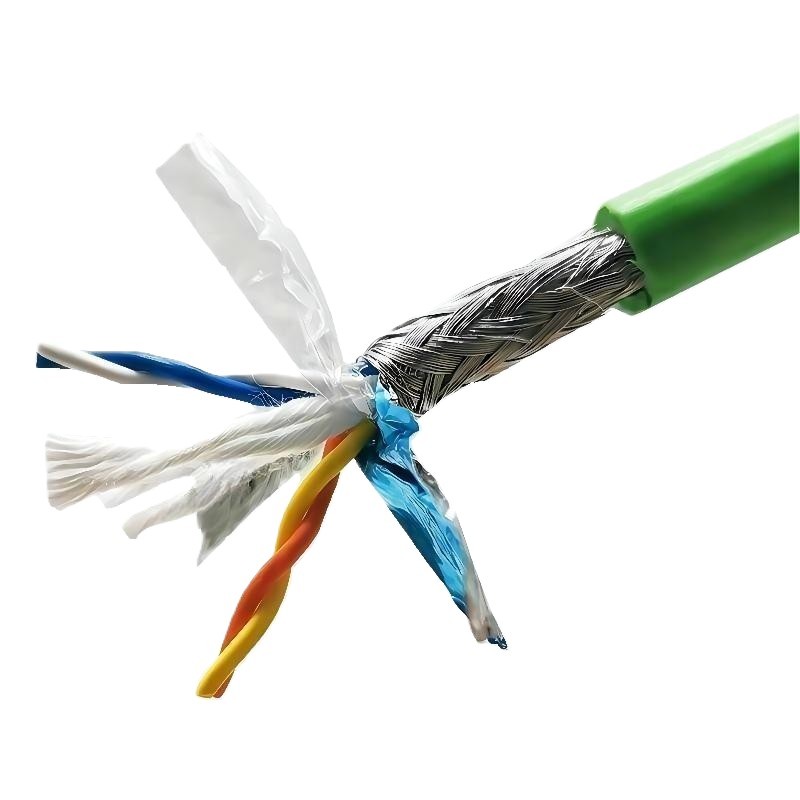
What a controls engineer checks first on an industrial Ethernet cable — before reading the full specification below.
The EtherCAT / PROFINET Industrial Ethernet Cable is an SF/UTP PUR data cable built for the part of the network that moves. PROFINET Type C — in the PNO design guideline the category defined for continuous movement in cable carriers — is what this construction is specified to, and the same physical layer satisfies EtherCAT.
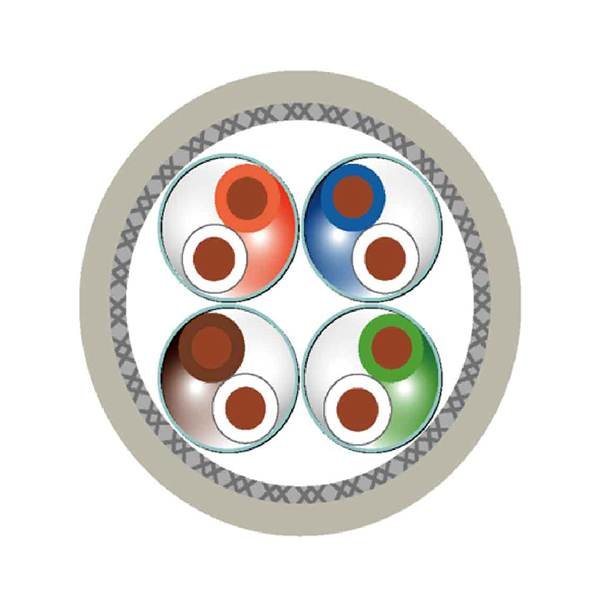
The conductor is 4 × AWG22/19 — nineteen strands of 0.15 mm, about 0.34 mm² per core — laid as two pairs in a star quad with white, blue, yellow and orange cores. The quad is the point, not a detail: two pairs are what 100BASE-TX uses, so the construction is a 100 Mbit/s cable by design. It is not a four-pair cable and cannot be presented as one — 1000BASE-T needs all four pairs, which is a different cable. Each core is insulated with HDPE at 1.50–1.55 mm and the assembly is screened SF/UTP: an aluminium-clad foil applied with overlap so there is no gap, plus a tinned copper braid of at least 85% optical coverage.
Electrically it is a 100 Ω cable across 1–100 MHz. The PNO Type C limit is 100 Ω ±15 Ω; tighter figures such as ±10% or ±5% also appear in supplier data, so the tolerance for a specific batch is stated on its data sheet. Resistance has to be read in two different ways and the two are not interchangeable: the per-conductor DC resistance is published at about 59.4 Ω/km for a peer 0.38 mm² core of this construction class, while the loop resistance — what a link budget actually cares about — is limited to below 115 Ω/km for Type C. Nominal velocity of propagation is 67% (≈0.67 c) and nominal capacitance is 50–53 pF/m, the bandwidth figures that decide whether a 100 m channel stays inside its attenuation budget. The resistance, velocity and capacitance values quoted here are published figures for comparable cables of this type rather than our own measurements, and Table 2 names the cable each attenuation figure comes from.
Mechanically the cable is a drag-chain product. The PUR jacket follows DIN EN 50363-10-2 and is rated oil resistance Class 3, coolant-resistant and resistant to hydrolysis and microbes; it is silicone-free and PTFE-free. Minimum bend radius is 4 × OD for fixed installation, 10 × OD for occasional flexing and 12.5–16 × OD across this cable class for continuous movement — we quote 15 × OD as our guaranteed carrier figure and confirm it against the selected construction. Flex life is quoted in double strokes and must always be read with that definition: the construction is designed to 3 million double strokes, while a named peer cable is rated at 4 million bending cycles at R100 mm, 4 m/s and 4 m/s² and carrier-tested 0.38 mm² bus cables in the same class are published at 5–10 million double strokes at test speeds of 0.5–2 m/s. Those peer figures carry their conditions because they mean nothing without them, and no cable in this class is tested at 5 m/s. There is no torsion rating on this cable; a twisting application needs a separate torsion-rated construction with its own data sheet.
Temperatures are −40°C to +80°C fixed, −30°C to +50°C for flexible use and −20°C to +70°C in a carrier. For everything fixed — cabinets, panels, machine-internal runs — see our Cat6A / Cat8 S/FTP Shielded Data Cable, and for the analogue control and encoder wiring alongside this link, our Multi-core Flexible Anti-interference Control Cable.
More about the manufacturer: About SORIVO →
The PNO cable category defined for continuous movement in cable carriers. Type C also covers the fixed and occasional-movement duty of Type A and Type B.
Two pairs carry 100BASE-TX at 100 Mbit/s, which is the physical layer PROFINET and EtherCAT both use. 1000BASE-T would need four pairs and a different cable.
4 × AWG22/19, about 0.34 mm² per core, with HDPE insulation at 1.50–1.55 mm and an optimised lay length so the pair geometry survives flexing.
Overlapped aluminium-clad foil with no gap, plus a tinned copper braid of at least 85% optical coverage — the combination that keeps 100 Ω stable next to drives.
Halogen-free PUR to DIN EN 50363-10-2, oil resistance Class 3, coolant-resistant, hydrolysis and microbe resistant, silicone-free and PTFE-free.
The construction is designed to 3 million double strokes at 15 × OD. Peer data in this class, quoted with its conditions: 4 million bending cycles at R100 mm / 4 m/s / 4 m/s², and 5–10 million double strokes at 0.5–2 m/s.
−40°C to +80°C fixed, −30°C to +50°C for flexible use and −20°C to +70°C in a carrier — quoted per duty so the rating matches the installation.
Installed as 100 m segments per 100BASE-TX. Supplied cut to length, or factory-terminated with RJ45 (IP20) or M12 D-coded (IP65/67) connectors.
Anywhere a 100 Mbit/s industrial Ethernet segment has to keep working while it moves.
IO-Device and IO-Controller links between remote IO stations, ET 200 modules and the PLC.
Servo drives and distributed IO on EtherCAT, where the segment runs inside the axis carrier.
Six-axis robot dress packs and tool changers, in the flexing section of the harness — not the torsion joint.
Gantry, tool magazine and pallet changer wiring, where oil mist and swarf reach the cable every shift.
Welding cells, conveyors and skid lines, where the shield has to hold against drive and welding noise.
Film feed, forming and sealing axes on packaging and filling lines running multi-shift.
AS/RS stacker cranes, shuttles and cross-belt sorters — travel of several metres inside one carrier.
The moving axis of a carrier or festoon system, where bend radius and cycle count decide service life.
The complete parameter set — with every figure that comes from outside Sorivo labelled as such.
How to read these tables: rows marked Peer construction value are published figures for comparable cables of the same type — the manufacturer and model are named in the row so you can check them yourself. They describe this construction class, not a measurement of the cable we ship, and we confirm the exact figure against the selected construction before the order. Rows marked Type C or Cat.5e are standard limits, not supplier claims. The data rate follows from the core count and is a property of the design itself.
| General Information | |
| Product Name | EtherCAT / PROFINET Industrial Ethernet Cable SF/UTP PUR High-Flex |
| Model | IE-PN-FD-C5E Series |
| PROFINET Cable Type | Type C — continuous movement in cable carriers (defined by the PNO PROFINET design guideline) |
| EtherCAT Compatibility | Meets the EtherCAT 100BASE-TX physical layer requirement (IEC 61158 Type 12 / IEC 61784-2 CPF 12) |
| Category | Cat.5e, 100 MHz — 100BASE-TX transmission at 100 Mbit/s; not a 4-pair / 1000BASE-T construction |
| Max. Segment Length | 100 m per 100BASE-TX channel |
| Sheath Colour | Green RAL 6018 (PROFINET standard colour) / custom |
| Conductor & Core | |
| Conductor Material | Stranded tinned copper |
| Conductor Size | 4 × AWG22/19 — 19 strands × 0.15 mm, approximately 0.34 mm² per core |
| Stranding Class | Flexible stranding to DIN EN 60228 |
| Core Insulation | HDPE (high-density polyethylene), ø 1.50–1.55 mm |
| Core Count & Assembly | 4 cores laid as two pairs in a star quad with optimised lay length |
| Core Identification | White, blue, yellow, orange |
| Shielding & Jacket | |
| Shielding | SF/UTP — aluminium-clad plastic foil applied with overlap (no gap) plus a tinned copper braid, ≥85% optical coverage |
| Inner Jacket / Bedding | LSZH / FRNC inner jacket, ø ≈4.0 mm |
| Outer Jacket | PUR (polyurethane), halogen-free, low-adhesion, highly abrasion resistant, to DIN EN 50363-10-2 |
| Dimensions & Weight | |
| Overall Diameter | Peer construction value ≈6.3–7.0 mm, confirmed against the selected construction (LÜTZE 6.3 mm, Siemens 6.5 mm, igus 7.0 mm max.) |
| Diameter Tolerance | ±0.2 mm to ±0.3 mm; confirm against the selected construction (Siemens ±0.2 mm; LAPP ±0.3 mm) |
| Weight | Peer construction value ≈63–64 kg/km at ≈6.5–7.0 mm OD (Siemens 63 kg/km, igus 64 kg/km); confirm against the selected construction |
| Copper Index | Peer construction value ≈33 kg/km at this construction (igus CFBUS.PUR.060); confirm against the selected construction |
| Strain Relief Element | Peer construction value: the carrier type uses a tensile stress-resistant centre element (igus CFBUS.PUR.060); whether the delivered build carries one is to be confirmed against the selected construction |
Read the core count before the category. Four cores means two pairs, and two pairs means 100BASE-TX at 100 Mbit/s. 1000BASE-T requires four pairs, so a 4-core cable must never be quoted as gigabit-capable. The Type C core cross-section is AWG22/19 or AWG22/7 per the PNO guideline; 19 × 0.15 mm works out at about 0.34 mm², and peer carrier cables of this type are published at 0.38 mm², so the conductor cross-section to be delivered is confirmed against our own construction drawing before ordering.
| Frequency MHz | Attenuation dB/100 m |
|---|---|
| 1 | 2.0 |
| 4 | 4.1 |
| 10 | 6.2 |
| 16 | 7.8 |
| 20 | 8.7 |
| 31.25 | 11.0 |
| 62.5 | 16.3 |
| 100 | 21.2 |
These attenuation values are the published igus chainflex CFBUS.PUR.060 figures for a 4 × 0.38 mm² star-quad PUR carrier cable — the same construction class as this product, quoted here because it is the source we can point to. Attenuation for the cable actually supplied is verified on our own test report, which we send with the quotation; the Cat 5e attenuation limit at 100 MHz is 22.0 dB/100 m, so a 100 m channel has to be budgeted with the connectors included.
| Electrical Characteristics | |
| Characteristic Impedance | 100 Ω ±15 Ω across 1–100 MHz, the PNO Type C limit; tighter supplier figures (±10%, ±5%) are batch-specific and are stated on the data sheet |
| Per-Conductor DC Resistance | Peer construction value ≈59.4 Ω/km at 20°C for a 0.38 mm² core (igus measured value for this size); confirm against the selected construction |
| Loop Resistance | <115 Ω/km — the PROFINET Type C standard limit. For reference, Siemens publishes a maximum of 120 mΩ/m (120 Ω/km) on its own Type C cable, which is above that limit. |
| Nominal Velocity of Propagation | Peer construction value ≈67% (nom. 0.67 c); peer range 67–69%. Confirm against the selected construction. |
| Nominal Capacitance | Peer construction value 50–53 pF/m (igus 53 pF/m; LÜTZE <50 pF/m; LAPP nom. 50 nF/km); confirm against the selected construction |
| Capacitance Imbalance | Peer construction value ≤1 600 pF/km at 1 kHz (LAPP value for this cable class) |
| Operating Voltage | Peer construction value 100 V, not for power delivery (LAPP figure for this class; peer ratings run from 50 V nominal to 250 V because the jacket systems differ). The voltage for the delivered construction is to be confirmed on its data sheet. |
| Test Voltage | Peer construction value, and it varies widely — 500 V (igus), 1 500 V (LÜTZE) and 3 000 V (LAPP) all appear in this class. Not stated as a Sorivo figure; it is confirmed against the selected construction. |
| Insulation Resistance | Peer construction value ≥5 GΩ·km, equal to ≥5 000 MΩ·km (LAPP); confirm against the selected construction |
| Bandwidth | 100 MHz, Cat.5e; transmission characteristics to IEC 61156-6 and EN 50288-2-2 |
| Mechanical — Flex Life | |
| Carrier Cycles — Design Rating | ≥3 million double strokes at a 15 × OD bend radius. This is the rating the construction is designed to; the confirmed figure for the delivered build is stated on its data sheet. |
| Carrier Cycles — Named Peer References | Peer values, quoted with their test conditions: Siemens 6XV1840-3AH10 — 4 million bending cycles at R100 mm, 4 m/s, 4 m/s²; igus chainflex CFBUS.PUR series — 5–10 million double strokes, graded by temperature. These are the named manufacturers' figures, not Sorivo measurements, and the two use different definitions — see the cycle definition row below. |
| Test Speed | Peer test conditions: 0.5–2 m/s in the igus carrier test; 4 m/s in the Siemens cycle rating. Nothing in this class is tested at 5 m/s, so no cycle count should be quoted at that speed. |
| Test Acceleration | Peer test conditions: 4 m/s² (Siemens); 0.5–1.5 m/s² in the igus carrier test. The 30 m/s² figure quoted by carrier-system suppliers is a rail-system limit, not a cable durability condition. |
| Travel / Stroke | Peer test condition: test stroke about 1–15 m; unsupported and gliding applications to 20 m (igus Class 3 definition) |
| Torsion Rating | None on this construction — no torsion, Class 1. A twisting axis needs a separate torsion-rated cable with its own data sheet. |
| Cycle Definition | Manufacturers define this differently and the number must always be read with its definition. A double stroke is one out-and-back travel; a bending cycle is a single bend. The same figure under the two definitions differs by a factor of two, which is why the Siemens and igus numbers above cannot be placed side by side without their labels. |
| Mechanical — Bending Radius | |
| Min. Bending Radius — Fixed | 4 × overall diameter, the requirement for the fixed duty; peer fixed values in this class are LAPP 4 × OD, LÜTZE 6 × D and igus 7 × d |
| Min. Bending Radius — Flexible | 10 × OD for occasional movement; peer flexible values run from 10 × d (igus) and 12 × D (LÜTZE) to 16 × OD (LAPP). Confirm against the selected construction. |
| Min. Bending Radius — Carrier | 15 × OD as our guaranteed value for continuous movement; peer carrier values are igus 12.5 × d, LÜTZE 12 × D and Siemens 100 mm continuous bending at 6.5 mm OD (≈15.4 × OD). The guaranteed figure is confirmed against the selected construction. |
| Temperature & Environment | |
| Ambient — Fixed Installation | −40°C to +80°C; peer-sourced for this construction class and confirmed against the selected construction |
| Ambient — Flexible Use | −30°C to +50°C; peer-sourced for this construction class and confirmed against the selected construction |
| Ambient — Cable Carrier | −20°C to +70°C; peer-sourced for this construction class and confirmed against the selected construction |
| Ambient — Peer Reference | For comparison only: Siemens 6XV1840-3AH10 operates −40°C to +75°C and is installed −20°C to +60°C |
| Oil & Coolant Resistance | PUR jacket to DIN EN 50363-10-2, oil resistance Class 3; oil-resistant and coolant-resistant |
| Hydrolysis & Microbes | Hydrolysis-resistant and microbe-resistant; notch-resistant |
| UV Resistance | Medium — intended for indoor use and for outdoor use without direct solar exposure |
| Silicone / PTFE / LABS | Silicone-free and PTFE-free; LABS-free, so it does not interfere with paint processes |
| Flame Retardancy | IEC 60332-1-2; the UL and CSA marks are separate items — UL VW-1 and CSA FT1 or FT2 — and the mark applicable to the delivered construction is stated on its data sheet |
| Halogen-Free | IEC 60754-1 and IEC 60754-2 |
| UL Style | AWM 21576, CMX 75°C. In North America this rating suits wiring inside industrial machines and control cabinets; open tray routing needs a PLTC or CMR-rated variant. No UL certificate number is held for this model, so it is offered to the UL AWM design rather than as UL Listed. |
| RoHS / REACH | Compliant with RoHS II (2011/65/EU) and REACH (EC) 1907/2006 |
| Packaging & Logistics | |
| Packaging | Plastic reel / coil / custom per order |
| Standard Length | 100 m / 500 m / 1000 m per reel, customizable |
| Custom Lengths | Cut-to-length available per project |
| Pre-Assembled Cables | Available with RJ45 (IP20) or M12 D-coded (IP65/67) connectors, fully tested for wiremap, continuity, NEXT and shield continuity; custom lengths from 0.5 m to 50 m |
| MOQ | 500 m (sample length negotiable) |
| Lead Time | 7–15 working days |
Every figure on this page comes from one of three places and is labelled accordingly. Design properties — the 4-core star quad, the 100 Mbit/s data rate, the 100 m channel limit, the 100 MHz bandwidth and the 100 Ω ±15 Ω and <115 Ω/km Type C limits — follow from the construction and the standards. Peer construction values are published figures for comparable cables of the same type and are marked as such, with the manufacturer and model named in the row; they are not measurements of the cable we ship, and we confirm the exact figure against the selected construction before the order. Standard limits are quoted from the PNO PROFINET design guideline and the EN / IEC cable standards. No peer certification or file number is reproduced on this page. Items deliberately left off because no source supports them: delay skew, tensile strength, the UL 1581 §1200 UV test and the JIS C 3005 Type B oil test. Final cable selection should be based on channel length, the carrier's bend radius and stroke, travel speed and acceleration, the chemical environment and the applicable local requirements — send us the axis data and our engineers will confirm the construction.
The cable type for continuous movement in a carrier, as defined in the PNO PROFINET design guideline, with the Type C electrical limits: 100 Ω ±15 Ω impedance and loop resistance below 115 Ω/km.
Request construction data →Transmission characteristics for screened symmetrical cables up to 100 MHz. Certificate and attenuation, impedance and NEXT test data for the delivered reel are available on request.
Request test report →IEC 60332-1-2 flame propagation and IEC 60754-1 / -2 halogen-free behaviour, with a PUR jacket to DIN EN 50363-10-2 at oil resistance Class 3 — the set specified for machine tools and automotive lines.
Request test report →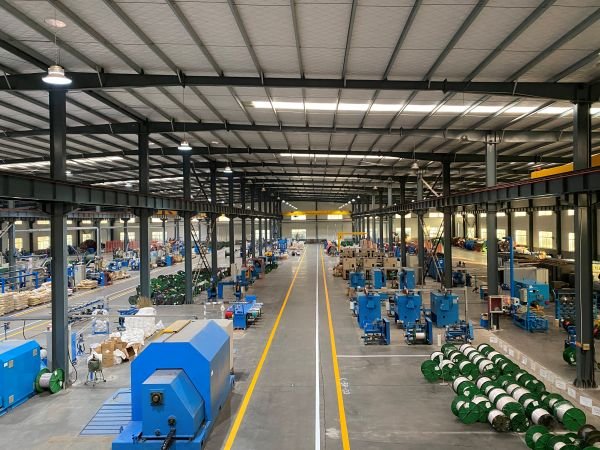
Every reel of industrial Ethernet cable is produced under controlled processes and released against the applicable EN 50288-2-2 and IEC 61156-6 requirements.
Tell us the axis duty, cable length, jacket colour and destination market.
We confirm conductor, shield, jacket, connector options and quotation within one working day.
Sample length for carrier or cable qualification — stocked sizes within a few working days.
7–15 working days lead time with batch test documentation.
Reel or coil packing to your length, shipping documents and after-sales support.
Tell us the bend radius, stroke and speed — we reply within one working day.
The more detail you give, the faster and more accurate our quotation. Our engineers reply within one working day.
Thanks — our engineers will reply within one working day.