Professional cable manufacturer

Professional cable manufacturer
Home » Products » Control & Instrumentation » Cat6A / Cat8 S/FTP Shielded Data Cable LSZH CPR Eca/Dca
Screened twisted-pair data cable with individual foil screening per pair plus an overall braid — one foil per pair, one braid overall — in an LSZH sheath, classified Eca or Dca to EN 13501-6 under CPR.
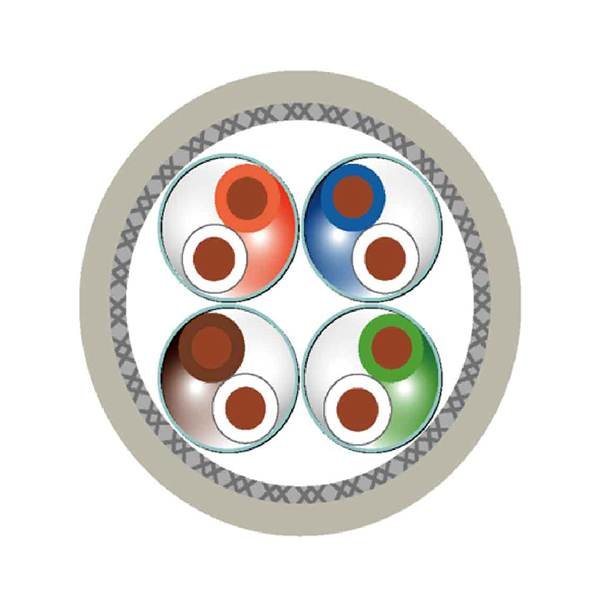
The category, the screening build and the fire class — the three things that decide whether this cable belongs in your installation.
This is a screened twisted-pair data cable for structured cabling, built on 23 AWG solid bare copper conductors in an LSZH sheath, and offered across three categories: Cat6A (ISO Class EA, 500 MHz), Cat8.1 (ISO Class I) and Cat8.2 (ISO Class II) — both specified up to 2000 MHz. The categories share a construction philosophy but not a test limit, and the tables below set out where each one applies.
The designation S/FTP is worth reading letter by letter, because it is often described loosely. S is the overall screen — a tinned copper braid over the assembled cable. F is a foil screen applied to each pair individually, so every pair carries its own electrostatic barrier. TP is twisted pair. That is two shield levels: one per pair, one overall. The per-pair foil is what keeps pair-to-pair coupling low at high frequency, and the overall braid is what protects the cable as a whole from external interference. Describing this build as “triple shielding” is simply wrong, and we do not use the phrase.
The practical consequence is an installation requirement rather than a sales point: the screen has to be bonded. A shield terminated at both ends to the equipotential bonding system, with a proper 360° gland or panel bond, does its job. A shield left floating does not — it behaves like an antenna and can make the interference situation worse than an unscreened cable. Single-ended termination is used only where the installation specification explicitly calls for it.
On the fire side, this cable is an LSZH construction: halogen-free to IEC 60754-1 and IEC 60754-2, tested for smoke emission to IEC 61034-1 / -2, flame retardant to IEC 60332-1-2, and classified Eca or Dca to EN 13501-6 under CPR (EU) 305/2011 with EN 50575 as the product standard and a Declaration of Performance issued for the construction supplied. Two things are routinely confused here and we keep them apart: the EN 13501-6 class is a building-products reaction-to-fire classification used for regulatory compliance, while IEC 60332-1-2 is a laboratory flame test on the cable itself. They are different regimes and neither replaces the other.
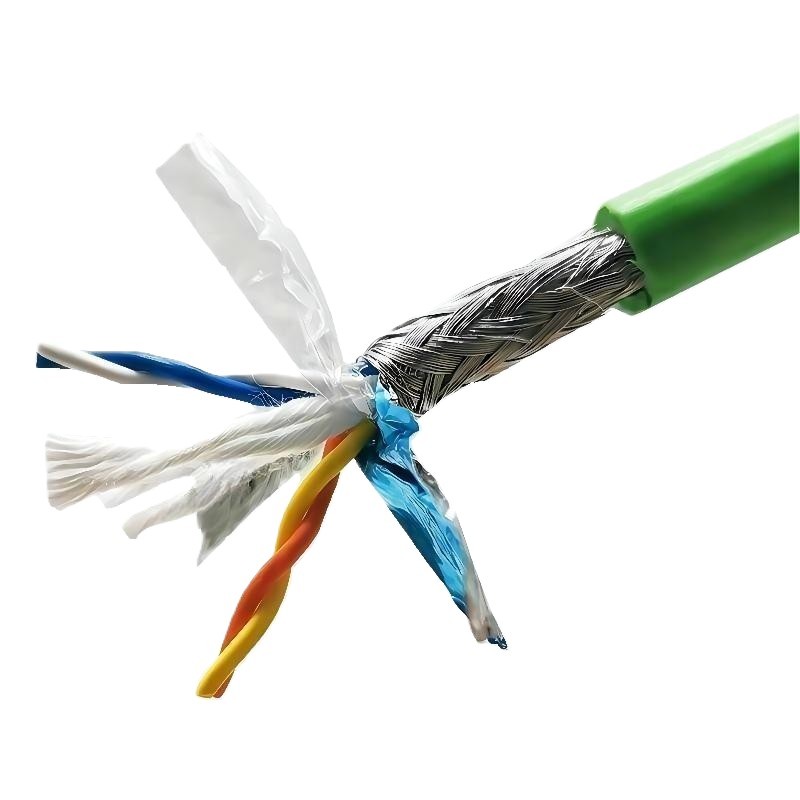
For an industrial drag-chain or continuously flexing variant, see the EtherCAT / PROFINET Industrial Ethernet Cable. For screened control wiring in the same plant, the CY Shielded Control Cable and the LSZH Control Cable cover the non-Ethernet side.
More about the manufacturer: About SORIVO →
The “F” in S/FTP: aluminium foil applied individually over each twisted pair, so each pair has its own electrostatic barrier. This is what holds pair-to-pair coupling down at high frequency.
The “S”: a tinned copper wire braid over the assembled pairs. Two shield levels in one cable, and both have to be bonded to work.
Solid 23 AWG (approx. 0.57 mm) bare copper conductors — the standard conductor for screened horizontal data cabling, not a stranded or plated substitute.
Low smoke, zero halogen. Halogen-free to IEC 60754-1 / -2 and tested for smoke emission to IEC 61034-1 / -2, which is what makes the cable suitable for occupied and critical spaces.
Classified to EN 13501-6 under CPR (EU) 305/2011, product standard EN 50575, with a Declaration of Performance for the construction supplied. Eca is the entry level; Dca is the next step up.
Cat6A is specified to 500 MHz — the ISO Class EA limit — and supports 10GBASE-T over a 100 m channel. We do not quote a higher “Cat6A” frequency than the standard allows.
Both are specified to 2000 MHz — the difference is the construction and the connector, not the frequency. Class I (Cat8.1) needs U/FTP or F/UTP as a minimum and keeps the 8P8C (RJ45) interface; Class II (Cat8.2) needs F/FTP or S/FTP and uses TERA, GG45 or ARJ45.
Suitable for IEEE 802.3af / at / bt transmission requirements. Current capacity and temperature rise in a bundle depend on the bundle size and ambient temperature, so they are calculated per installation rather than quoted as a number.
Routed where the cable shares space with power or machinery — the screening is bought for an environment, not for a datasheet.
Rack-to-rack and rack-to-panel links where Cat6A carries 10GBASE-T over 100 m and the fire class matters inside the building.
Horizontal and backbone runs in commercial buildings, installed to ISO/IEC 11801-1 and the applicable EN 50173 application standard.
Screened cabling near drives, inverters and switchgear, where per-pair foil is what preserves signal integrity at the frequency the protocol uses.
Wireless access points, cameras and other powered devices on IEEE 802.3af / at / bt, with bundle current capacity calculated for the installation.
Audio-over-IP and video-over-IP distribution where a screened, low-emission cable suits equipment rooms and public spaces.
LSZH construction with halogen and smoke references named, for areas where cable fire performance is part of the specification.
Horizontal cabling where the LSZH sheath and the CPR class are specified by the building designer rather than chosen by the installer.
Patch panels and top-of-rack runs where the foil-per-pair build keeps alien crosstalk down in tight bundles.
The complete parameter set — the same data our engineers quote from.
| Category | Frequency | Screening structure | Conductor | Applicable standards | Max. channel length |
|---|---|---|---|---|---|
| Cat6A | 500 MHz | S/FTP or F/UTP | 23 AWG solid bare copper | ISO/IEC 11801-1 (Class EA), IEC 61156-5 / -6, EN 50288-10-1 (screened) and EN 50288-11-1 (un-screened), ANSI/TIA-568.2-D | Up to 100 m |
| Cat8.1 | 2000 MHz (ISO Class I) | U/FTP or F/UTP minimum | 23 AWG solid bare copper | ISO/IEC 11801-1 (Class I); IEC 61156-9 / -10 | Short-reach channel — confirm to the Class I specification |
| Cat8.2 | 2000 MHz | F/FTP or S/FTP | 23 AWG solid bare copper; 22 AWG on some constructions | ISO/IEC 11801-1 (Class II); IEC 61156-9 / -10 | Short-reach channel — confirm to the Class II specification |
The three categories are not interchangeable, and two points are worth stating plainly. First, Cat8.1 (Class I) and Cat8.2 (Class II) are both specified up to 2000 MHz — IEC 61156-10 recognises Category 8.1 for Class I and Category 8.2 for Class II at the same 2000 MHz limit, so the choice is not “how fast” but which minimum construction and which connector system. What we do not do is print “Cat8 = 2000 MHz” beside an RJ45 claim as though the two always go together. Second, Cat8.1 and Cat8.2 are not the same connector system: Class I (Cat8.1) has a minimum cable design of U/FTP or F/UTP, keeps the 8P8C (RJ45) interface and is backward compatible with Class EA (Cat6A), while Class II (Cat8.2) requires F/FTP or S/FTP and uses TERA, GG45 or ARJ45, compatible with Class FA (Cat7A). Channel length depends on the class and on the patch cords used, so it is confirmed per project rather than quoted as one number here.
| Category & Transmission | |
| Category | Cat6A (ISO Class EA, 500 MHz) and Cat8.1 / Cat8.2 (ISO Class I / Class II) |
| Reference Standards | ISO/IEC 11801-1; EN 50173; IEC 61156-5 (horizontal cabling) and IEC 61156-6 (work area); EN 50288-10-1 (screened, 500 MHz) and EN 50288-11-1 (un-screened, 500 MHz) for Cat6A; IEC 61156-9 (channels) and IEC 61156-10 (work area cords) for Cat8.1 / Cat8.2; ANSI/TIA-568.2-D |
| Impedance | 100 Ω nominal; tolerance narrows at low frequency and widens with frequency — the tolerance and band are taken from the sectional specification of the category ordered |
| Max. DC Resistance | 9.5 Ω/100 m at 20 °C — manufacturer value, confirmed against the test report for the selected construction |
| Transmission Tests | Attenuation, NEXT, PS-NEXT, ACR and return loss measured across the category frequency band to the sectional specification above; test report available on request |
| Construction | |
| Conductor | 23 AWG (approx. 0.57 mm) solid bare copper |
| Insulation | Foamed PE (foamed / skin PE — the exact dielectric build is confirmed per construction) |
| Pair Screening (F) | Aluminium foil applied individually over each pair — one foil per pair, so each pair carries its own electrostatic screen |
| Overall Screening (S) | Tinned copper wire braid over the screened pairs — the second, outer screening layer |
| S/FTP Explained | S = overall braid screen; F = foil screen per pair; TP = twisted pairs. That is two shield levels, and it is how the designation is defined |
| Sheath | LSZH — low smoke, zero halogen |
| Core Identification | Colour-coded pairs to the category wiring scheme; the code for the ordered construction is confirmed on the drawing |
| Fire, Smoke & Halogen | |
| Reaction-to-Fire Class | Classified Eca or Dca to EN 13501-6 under CPR (EU) 305/2011; product standard EN 50575; a Declaration of Performance (DoP) is issued for the construction supplied |
| Eca vs Dca | Eca is the entry level of the CPR classes for cables; Dca is the next step up, with stricter criteria on heat release, flame spread and flaming droplets |
| Flame Retardance | IEC 60332-1-2 / EN 60332-1-2 vertical flame propagation on a single cable. This is a cable flame test and is not the same regime as the EN 13501-6 building-products classification |
| Halogen Content | Halogen-free to IEC 60754-1 and IEC 60754-2 |
| Smoke Emission | Tested to IEC 61034-1 / IEC 61034-2 |
| Installation & Environment | |
| Operating Temperature | −20 °C to +60 °C for fixed installation — manufacturer value for the ordered jacket compound |
| Minimum Bend Radius | Confirmed against the construction drawing for the ordered jacket and category |
| Screening & Earthing | The screen must be bonded at both ends to the equipotential bonding system (360° termination), or single-ended only where the installation specification explicitly requires it. A floating screen is not an acceptable installation — it acts as an antenna and degrades the very immunity the S/FTP build is bought for |
| PoE Readiness | Suitable for IEEE 802.3af (PoE), IEEE 802.3at (PoE+) and IEEE 802.3bt (PoE++) transmission requirements. Current-carrying capacity and temperature rise in a bundle or conduit depend on how many cables are bundled and on the ambient temperature, so they are calculated per installation rather than quoted as a single figure |
| Installation Note | Indoor / data-hall LSZH construction. For outdoor routes select a UV-stabilised sheath construction; this page does not cover an outdoor variant |
| Configuration & Logistics | |
| Standard Lengths | 305 m (1000 ft) / 500 m / 1000 m per reel; custom lengths available |
| Packaging | Wooden drum / cardboard box / plastic reel |
| Jacket Colour | Specified on order; the standard stock colours are confirmed with the quotation |
| MOQ | 1 reel (sample length negotiable) |
| Lead Time | 7–15 working days |
Two notes apply to the whole table. The 9.5 Ω/100 m DC resistance figure is a manufacturer value and is confirmed against the test report for the construction supplied. The PoE statement means the cable meets the transmission requirements of IEEE 802.3af / at / bt; it is not a current rating, because the current a bundled cable can carry depends on bundle size, spacing and ambient temperature and has to be calculated for the installation.
Built and tested to ISO/IEC 11801-1 and the applicable cable standards — IEC 61156-5 / -6 and EN 50288-10-1 / EN 50288-11-1 for Cat6A, and IEC 61156-9 / -10 for Cat8.1 and Cat8.2 — with attenuation, NEXT, PS-NEXT, ACR and return loss measured across the category frequency band. Test report available on request.
Request test report →Reaction-to-fire class declared to EN 13501-6 under CPR (EU) 305/2011, with EN 50575 as the product standard and a Declaration of Performance issued for the construction supplied. We write “classified Eca / Dca to EN 13501-6”, not “CPR certified”.
Request DoP →Halogen-free to IEC 60754-1 and IEC 60754-2, smoke emission tested to IEC 61034-1 / -2, and flame retardant to IEC 60332-1-2 — named as test standards rather than summarised as “fire rated”.
Request documentation →
Category claims are easy to exaggerate and hard to verify. These are the checks that make ours verifiable.
Tell us the category you need (Cat6A, Cat8.1 or Cat8.2), the sheath colour, the reel length and the quantity — and where the run sits relative to power cabling, since that is what decides whether the screening build is the right choice.
We confirm the category, the construction and the fire class against the standard, and send the quotation with the applicable Declaration of Performance, test data and drum schedule within one working day.
Sample for qualification — stocked configurations within a few working days.
7–15 working days from order confirmation. Lengths above the standard reel sizes, and non-standard sheath colours, are scheduled per order.
Drum and reel packing, shipping documents, and support through cabling qualification — including construction drawings, test data and guidance on screen bonding and bundle current capacity.
Send the category, sheath colour and the channel arrangement and we will arrange a sample plus the transmission test data.
Tell us the category, the class and the route conditions, and we will come back within one working day with price, availability and documentation.
Thanks — our engineers will reply within one working day.