Professional cable manufacturer

Professional cable manufacturer
Home » Products » Control & Instrumentation » Flat Elevator Traveling Cable TVVB Steel Rope Reinforced
Flat PVC-insulated traveling cable for the moving loop between the elevator car and the machine room or controller — reinforced with a 6×19+IWS galvanised steel rope so long hoistway loops hang on steel, not on copper.
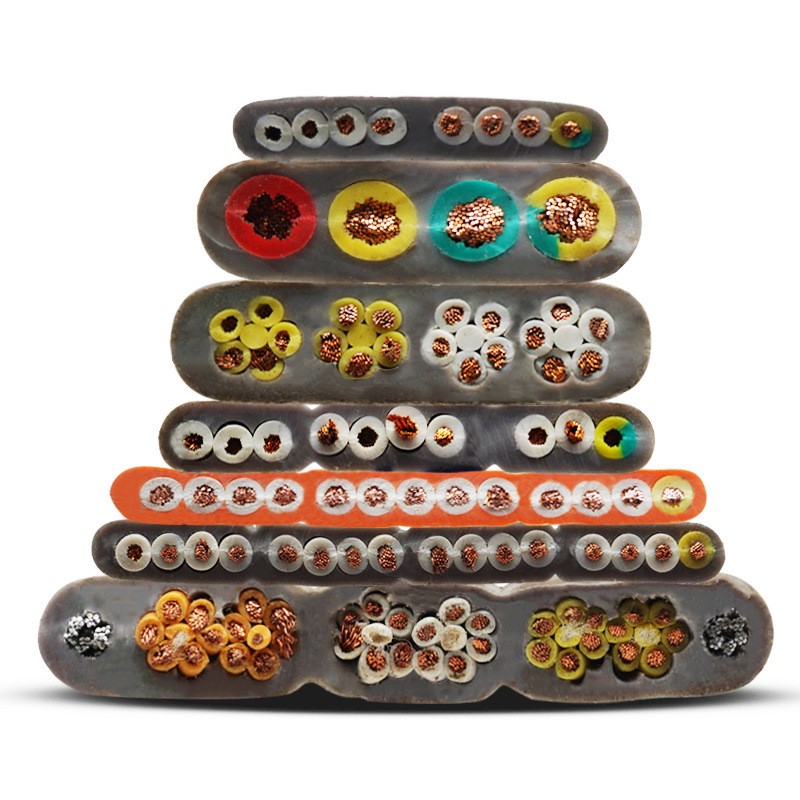
What a lift engineer checks first on a traveling cable — before reading the full specification below.
The TVVB is a flat, flexible PVC-insulated and PVC-sheathed traveling cable that hangs in the hoistway and moves with the elevator car. It is specified to GB/T 5023.6-2006, the Chinese lift-cable standard that is identical (IDT) to IEC 60227-6:2001. Sizes of 1 mm² and below also fall under JB/T 8734.6-2016, and the European equivalent standard is EN 50214:2024, whose type designations are H05VVH6-F and H07VVH6-F.
The steel-rope-reinforced version — written TVVBG or TVVB(G) — carries a 6×19+IWS galvanised steel rope of 4.0+0.4 mm nominal diameter with a minimum breaking force of 12.4 kN laid into the flat section alongside the cores. The rope takes the weight of the hanging loop, which is what allows the cable to travel long distances without stretching the copper. The letter G stands for that steel load-bearing element; it is not a ground conductor.
Cores are fine-stranded bare copper, Class 5 to IEC 60228 / VDE 0295. Two arrangements are produced: a parallel, one-row layout from 2 to 24 cores, and a quincunx laid-up layout from 12 to 66 cores, which is the usual choice above 24 cores because it keeps the flat section compact. At 0.75 mm² the maximum DC conductor resistance is 26.0 Ω/km at 20°C, matching the IEC 60228 Class 5 maximum.
Rated voltage follows the core size: 300/500 V up to 1 mm² and 450/750 V above 1 mm², with a 2 500 V test voltage. The maximum continuous conductor temperature is +70°C (160°C for 5 seconds under short circuit), the mobile-installation ambient range is −15°C to +70°C, and the cable is not normally installed below 0°C. Without a load-bearing element the published limits are ≤35 m at ≤1.6 m/s in parallel layout and ≤80 m at ≤4 m/s in quincunx layout; with the steel rope the loop can exceed 80 m and run at up to 10 m/s.
More about the manufacturer: About SORIVO →
Specified to the Chinese lift-cable standard, which is identical (IDT) to IEC 60227-6:2001; sizes of 1 mm² and below also meet JB/T 8734.6-2016.
A galvanised steel rope of 4.0+0.4 mm nominal diameter with 12.4 kN minimum breaking force and <1.0% elongation is laid into the flat section to carry the hanging loop.
4.6 mm thick in parallel layout and 9.0 mm in quincunx layout, so the cable fits the narrow gap between the car and the shaft wall without a cable chain.
Bare copper to IEC 60228 / VDE 0295 Class 5 — 30/0.18 mm at 0.75 mm² and 32/0.20 mm at 1.0 mm² — so the cores keep flexing around the sheave instead of work-hardening.
Parallel layout from 2 to 24 cores, quincunx layout from 12 to 66 cores, 0.75 mm² standard and up to 25 mm² in the 450/750 V sizes; shielded and video versions available.
≤35 m at ≤1.6 m/s parallel and ≤80 m at ≤4 m/s quincunx without a load-bearing element; with the steel rope, beyond 80 m at up to 10 m/s.
Flame propagation to IEC 60332-1-2 / EN 60332-1-2, oil resistance to EN 60811-2-1, water jets AD5 and impact AG2 for dirty, wet shafts.
WDZ-TVVB and WDZ-TVVBG variants use an LSOH sheath for halogen-free, low-smoke installations such as metro, airport and hospital shafts.
Anywhere a flat cable has to follow a moving carriage — not only in lifts.
The car-to-controller mobile loop in passenger and freight elevators, hanging freely in the hoistway.
Bed lifts, dumbwaiters and service elevators where long cables handle many short, frequent trips.
Glass shafts, atriums and scenic lifts where the loop is long, visible and continuously exposed.
Builder's lifts and site hoists working in dust, grit and weather, where sheath toughness decides service life.
Travelling cranes, plating cranes, trolleys and flaw-detection carriages with repeated back-and-forth motion.
Transfer machines, automated production lines and warehouse handling equipment with moving carriages.
Cold-store, explosion-proof, mine, ship and vehicle lifts — the variants where the sheath compound is specified separately.
Car and landing door operators, plus festoon and drag-chain runs where the cable is guided and bent repeatedly.
The complete parameter set — with the steel-rope-reinforced dimensions, not the plain TVVB figures.
| Core count × mm² | Flat width mm | Thickness mm | Approx. weight kg/km |
|---|---|---|---|
| 24 × 0.75 | 40.9 | 9.0 | 651 |
| 36 × 0.75 | 52.6 | 9.0 | 878 |
| 48 × 0.75 | 65.9 | 9.0 | 1125 |
| 54 × 0.75 | 72.1 | 9.0 | 1233 |
| 66 × 0.75 | 84.4 | 9.0 | 1447 |
The 24 × 0.75 mm² row is highlighted — it is the size this page is usually quoted on. Width, thickness and weight are the steel-rope-reinforced (TVVBG) values published by one manufacturer and are given here from that single source so the figures are consistent; intermediate core counts and other arrangements are produced on request. The same construction without the steel rope is smaller and lighter — for the 24 × 0.75 mm² quincunx size, 31.9 mm and 505 kg/km against 40.9 mm and 651 kg/km here — so a plain TVVB dimension table must never be used for a reinforced cable.
| Core count × mm² | Flat width mm | Thickness mm | Approx. weight kg/km |
|---|---|---|---|
| 2 × 0.75 | 13.5 | 4.6 | 112 |
| 6 × 0.75 | 23.9 | 4.6 | 198 |
| 12 × 0.75 | 39.0 | 4.6 | 324 |
| 24 × 0.75 | 70.9 | 4.6 | 591 |
The parallel layout keeps the cable thin but grows quickly in width — 24 cores in one row is 70.9 mm wide against 40.9 mm in the quincunx layout. Above about 24 cores the quincunx layout is normally specified.
| Nominal cross-section mm² | Conductor construction no. × Ø mm | Max. DC resistance at 20°C, Ω/km |
|---|---|---|
| 0.75 | 30 / 0.18 | 26.0 |
| 1.0 | 32 / 0.20 | 19.5 |
| 1.5 | 48 / 0.20 | 13.3 |
| 2.5 | 47 / 0.26 | 7.98 |
| 4 | 77 / 0.26 | 4.95 |
| 6 | 112 / 0.26 | 3.30 |
| 10 | 182 / 0.26 | 1.91 |
| 16 | 301 / 0.26 | 1.21 |
| 25 | 456 / 0.26 | 0.78 |
The 0.75 mm² row is highlighted. Construction and resistance are the manufacturer's published TVVB values and agree step for step with the IEC 60228 / GB/T 3956 Class 5 maxima for each size, which is the cross-check that fixes the conductor class.
| General Information | |
| Product Name | Flat elevator traveling cable, TVVBG / TVVB(G) — flat PVC insulated and sheathed, steel rope reinforced |
| Primary Standard | GB/T 5023.6-2006 — lift cables and cables for flexible connections (identical, IDT, to IEC 60227-6:2001) |
| Further Standards | JB/T 8734.6-2016 for the 300/500 V sizes; European equivalent EN 50214:2024 (H05VVH6-F / H07VVH6-F) |
| Rated Voltage | 300/500 V for cores up to 1 mm²; 450/750 V above 1 mm² |
| Test Voltage | 2 500 V; 3 000 V for the European H07VVH6-F equivalent |
| Core Count | 2–24 cores in the parallel layout; 12–66 cores in the quincunx laid-up layout |
| Cross Sections | 0.75 mm² standard for the steel-rope-reinforced construction; 0.5–2.5 mm² parallel and 0.5–0.75 mm² quincunx across the family; 450/750 V sizes up to 25 mm² |
| Arrangement | Parallel (one-row) or quincunx ("plum-blossom") laid-up |
| Sheath Colour | Grey RAL 7001 or black RAL 9005; European flat cables of this type are commonly black |
| Conductor | |
| Conductor Material | Bare copper, fine stranded |
| Conductor Class | Class 5 to IEC 60228 / VDE 0295; the European H07VVH6-F equivalent uses Class 6 from 1.5 mm² and returns to Class 5 from 10 mm² |
| Conductor Construction | 0.75 mm²: 30/0.18 mm; 1.0 mm²: 32/0.20 mm — full table in Table 3 |
| Max. DC Resistance | 0.75 mm²: 26.0 Ω/km at 20°C (all sizes in Table 3) |
| Steel Rope Reinforcement | |
| Load-Bearing Element | High-strength galvanised aviation steel rope, 6×19+IWS, laid into the flat section — the "G" in TVVBG (not a ground conductor) |
| Rope Nominal Diameter | 4.0 + 0.4 mm, with a non-loosening diameter increase below 0.43 mm |
| Min. Breaking Force | 12.4 kN for the rope, with elongation below 1.0% |
| Rope Lay & Coating | Right-hand alternate lay with the centre strand opposed to the outer strands; galvanised layer 15–25 g/m² |
| Insulation & Sheath | |
| Insulation | PVC, colour-coded; European construction uses PVC type TI2 to EN 50363-3 |
| Sheath / Jacket | Flexible PVC; European construction uses PVC type TM2 to EN 50363-4-1 |
| Bedding / Inner Sheath | None |
| Core Identification (China) | Five-colour code to GB/T 5023.6 — yellow, white, orange, light green and pink — plus numeric marking; no green/yellow earth core |
| Core Identification (Europe) | HD 308 / EN 50334 — 4 cores brown / black / grey / green-yellow, 6 cores and above black with white numbers; VDE 0293-308 in the LAPP construction |
| Ripcord | Available in the European construction, to open the sheath without nicking the cores |
| Mechanical Ratings | |
| Free Suspension Length | ≤35 m parallel and ≤80 m quincunx without a load-bearing element; beyond 80 m with the steel rope |
| Travel Speed | ≤1.6 m/s parallel; ≤4 m/s quincunx; up to 10 m/s with the steel rope |
| Min. Bending Radius | 4 × thickness fixed, 5 × thickness free movement, 10 × thickness over pulleys and in festoon use; alternatively ≥4D for D ≤25 mm and ≥6D for D >25 mm, or not less than 6 × the smaller side of the flat section |
| Installation | Free suspension only; overlaying (stacking) cables on top of each other is not recommended |
| Temperature & Environment | |
| Max. Conductor Temperature | +70°C continuous |
| Max. Short-Circuit Temperature | +160°C for a maximum of 5 seconds |
| Ambient — Mobile Installation | −15°C to +70°C |
| Ambient — Fixed Installation | −30°C to +70°C |
| Min. Installation Temperature | 0°C — the cable is not normally installed below 0°C |
| Cold Flexibility | Dedicated cold-flexible PVC sheath remains flexible down to −15°C |
| Flame Performance | IEC 60332-1-2 / EN 60332-1-2; GB/T 18380.1 (referenced by GB/T 5023.6-2006) or GB/T 18380.12-2008 (referenced by JB/T 8734.6-2016) |
| Oil Resistance | EN 60811-2-1 |
| Water Resistance | AD5 — water jets from any direction |
| Impact Resistance | AG2 — medium severity |
| UV Resistance | Good; long-term discolouration of the sheath is possible |
| Halogen Content (PVC) | Low halogen emission, chlorine content below 15% |
| Halogen-Free Variant | WDZ-TVVB / WDZ-TVVBG with LSOH sheath — halogen-free, low smoke, flame retardant to IEC 60332-1 |
| RoHS | Free of harmful substances to RoHS II, Directive 2011/65/EU and Delegated Directive (EU) 2015/863 |
| Packaging & Logistics | |
| Packaging | Wooden drum / coil |
| Standard Length | 50 m / 100 m per coil, customizable |
| MOQ | 100 m, sample negotiable |
| Lead Time | 7–15 working days |
Where sources differ, this page states the majority figure and notes the alternative: the 300/500 V / 450/750 V split is published as 1 mm² by four sources and as 1.5 mm² by one; the parallel-layout suspension limit is published as 35 m and 1.6 m/s by three sources and as 40 m and 2 m/s by one. A Chinese elevator-industry draft standard for traveling cables proposes a maximum free suspension length of 300 m. Final selection depends on travel height, speed, sheave diameter, number of starts per hour and the local lift code — send us the duty and we will confirm the construction, the rope and the core count.
The standard this construction is specified to and the identical IEC basis behind it. Declaration of conformity for the delivered construction available on request.
Request declaration of conformity →The European flat flexible cable standard for lifts and hoists. European type designations are H05VVH6-F up to 1 mm² and H07VVH6-F from 1.5 mm².
Request EN 50214 documents →IEC 60332-1-2 / EN 60332-1-2 flame propagation, EN 60811-2-1 oil resistance, AD5 water jets and AG2 impact — the performance set specified for wet, dirty hoistways.
Request test report →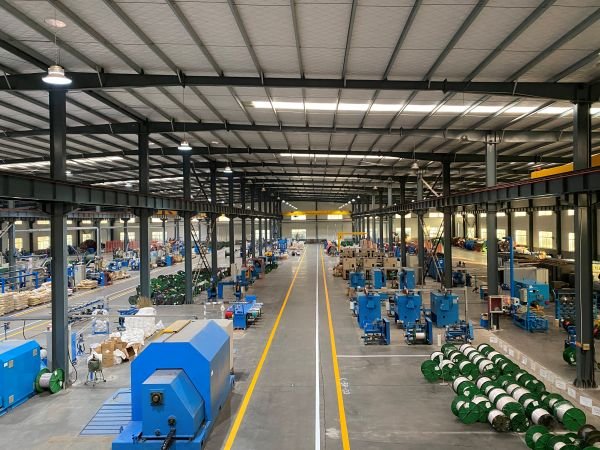
Every drum of traveling cable is produced under controlled processes and released against the applicable GB/T 5023.6-2006 requirements.
Tell us core count, cross-section, arrangement, suspension height and destination market.
We confirm the flat dimensions, the steel rope, core identification and quotation within one working day.
Sample for lift qualification — standard sizes within a few working days.
7–15 working days lead time with batch test documentation.
Wooden drum or coil packing to your length, shipping documents and after-sales support.
Tell us the core count, cross-section and suspension height — we reply within one working day.
The more detail you give, the faster and more accurate our quotation. Our engineers reply within one working day.
Thanks — our engineers will reply within one working day.