Professional cable manufacturer

Professional cable manufacturer
Home » Products » EV Charging Cable » Type 2 to Type 2 EV Charging Cable 22kW 32A 3-Phase
Type 2 plug to Type 2 plug Mode 3 charging cable for 22 kW three-phase public and workplace charging — 32 A, 220 Ω coding at both ends, halogen-free TPU jacket.
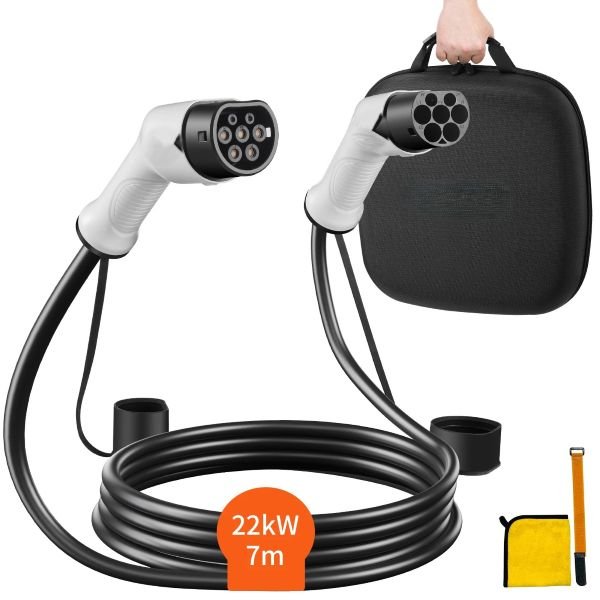
What a driver or fleet buyer checks first on a Type 2 to Type 2 cable — before reading the full specification below.
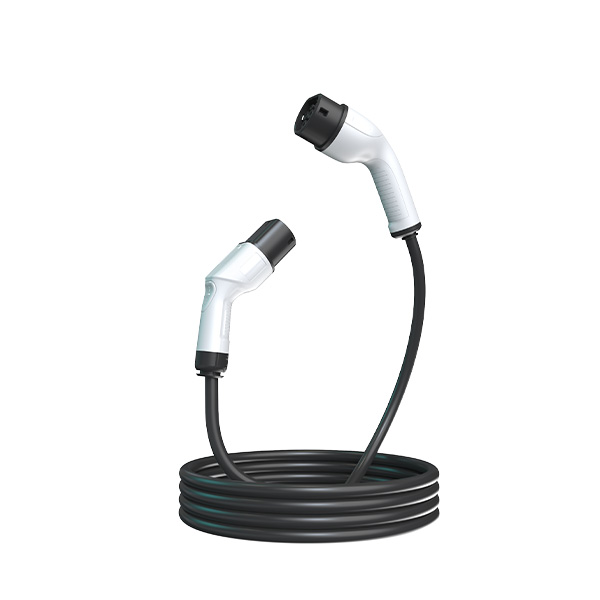
This is a plug-to-plug Type 2 cable — the cable a driver keeps in the car and uses at a public or workplace charge point that has a socket rather than a tethered lead. Both ends are Type 2 (Mennekes) connectors to IEC 62196-2, the cable is rated 32 A, and it delivers 22 kW on three-phase 400 V or 7.4 kW on single-phase 230 V. In the language of IEC 61851-1 this is a Mode 3, Case B assembly: charging from a dedicated charge point, with a cable that is not permanently attached to it.
Because the driver plugs it in by hand several times a day, the practical qualities matter as much as the current. The jacket is a halogen-free TPU compound that stays flexible down to about −35 °C (manufacturer-declared), so the cable does not fight the driver in a winter car park, and the mated assembly is declared IP54. That declaration covers the mated connector pair, and it is confirmed against the test report for the selected construction rather than assumed from the standard — IEC 62196-1’s own IP requirements are not something we cite without the test behind them. A higher mated rating is quoted only on the strength of a type-test report on the specific connector version.
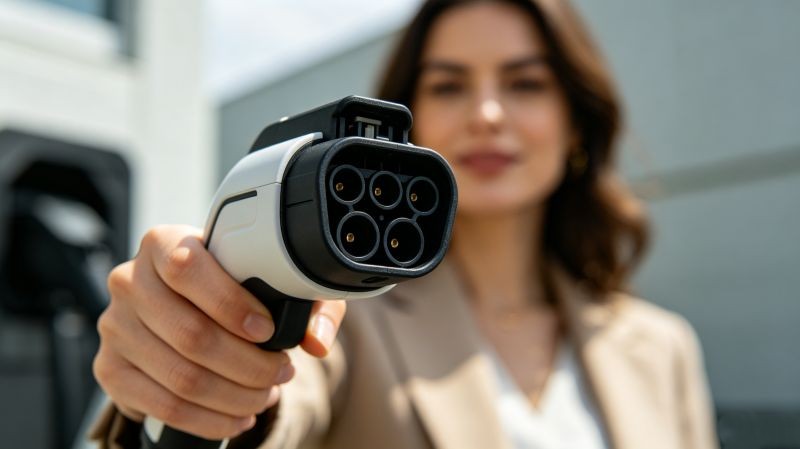
The electrical side is the standard Type 2 arrangement of seven contacts: L1, L2, L3, N and PE for power, plus CP for control pilot and electrical locking and PP for cable coding. A 220 Ω resistor is fitted between PP and PE at each end — the 32 A step of the IEC coding scale (1500 Ω = 13 A, 680 Ω = 20 A, 220 Ω = 32 A, 100 Ω = 63 A). The resistor belongs at both ends: with only one fitted, the charge point may refuse to start. Measuring between the two PP contacts reads about twice the single-end value, which is normal.
The power cores are 5 × 6.0 mm² flexible Class 5 copper to IEC 60228, with a 1 × 0.5 mm² signal core, in a construction manufactured to EN 50620 with IEC 62893-3 covering AC charging cables. Ambient range is −30 °C to +50 °C, the range IEC 62196-1 specifies. A coiled version is available for drivers who want the cable to stay tidy in the boot, and custom lengths, jacket colours and branding are made to order.
For a tethered cable on a charge point or a general Type 2 assembly, see our Type 2 32A IEC 62196 EV Charging Cable. If your vehicle uses the Chinese-standard connector and you are charging from a Type 2 point, the Type 2 to GB/T Cable is the adapter lead for that case.
More about the manufacturer: About SORIVO →
Two IEC 62196-2 Type 2 connectors, so the cable plugs into any standard Type 2 socket on a public or workplace charge point.
32 A on a 400 V three-phase supply and 7.4 kW single-phase — the two ratings European AC charging is built around.
The 32 A coding step fitted at each end, so the charge point reads the cable correctly whichever connector is inserted first.
A TPU jacket that stays workable in winter conditions, where a stiff cable is left on the ground and driven over.
Declared IP54 protection for the mated connector pair, confirmed against the test report rather than quoted as a standard requirement.
Abrasion-resistant and halogen-free, with UV stabilisation for cables that live on a hook in the open.
Flexible Class 5 copper to IEC 60228 with a 1 × 0.5 mm² signal core, sized for continuous 32 A operation.
Straight assemblies for wall-mounted use and coiled versions for drivers who want the cable stored compactly in the boot.
Public sockets, shared bays and workplace charging — anywhere a driver supplies their own cable.
Untethered destination charging in car parks and on-street posts, where the driver brings the cable.
Staff charging points with Type 2 sockets, used by vehicles with different cable preferences.
Hospitality sites that provide a socket instead of a tethered lead, avoiding cable wear from misuse.
A cable issued with the vehicle so it charges wherever it is parked, not only at base.
Communal bays where a permanently attached cable would be a liability rather than a convenience.
A cable that travels with demonstrator cars and can be used on any available Type 2 socket.
Northern car parks and mountain locations, where the −35 °C cold-flexibility figure is the deciding property.
Private-label supply of a high-turnover accessory, with branding and packaging options.
The complete parameter set — the same data our engineers quote from.
| Contact | Function | Rating | |
|---|---|---|---|
| L1 | Phase conductor 1 | 480 V AC / 32 A | |
| L2 | Phase conductor 2 | 480 V AC / 32 A | |
| L3 | Phase conductor 3 | 480 V AC / 32 A | |
| N | Neutral | 480 V AC / 32 A | |
| PE | Protective earth | Rated for the prospective fault current | |
| CP | Control pilot — charging control and, on Type 2, electrical locking | 30 V / 2 A | |
| PP | Proximity pilot — cable current coding | 30 V / 2 A |
Both ends carry the same seven-contact arrangement, so the table applies to either connector. The PP coding resistor described in Table 2 is fitted at each end — with only one fitted, a charge point may not start the session. The CP contact carries the control pilot signal and also provides the electrical locking that stops the plug being withdrawn under load.
| General Information | |
| Product Name | Type 2 to Type 2 EV Charging Cable 22kW 32A 3-Phase |
| Connector Type | Type 2 plug to Type 2 plug (Mennekes type) |
| Connector Standard | IEC 62196-2 — designed and constructed to the connector standard |
| General Standard | IEC 62196-1:2014; connector tested to IEC 62196-1:2014 and IEC 62196-2:2016 |
| Cable Standard | Manufactured to EN 50620; IEC 62893-3 for AC charging cables, IEC 62893-1 for general requirements |
| Charging Mode | Mode 3, Case B per IEC 61851-1 — charging from a dedicated charge point with a cable that is not fixed to it |
| Electrical Ratings | |
| Rated Current | 32 A |
| Rated Voltage | 480 V AC three-phase / 250 V AC single-phase (IEC 62196-1 basic interface); 400 V AC line-to-line and 230 V AC line-to-neutral system voltages |
| Rated Power | 22 kW three-phase; 7.4 kW single-phase |
| Contacts | 7 per end — L1, L2, L3, N, PE, CP, PP |
| PP Coding Resistor | 220 Ω at each end — the 32 A step (1500 Ω = 13 A, 680 Ω = 20 A, 220 Ω = 32 A, 100 Ω = 63 A) |
| Insulation Resistance | ≥ 500 MΩ at 500 V DC (manufacturer test value, confirmed against the test report for the selected construction) |
| Dielectric Withstand | 2000 V AC, 1 minute (manufacturer routine test value) |
| Contact Resistance | ≤ 0.5 mΩ (manufacturer test value) |
| Temperature Rise | ≤ 50 K (manufacturer test value) |
| Construction | |
| Cable Construction | 5 × 6.0 mm² power cores plus 1 × 0.5 mm² signal core |
| Conductor | Flexible stranded copper, Class 5 to IEC 60228 |
| Jacket | TPU, halogen-free, UV-stabilised |
| Jacket Colour | Black standard; other colours to order |
| Cable Form | Straight; coiled version available |
| Contact Material | Copper alloy with silver plating |
| Flame Performance | Flame-retardant housing; VW-1 is a vertical wire flame test and is a separate regime from the UL 94 plastics classification, so the two are quoted as separate properties |
| Mechanical Life | ≥ 10,000 mating cycles (manufacturer test value; the industry convention for Mode 3 connectors) |
| Impact Protection | IK10 on the connector housing (manufacturer test value) |
| Environment | |
| Ambient Temperature | −30 °C to +50 °C — the range specified in IEC 62196-1 |
| Cold Flexibility | Down to about −35 °C (manufacturer-declared; the TPU jacket remains flexible at this temperature) |
| Ingress Protection (Mated) | IP54 mated, manufacturer-declared; confirmed against the test report for the selected construction. A higher mated rating such as IP65 or IP67 requires a type-test report on the specific connector version and is quoted on request. |
| Operating Humidity | 5 % to 95 % RH, non-condensing |
| UV Resistance | UV-stabilised jacket compound |
| Configuration & Logistics | |
| Standard Length | 5 m; 3 m and 7 m to order |
| Cable Form | Straight or coiled |
| Customization | Length, jacket colour, connector colour, logo and packaging |
| Packaging | Carton with foam insert, mesh bag or custom packaging |
| MOQ | 100 pieces; sample orders negotiable |
| Lead Time | 15–30 working days (stocked configurations within 3–7 days) |
Ingress protection, cold flexibility, impact rating and the electrical test values are manufacturer-declared figures and are confirmed against the test report for the selected cable; standard-based values are limited to the IEC 62196-1 basic interface ratings and the −30 °C to +50 °C ambient range, which IEC 62196-1 does specify. Final selection should be based on the charge point rating, how the cable is stored and the applicable local requirements.
Type 2 (Mennekes) is the European AC charging interface defined in IEC 62196-2 as an implementation of the IEC 62196-1 basic interface. Designed and constructed to IEC 62196-2, with the connector tested to IEC 62196-1:2014 and IEC 62196-2:2016 — the connector standard is a dimensional and interchangeability standard, so it is a design and test reference rather than a certification mark.
Request test report →The cable standard for EV charging cables: manufactured to EN 50620, the European charging-cable standard, with IEC 62893-3 covering AC charging cables. Cable and conductor test records are provided with the quotation.
Request test report →CE marking for the complete cable assembly is a manufacturer’s declaration of conformity, not third-party certification. The declaration covers the applicable directives for the assembly supplied and is provided with the shipment.
Request declaration copy →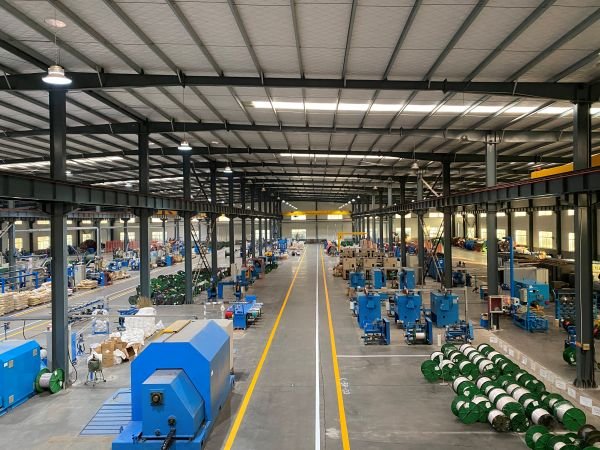
A plug-to-plug cable is handled far more than a tethered one, so the release checks cover the coding resistors and locking as well as the cable.
Tell us the length, the form (straight or coiled), the colour and the quantity.
We confirm connector variants, cable construction and quotation within one working day.
Sample for qualification — stocked configurations within a few working days.
15–30 working days with test documentation; stocked configurations within 3–7 days.
Carton packing, shipping documents and support through installation and distributor qualification.
Tell us the length, form and colour — we reply within one working day.
The more detail you give, the faster and more accurate our quotation. Our engineers reply within one working day.
Thanks — our engineers will reply within one working day.