Professional cable manufacturer
Professional cable manufacturer
Every week, we receive RFQs that list "XLPE cable" and "LSZH cable" as if they are two mutually exclusive product categories. Some procurement lists even ask for a "quote for both types, we'll decide later" — unaware that many modern cable standards, including BS 6724 and IEC 60502-1, specify both in a single cable construction.
This confusion is understandable but expensive. If you treat XLPE and LSZH as competing alternatives, you risk:
This article clears up the confusion once and for all: XLPE and LSZH are not the same thing, they are not alternatives to each other, and they are frequently used together in the same cable. By the end, you will know exactly what each term means, which standards reference them, and how to specify the correct combination for your project.
To understand the difference, you first need to see a cable as a layered product. Each layer serves a distinct purpose:
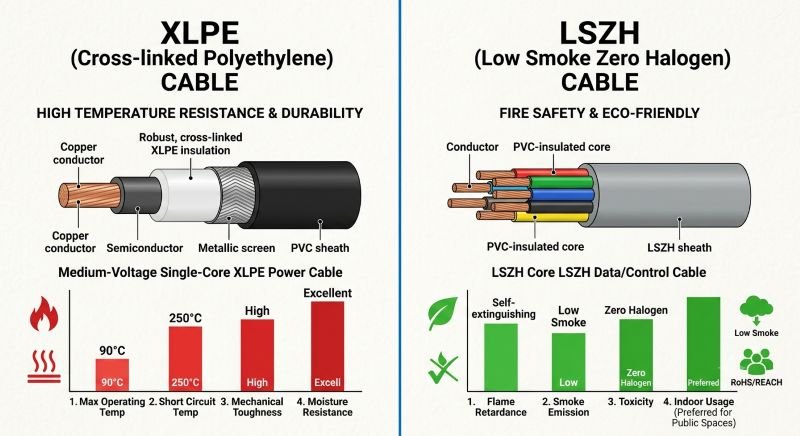
XLPE most commonly describes the cable's insulation material, while LSZH is commonly used to describe low-smoke, halogen-free insulation or sheathing compounds and cable constructions. In many power cables, LSZH refers specifically to the outer sheath.
XLPE is a thermoset polymer — polyethylene that has been chemically or physically cross-linked to form a three-dimensional molecular network. This cross-linking transforms the material from a thermoplastic (which melts when heated) into a thermoset (which retains its shape and insulating properties even at high temperatures).
| Property | XLPE Value | Why It Matters |
|---|---|---|
| Max continuous operating temperature | 90°C | 20°C higher than PVC — allows higher ampacity per conductor size |
| Short-circuit temperature | 250°C (max. 5 s) | For IEC 60502-1 cables, XLPE insulation is associated with a 90°C maximum conductor operating temperature and a 250°C maximum conductor temperature under short-circuit conditions of limited duration |
| Dielectric constant | 2.3–2.5 (typical) | Excellent insulation efficiency; low capacitance in long runs. Values vary by compound and manufacturer |
| Dielectric strength | High (typical for thermoset insulation) | Suitable from LV (0.6/1 kV) up to EHV (220 kV+). Exact value depends on compound formulation and test method |
| Tensile strength | Typical for cross-linked thermoset compounds | Robust against mechanical stress during installation. Exact value depends on compound formulation and applicable product standard |
| Density | ~0.92–0.93 g/cm³ (typical) | Lightweight compared to rubber or paper insulation. Values vary by compound |
| Halogen content | Zero (pure hydrocarbon) | Inherently halogen-free — but not certified to LSZH smoke density limits |
| Service life | Depends on cable design, operating temperature, installation and environment | XLPE-insulated power cables are widely used for long-life fixed installations; actual service life is not a material constant |
The cross-linking process is the key differentiator. Cross-linking changes polyethylene from a thermoplastic material into a thermoset network that retains its mechanical integrity at elevated temperatures. For cables designed to IEC 60502-1, XLPE insulation is associated with a 90°C maximum conductor operating temperature and a 250°C maximum conductor temperature under short-circuit conditions of limited duration (max. 5 seconds). XLPE is widely used in modern LV and MV power cables, particularly where a 90°C operating temperature and long-term thermal performance are required.
LSZH is not a single material. It is a performance classification applied to a family of compounds — typically polyolefin-based resins blended with inorganic flame-retardant fillers such as aluminium trihydroxide (ATH) or magnesium hydroxide (Mg(OH)&sub2;). These fillers release water vapour when heated, suppressing flames and diluting smoke without emitting halogen gases.
What distinguishes LSZH from standard sheath materials is its verified fire performance under tests commonly referenced in halogen-free cable specifications:
| Standard | Test | Typical Acceptance Criteria |
|---|---|---|
| IEC 60754-1 | Halogen acid gas content (test method) | A ≤0.5% HCl limit is commonly specified for halogen-free cable constructions, but the acceptance criterion comes from the applicable cable/product specification rather than from IEC 60754-1 alone |
| IEC 60754-2 | Corrosivity of combustion gases (test method) | Common acceptance criteria used in applicable halogen-free cable specifications include pH ≥ 4.3 and conductivity ≤ 10 μS/mm |
| IEC 61034 | Smoke density (test method) | Where no different limit is specified by the applicable cable standard, IEC 61034-2 recommends a minimum light transmittance of 60% |
| IEC 60332-1-2 | Single vertical flame propagation | Self-extinguishing within specified limits — a flame propagation test, not an LSZH definition criterion |
| IEC 60332-3 | Bunched cable flame spread (Cat A–D) | No flame spread beyond the test zone — a flame propagation test, not an LSZH definition criterion |
An LSZH sheath ensures that in a fire:
| Comparison Point | XLPE | LSZH |
|---|---|---|
| Cable layer | Most commonly the insulation (around conductor) | Most commonly the outer sheath; can also describe insulation or cable construction |
| Primary function | Electrical insulation, thermal performance, dielectric strength | Fire safety: low smoke, zero halogen, flame retardance |
| Material family | Cross-linked polyethylene (thermoset) | Polyolefin + ATH/Mg(OH)&sub2; fillers (thermoplastic or cross-linked) |
| Continuous temp. rating | 90°C (typical per IEC 60502-1) | Product- and compound-specific; refer to cable datasheet |
| Short-circuit temp. | 250°C (max. 5 s, per IEC 60502-1) | N/A (sheath is not rated for short-circuit) |
| Smoke emission in fire | Moderate | Very low (typically ≥60% transmittance per IEC 61034-2, where specified) |
| Halogen content | Zero (inherent, but not certified) | Zero (typically ≤0.5% HCl where specified) |
| Mechanical strength | High (varies by compound and standard) | Moderate (stiffer due to mineral fillers) |
| UV resistance | Good (with carbon black additive) | Moderate (requires UV-stabilised grade) |
| Flexibility | Good | Moderate (stiffer in cold temperatures) |
| Relative cost (material) | Medium | Medium–High |
| Typical standard reference | IEC 60502-1, BS 5467, BS 6622 | IEC 60754, IEC 61034, IEC 60332 |
The bottom line: Comparing "XLPE vs LSZH" is like comparing "engine performance vs brake safety" in a car. They serve different functions and the best solution uses both where required.
Understanding the applicable standards is the most reliable way to distinguish between materials and sheath classifications in real-world procurement.
These two UK standards are the clearest illustration of the XLPE/LSZH relationship:
| Standard | Typical Insulation | Typical Sheath | Armour | Typical Application |
|---|---|---|---|---|
| BS 5467 | XLPE (GP8 per BS 7655) | PVC (Type 3051) | SWA or AWA | General industrial, buried, indoor dry areas |
| BS 6724 | XLPE (GP8 per BS 7655) | LSZH (LTS1 per BS 7655) | SWA or AWA | Tunnels, public buildings, data centres, metro |
Both standards cover thermosetting-insulated armoured cables at 600/1000 V and 1900/3300 V. In common 0.6/1 kV copper SWA constructions, BS 5467 and BS 6724 can share similar conductor, XLPE insulation and armour arrangements, while BS 6724 additionally specifies low-smoke and low-corrosive-gas performance requirements when affected by fire. However, the exact construction should be verified against the applicable edition and product design rather than assuming the two standards are identical apart from the sheath.
| Standard | Scope | XLPE Role | LSZH Role |
|---|---|---|---|
| IEC 60502-1 | LV power cables (0.6/1 kV) | One common thermosetting insulation option; typically 90°C conductor rating | LSZH sheath is an option; PVC is the default |
| IEC 60502-2 | MV power cables (6–30 kV) | Standard insulation material | LSZH sheath available as fire-safety option |
| EN 50618 | Solar PV cables (1.5 kV DC) | H1Z2Z2-K uses XLPO (similar to XLPE) | For cables specified to EN 50618, the insulation and sheath are required to be cross-linked and low-smoke halogen-free |
| BS 8573 | 600/1000 V non-armoured thermosetting-insulated cables with reduced smoke/corrosive emissions | XLPE insulation | LSZH inner and outer sheath |
| BS 7846 | Fire-resistant armoured cables (600/1000 V) with low emission of smoke and corrosive gases | Common constructions use XLPE insulation with a fire-resistant barrier system such as mica tape | LSZH sheath; exact construction and fire-performance requirements should be verified against the specified edition |
| NEC Type TC-ER | Tray cables (US market) | XLPE permitted | US plenum applications use specific NEC/UL/NFPA fire and smoke requirements; LSZH terminology should not be treated as interchangeable with plenum ratings |
The selection of insulation and sheath materials should be driven by the installation environment, not by habit or convenience.
This is a common combination for safety-critical infrastructure. It applies when both thermal/electrical performance and fire safety are required. Representative standards: BS 6724, BS 8573, BS 7846, and IEC 60502-1 with the LSZH option.
Cable: CU/XLPE/SWA/LSZH (BS 6724)
Why: XLPE handles the current load across 30+ floors; LSZH protects occupants and equipment in the event of a fire in the riser shaft.
Cable: CU/XLPE/SWA/LSZH or CU/XLPE/AWA/LSZH
Why: Tunnels are enclosed, high-occupancy, and fire-critical. In tunnels and other fire-sensitive enclosed spaces, project and regulatory requirements may call for low-smoke, low-corrosivity cable constructions such as cables specified to BS 6724, where applicable.
Cable: CU/XLPE/SWA/PVC (BS 5467)
Why: No occupancy risk, temperatures may be elevated. PVC sheath is more cost-effective and UV-resistant in outdoor above-ground installations.
Cable: H1Z2Z2-K (XLPO/LSZH, EN 50618)
Why: For projects specifying EN 50618 H1Z2Z2-K cable, the cable construction is low-smoke halogen-free with crosslinked insulation and sheath, including for outdoor PV applications.
The most common objection to LSZH-sheathed cables is upfront cost. LSZH constructions are often more expensive than otherwise comparable PVC-sheathed cables, but the premium varies by construction, size, certification and market conditions. A long-term TCO view tells a more complete story:
| Cost Factor | XLPE/PVC (BS 5467) | XLPE/LSZH (BS 6724) |
|---|---|---|
| Initial cable material | Lower baseline cost | Higher — premium varies by construction, size, certification and market conditions |
| Installation labour (same laying method) | Identical | Identical |
| Fire-safety retrofit risk | High — if building codes or project specifications later require LSZH | None — already compliant |
| Corrosion damage to adjacent equipment in fire | High — HCl gas from PVC destroys electronics | None — zero halogen |
| Insurance premium impact | Standard rate | May vary by jurisdiction and insurer |
| Long-term asset protection | May need replacement earlier in harsh environments | Designed for long-life fixed installations |
Key takeaway: Where LSZH is required or provides a project-specific fire-safety benefit, the additional material cost should be evaluated against potential retrofit, access and business-interruption costs. The economic impact of retrofitting or replacing cable systems after a fire-safety specification failure can be substantial, particularly where access and business interruption costs are high. In safety-critical installations, specifying LSZH from the outset is the only approach that satisfies both regulatory compliance and long-term asset protection.
Theoretical knowledge is useful only when you can verify it on the cable drum or in the trench. Here are practical verification steps:
Every compliant cable has sequential markings printed along its length. Look for the construction code and standard number:
A supplier claiming LSZH compliance should provide:
For XLPE insulation verification, rely on:
Informal field observations (scratch tests, lighter tests) cannot substitute for standardised verification. They are non-quantitative and may damage the product.
In the real world, not all XLPE or LSZH materials perform equally. The difference between a budget generic cable and a fully certified product is measurable in both performance and traceability:
| Feature | Budget / Economy Grade | Sorivo Premium Grade |
|---|---|---|
| Conductor | Bare copper (oxidises, contact resistance increases over time) | Tinned copper (IEC 60228 Class 2/5, corrosion-resistant) |
| Insulation | PVC (70°C) or uncross-linked PE | XLPE (90°C continuous, 250°C short-circuit per IEC 60502-1) |
| Sheath | PVC (releases HCl gas, dense smoke) | LSZH Type LTS1 per BS 7655 (IEC 60754 test methods, IEC 61034 smoke density test) |
| UV resistance | Minimal stabiliser package | UV-stabilised compound (Sorivo specific material specification), HD 605 S1 tested |
| Certification | Self-declared CE | TUV / UL / BASEC / KEMA — third-party verified |
| Traceability | None or illegible print | Continuous metre marks, batch code + date, fully traceable |
| Warranty | Short-term | Refer to Sorivo warranty terms for applicable products |
XLPE is a high-performance insulation material selected for its thermal rating, dielectric strength, and suitability for long-life fixed installations. LSZH is a fire-safety sheath classification selected to protect lives and equipment in a fire. They are not competitors — they are complementary layers in a well-designed cable.
When you see a specification for "XLPE/LSZH cable" (such as BS 6724), what it really means is: an XLPE-insulated cable with an LSZH sheath — combining the thermal and electrical performance of XLPE with the fire safety of LSZH.

Every project is different. Our engineering team can review your installation conditions and provide a cable specification that optimises safety, compliance, and budget — with full third-party certification documentation.
Email: sale@sorivocable.com
Phone / WhatsApp: +86 192 8290 5529
How this was written: every figure in this article is checked against the standard or regulation listed in Sources before publication. Where a value is our own measurement, it is labelled as such.