Professional cable manufacturer
Professional cable manufacturer
Home » Products » Building Wire » 6491X H07V-R 1.5mm² PVC Single Core Cable
Single core, non-sheathed PVC building wire for fixed wiring in conduit, trunking and switchgear — Class 2 stranded copper, 450/750 V, 70 °C conductor, available from 1.5 to 16 mm² and in the full range of wiring colours.
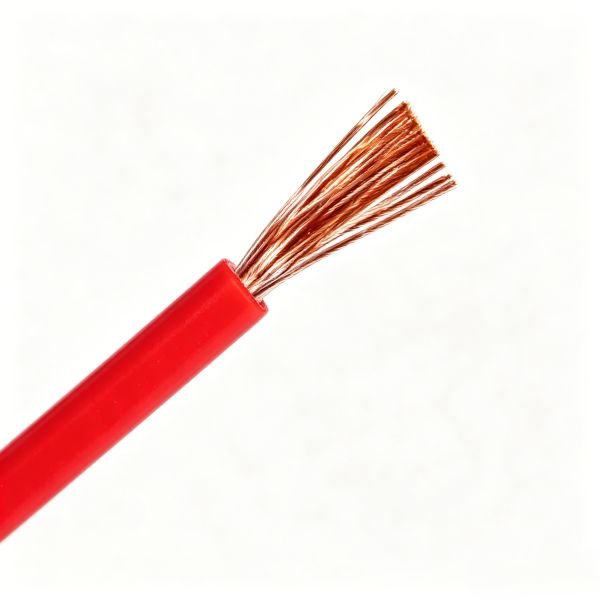
What a panel builder or electrical contractor checks first on a single core building wire — before reading the full specification below.
This is a single core, non-sheathed cable with thermoplastic PVC insulation, rated 450/750 V, built to BS EN 50525-2-31 — the harmonised part standard for single core non-sheathed PVC-insulated cables of rated voltages up to and including 450/750 V. The British market knows it as 6491X. That code comes from BS 6004, the older British standard: 6491X is the BS 6004-era designation, and the harmonised standard that now governs the construction is BS EN 50525-2-31. We quote the current standard, and describe 6491X as the familiar British name rather than as a second, parallel standard.
Under EN 50525-2-31 the same nominal cross-section is offered in three conductor classes, and the letter in the harmonised code is the class: H07V-U is Class 1 solid copper, H07V-R is Class 2 round stranded copper, and H07V-K is Class 5 flexible stranded copper. 6491X maps onto all three. This page is built around H07V-R, the Class 2 stranded version at 1.5 mm², which is the construction most fixed building wiring is specified in.
What the design is actually rated at: 450/750 V Uo/U, a maximum conductor operating temperature of +70 °C because the insulation is PVC, a short-circuit conductor temperature of +160 °C, and a finished-cable test voltage of 2500 V AC. The headline electrical number a buyer can verify with a resistance bridge is the maximum DC resistance at 20 °C — 12.1 Ω/km at 1.5 mm², which is the IEC 60228 limit and is the same for Class 1 and Class 2 at that size.
Choosing between the classes is a question of how the cable is terminated and how much flexibility the route needs. Class 1 solid is stiff and holds its shape, which suits switchgear and terminal blocks. Class 2 stranded is the general-purpose building wire — easier to pull through conduit and trunking than a solid conductor of the same size, without being a flexible cable. Class 5 flexible is the one to specify where a tight bend radius or a repeated small movement is unavoidable. Worth being blunt about one thing: H07V is a fixed-installation cable. None of these three classes is a trailing or mobile-duty cable, and a Class 5 conductor does not turn it into one.
Two standards are often confused on pages like this, so we keep them apart. The flame performance of the cable itself is IEC 60332-1-2, a vertical flame propagation test on a single cable. The CPR reaction-to-fire classification is a different regime entirely: it is a building-products classification made under CPR (EU) 305/2011, with the class determined to EN 13501-6 and the product standard being EN 50575. One is a cable test; the other is a declaration about the product placed on the market. We do not use either as a substitute for the other.
The halogen-free low smoke version of this construction is the 6491B / H07Z-R single core equivalent, which is quoted on request rather than stocked as its own listing. For halogen-free low smoke cable that is already listed, see the LSZH Control Cable. For multi-core control and panel wiring where a screened or sheathed cable is needed, the KVV / KVVR / KVVP Control Cable and the CY Shielded Control Cable are the natural next step.
More about the manufacturer: About SORIVO →
The current harmonised part standard for single core non-sheathed cables with thermoplastic PVC insulation at 450/750 V. 6491X is the BS 6004-era British name for the same construction.
Round stranded annealed copper to IEC 60228, which is the H07V-R class. Easier to draw into conduit than a solid conductor of the same size, while remaining a fixed-installation cable.
Thermoplastic PVC insulation with a +70 °C maximum conductor temperature and a +160 °C short-circuit rating — the material choice that defines the whole temperature envelope of this cable.
The finished core is tested at 2500 V AC, which is the test voltage level for the 450/750 V rating rather than a marketing figure.
The maximum DC resistance at 20 °C is published per size and follows the IEC 60228 limits, so it can be checked on the drum with a resistance bridge.
Vertical flame propagation tested on a single cable. This is a cable flame test and is kept separate from the CPR reaction-to-fire classification in the documentation below.
Brown, blue, black, red, yellow, grey and white, plus green/yellow for the protective conductor and violet on request — the colours a fixed-wiring schedule actually calls for.
The same construction basis across the range on this page, so a project does not change cable type between a 1.5 mm² lighting circuit and a 16 mm² sub-main.
Fixed wiring inside buildings and inside equipment — the cable goes into conduit, trunking or a closure, and it stays there.
Switch drops and lighting final circuits inside conduit or trunking, where the conductor is pulled in and terminated rather than flexed in service.
Final-circuit and sub-circuit wiring inside distribution boards and consumer units, in the sizes and colours a wiring schedule expects.
Panel and switchgear internal wiring where a Class 2 stranded conductor gives an easier pull and a cleaner termination than a solid core of the same size.
Fixed internal wiring inside enclosures — not the moving connections on the machine itself, which need a flexible cable.
The application the cable is designed for: embedded, semi-flush and closed conduit or trunking systems where the cable is installed once and left in place.
In the green/yellow colour, used as a circuit protective or earthing conductor in fixed wiring.
Internal wiring of appliances and equipment in an enclosed and protected environment, which is one of the uses the standard covers.
Cable enclosed within the building fabric — always inside a conduit or duct, never in direct contact with the plaster or concrete.
The complete parameter set — the same data our engineers quote from.
| Size (mm²) | Insulation (mm) | Outer dia. (mm) | Weight (kg/km) | Max. DC resistance at 20 °C (Ω/km) | Current (A), Method A / B |
|---|---|---|---|---|---|
| 1.5 | 0.7 | 2.7 – 3.3 | 23 | 12.1 | 14.5 / 17.5 |
| 2.5 | 0.8 | 3.3 – 4.0 | 35 | 7.41 | 20 / 24 |
| 4 | 0.8 | 3.8 – 4.6 | 51 | 4.61 | 26 / 32 |
| 6 | 0.8 | 4.3 – 5.2 | 71 | 3.08 | 34 / 41 |
| 10 | 1.0 | 5.6 – 6.7 | 120 | 1.83 | 46 / 57 |
| 16 | 1.0 | 6.4 – 7.8 | 170 | 1.15 | 61 / 76 |
The highlighted 1.5 mm² row is the Class 2 (H07V-R) construction this page is built around. The conductor class is set by the letter in the harmonised code — H07V-U is Class 1 solid, H07V-R is Class 2 stranded and H07V-K is Class 5 flexible, all to IEC 60228 — and Table 2 lists what each class is for. Individual wire stranding is not tabulated here: published sources differ on the exact strand count and diameter for the same Class 2 size, so the class reference to IEC 60228 is the verifiable statement, and the DC resistance column is the number that can actually be measured on the drum. Insulation thickness and the outer-diameter range follow the EN 50525-2-31 product table; weight is the nominal Class 2 value and is confirmed against the ordered construction. The 20 °C DC resistance column is the IEC 60228 maximum for plain copper — Class 1 and Class 2 share the same limit, Class 5 is slightly higher (13.3 Ω/km at 1.5 mm²). The last column is a selection aid, not a single rating: it is BS 7671 Table 4D1A, Method A (enclosed in conduit in a thermally insulating wall) and Method B (enclosed in conduit on a wall, or in trunking), single-phase, at 30 °C ambient with a 70 °C conductor. Apply the ambient-temperature and grouping correction factors for the actual installation.
| General Information | |
| Product Name | 6491X H07V-R 1.5mm² PVC Single Core Cable |
| Product Type | Single core, non-sheathed cable with thermoplastic PVC insulation — 6491X; harmonised designation H07V-R (Class 2), also available as H07V-U (Class 1) and H07V-K (Class 5) |
| Reference Standard | BS EN 50525-2-31 — Electric cables, low voltage energy cables of rated voltages up to and including 450/750 V (Uo/U), Part 2-31: single core non-sheathed cables with thermoplastic PVC insulation |
| British Designation | 6491X. This is the BS 6004-era British code; BS 6004 has been superseded by BS EN 50525-2-31, which is the standard this cable is built and quoted to |
| Halogen-Free Equivalent | 6491B / H07Z-R, to BS EN 50525-3-41 — a different insulation compound, quoted on request rather than listed as a separate product page |
| Conductor | |
| Conductor Material | Plain annealed copper |
| Conductor Class | Class 2 round stranded copper to IEC 60228 / EN 60228 for H07V-R. Class 1 solid for H07V-U; Class 5 flexible stranded for H07V-K |
| Stranding | Conductor class per IEC 60228. Individual strand counts and wire diameters are not tabulated: published sources differ for the same Class 2 size (7 × 0.53 mm to IEC 60228 against 7 × 0.52 mm under the DIN VDE reading), so the class reference and the measurable DC resistance are quoted instead |
| Max. DC Resistance at 20 °C | 12.1 Ω/km at 1.5 mm² (Class 1 and Class 2); 13.3 Ω/km at 1.5 mm² for Class 5. Full range in Table 1 |
| Insulation & Electrical | |
| Insulation Material | PVC (polyvinyl chloride), Type TI1 |
| Insulation Thickness | 0.7 mm nominal at 1.5 mm² — see Table 1 for the other sizes |
| Rated Voltage (Uo/U) | 450/750 V |
| Test Voltage | 2500 V AC on the finished cable |
| Max. Conductor Temperature | +70 °C — set by the PVC insulation |
| Max. Short-Circuit Temperature | +160 °C |
| Insulation Resistance | 10 MΩ·km |
| Environment & Installation | |
| Operating Temperature | −15 °C to +70 °C for fixed installation |
| Installation | Fixed installation only — in closed installation ducts, in embedded or semi-flush exposed conduit, or in trunking, and for the internal wiring of appliances in an enclosed and protected environment. Not for mobile, trailing or continuously flexing duty |
| Minimum Bending Radius | Up to 10 mm²: 3 × overall diameter. 10–25 mm²: 4 × overall diameter. Above 25 mm²: 5 × overall diameter |
| Direct Burial | Not covered. The cable is a non-sheathed single core and must be installed inside a conduit, duct or trunking |
| Flame Performance | Flame retardant to IEC 60332-1-2 / EN 60332-1-2 — vertical flame propagation on a single cable |
| CPR & Compliance | |
| CPR Classification | A class is declared to EN 13501-6 under CPR (EU) 305/2011, product standard EN 50575. The applicable Euroclass is stated on the Declaration of Performance for the construction ordered — the reaction-to-fire class is not preset on this page |
| CPR vs Flame Test | The EN 13501-6 class is a building-products reaction-to-fire classification; IEC 60332-1-2 is a cable flame test. They are separate regimes and neither substitutes for the other |
| RoHS | RoHS 2011/65/EU declaration available |
| CE | There is no CE certification for cable. A manufacturer’s declaration of conformity is provided on request where it applies |
| Configuration & Logistics | |
| Cross-Sections | 1.5 / 2.5 / 4 / 6 / 10 / 16 mm² on this page; the same construction runs to 630 mm² |
| Conductor Classes | Class 2 (H07V-R) as standard; Class 1 (H07V-U) and Class 5 (H07V-K) on request |
| Insulation Colours | Brown, blue, black, red, yellow, grey, white; green/yellow for the protective conductor; violet on request |
| Standard Lengths | 100 m / 500 m per reel; custom lengths available |
| Packaging | Reel / coil / drum |
| MOQ | 1 reel (sample order available) |
| Lead Time | 5–15 working days (stock: 3–5 days) |
Class 2 stranded annealed copper to IEC 60228, with the 20 °C maximum DC resistance published per size and measured on the finished cable — the one number on this page a buyer can verify with a resistance bridge.
Request test report →Flame retardance to IEC 60332-1-2 / EN 60332-1-2 is a cable flame test. The CPR reaction-to-fire class is a building-products classification declared to EN 13501-6 under CPR (EU) 305/2011, product standard EN 50575, and is issued as a Declaration of Performance for the construction ordered.
Request documentation →RoHS 2011/65/EU compliance declaration, and a manufacturer’s declaration of conformity where it applies. We do not use the phrase “CE certified” — there is no CE certification for cable, only a manufacturer’s declaration, and that is what we provide.
Request documentation →
Single core building wire is a commodity item, which is exactly why the checkable numbers matter more than the adjectives.
Tell us the cross-section, the conductor class you need (Class 2 H07V-R normally, or Class 1 H07V-U / Class 5 H07V-K), the insulation colour and the quantity.
We confirm the conductor class, cross-section and colour against the standard, and send the quotation with the applicable Declaration of Performance and test data within one working day.
Sample for qualification — stocked configurations within a few working days.
5–15 working days from order confirmation, with stocked configurations ready in 3–5 days. Lengths above the standard reel sizes are scheduled per order.
Reel and drum packing, shipping documents, and support through panel-build qualification including the test data for the delivered batch.
Send the cross-section, conductor class and colour and we will arrange a sample length plus the test data for the batch.
Send the details below and we will come back within one working day with price, availability and the applicable documentation.
Thanks — our engineers will reply within one working day.