Professional cable manufacturer

Professional cable manufacturer
Home » Products » Power Cable » Cu/XLPE/SWA/PVC 4 × 70 mm² 0.6/1 kV Armoured Power Cable
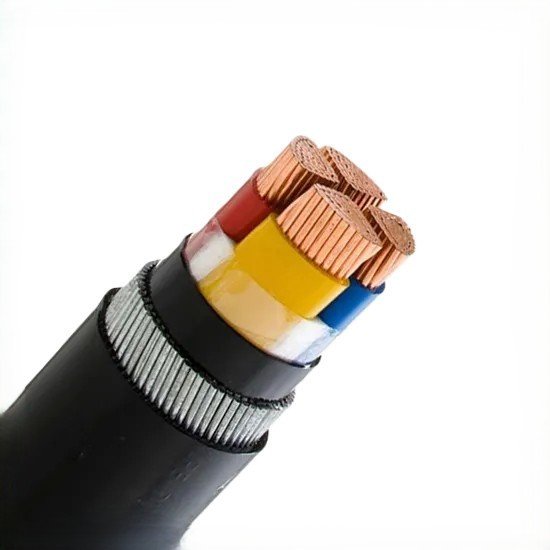
A 4 × 70 mm² armoured LV distribution cable: sector-shaped copper conductors to IEC 60228 Class 2, XLPE insulation, 2.0 mm galvanised steel wire armour and a black PVC over-sheath. 37 mm overall, 4000 kg/km, 246 A in air at 30 °C and 188 A direct buried.
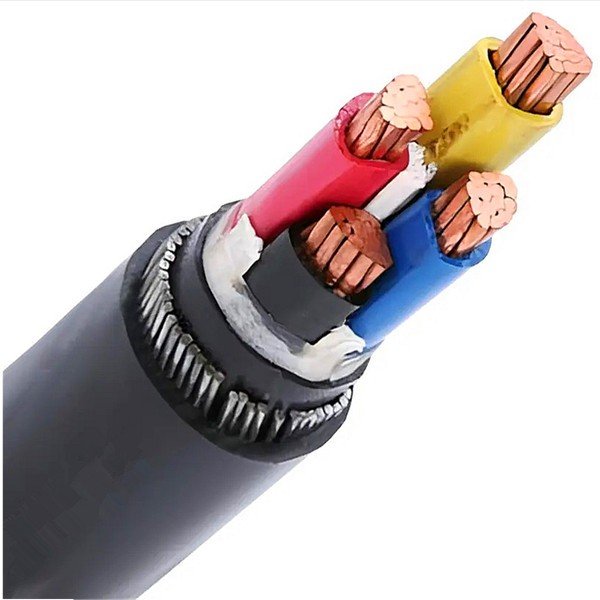
Four-core 70 mm² is the size where a cable stops being a cable and becomes a pulling and drum-handling job. These are the numbers that decide it.
This is the 4 × 70 mm² member of the BS 5467 armoured LV family — three phase conductors and a neutral, with no separate protective conductor. The published data for this exact size: 11.7 mm sector-shaped conductors, 1.1 mm XLPE insulation, a 1.2 mm PVC bedding, 2.0 mm galvanised steel wire armour, a 37 mm overall diameter, 4000 kg/km, 0.268 Ω/km conductor resistance and 1.2 Ω/km armour resistance, rated 246 A in air at 30 °C and 188 A direct buried at 20 °C.
Start with the weight, because it changes how the job is planned. At 4000 kg/km a 500 m drum holds about two tonnes, and that decides the drum size, the trailer, the winch and the route the drum can physically be taken along. The step from 4 × 35 mm² at 2500 kg/km and 30 mm to this size, and on to 4 × 95 mm² at 5250 kg/km and 41 mm, is not linear in effort — it is the point at which a pull becomes a planned operation with a pulling eye, rollers and a tension limit rather than a few people and a rope. Table 1 sets the four sizes side by side for that reason.
The second thing that catches people out is the conductor shape. At this cross-section the conductors are sector-shaped, not circular: four 70 mm² circular conductors inside a 37 mm cable would not fit. This matters at both ends of the installation. When you strip the cable, the conductor is a shaped segment rather than a round bundle, and it needs a compression lug matched to the sector form or a shaping die — a standard round lug crimped onto a sector conductor can look closed and still be a poor joint. Tell us the lug or the termination you intend to use and we will confirm what the conductor looks like at this size.
Third, the earthing arrangement. A four-core cable carries three phases and a neutral. When the project needs an independent protective conductor, the choice is a five-core cable, or a 3 + 1 or 3 + 2 arrangement with a reduced PE, or using the armour as the protective conductor where it is effectively earthed at both ends and the local wiring regulations allow it. The armour resistance for this size — 1.2 Ω/km — is the figure that assessment uses. Deciding this at the design stage costs nothing; discovering it at the joint bay costs a cable.
On the electrical side the cable is straightforward BS 5467 work: 0.6/1 kV, XLPE at +90 °C continuous and +250 °C for a 5-second short circuit, a 3.5 kV AC / 5 minute routine withstand test on every length, a published operating range of −20 °C to +90 °C and a minimum installation temperature of 0 °C. The laying bending radius at 8 × 37 mm is roughly 296 mm. And to be explicit about it: the steel wire armour is mechanical and rodent protection, not an EMC screen, in this size as in every other. For the full range including the two-core and three-core sections, see the Cu/XLPE/SWA/PVC 0.6/1 kV armoured power cable page.
More about the manufacturer: About SORIVO →
11.7 mm across, shaped rather than round, which is what allows four 70 mm² conductors to fit a 37 mm cable. It dictates the lug type and the stripping procedure.
A 500 m drum is around two tonnes. Drum size, trailer, winch, rollers and route access all follow from these two numbers.
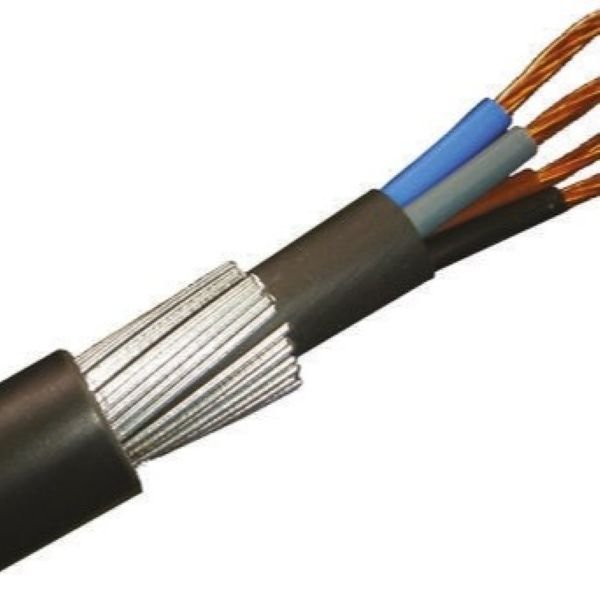
The heaviest armour wire in the small-and-medium range, providing the crushing and pulling protection and the rodent resistance the route needs.
Published at two reference conditions, in air at 30 °C and direct buried at 20 °C. The 24 % gap between them is why the route decides the size.
Four cores are three phases plus neutral. An independent protective conductor means a five-core cable, a 3 + 1 or 3 + 2 arrangement, or an assessed armour earth path at 1.2 Ω/km.
The conductor resistance for voltage-drop work, rising by roughly 20 % at the 90 °C conductor temperature — which on a 70 mm² feeder at a few hundred amps is not a rounding error.
8 × 37 mm. On a large four-core cable the minimum bend radius is a route-planning constraint, not a handling note, and it should be checked against the corners on the pull.
Every completed length is withstand-tested at 3.5 kV AC for five minutes, with conductor resistance and insulation resistance recorded against the drum.
Four-core LV distribution where the load and the route length both rule out a smaller section.
Sub-mains from a main switchboard to MCCs and distribution boards at the sort of load where 35 mm² no longer covers the voltage drop.
LV connections from a package substation or transformer to the building main board, laid in trench or on heavy tray.
Buried distribution to pump sets and process equipment, where the drum weight and the pull plan are part of the civils programme.
Four-core LV distribution into technical spaces — and the halogen-free version of the same cable where the fire strategy requires it.
LV collection and auxiliary distribution at renewable sites, in cable trench and on outdoor tray where the armour and the UV performance both matter.
Long buried runs between process buildings, where the length and the load together push the section up to 70 mm².
Heavy LV sub-mains within and between buildings, on tray, in riser or in duct where a four-core armoured cable is the standard engineering answer.
Replacing undersized or damaged four-core feeders, where the existing trench, duct or gland plate sets the diameter that has to be accommodated.
The complete parameter set — the same data our engineers quote from.
| Cores × size (mm²) | Conductor dia. (mm) | Insulation (mm) | Bedding (mm) | Steel wire dia. (mm) | Overall dia. (mm) | Weight (kg/km) | R20 (Ω/km) | In air 30 °C (A) | Buried 20 °C (A) |
|---|---|---|---|---|---|---|---|---|---|
| 4 × 35 | 6.9 | 0.9 | 1.0 | 1.6 | 30 | 2500 | 0.524 | 158 | 129 |
| 4 × 50 | 9.8 | 1.0 | 1.0 | 1.6 | 31 | 2750 | 0.387 | 192 | 153 |
| 4 × 70 | 11.7 | 1.1 | 1.2 | 2.0 | 37 | 4000 | 0.268 | 246 | 188 |
| 4 × 95 | 13.7 | 1.1 | 1.2 | 2.0 | 41 | 5250 | 0.193 | 298 | 226 |
The four sizes below are the neighbouring cross-sections a 4 × 70 mm² order is normally compared against. Note how the four-core weight moves from 2500 kg/km at 4 × 35 mm² to 4000 kg/km at 4 × 70 mm² and 5250 kg/km at 4 × 95 mm² — on a long pull that is a winch and drum-size decision, not a detail. The 4 × 70 mm² row is highlighted. Overall diameters and weights are nominal manufacturer values for this construction. The two current-rating columns are the reference conditions the manufacturer publishes, in air at 30 °C and direct buried at 20 °C; neither is a single "rated current", and the actual figure depends on the route.
| Cores × size (mm²) | Conductor dia. (mm) | Insulation (mm) | Bedding (mm) | Steel wire dia. (mm) | Overall dia. (mm) | Weight (kg/km) | R20 (Ω/km) | In air 30 °C (A) | Buried 20 °C (A) |
|---|---|---|---|---|---|---|---|---|---|
| 3 × 70 | 11.7 | 1.1 | 1.0 | 1.6 | 32 | 3000 | 0.268 | — | — |
| 4 × 70 | 11.7 | 1.1 | 1.2 | 2.0 | 37 | 4000 | 0.268 | 246 | 188 |
Same conductor cross-section, same 0.268 Ω/km, different physical cable: three cores come out at 32 mm and 3000 kg/km, four cores at 37 mm and 4000 kg/km. That is a 25 % increase in weight and a 16 % increase in diameter for one additional core, and it moves a 500 m drum from roughly 1.5 tonnes to 2 tonnes. The four-core current rating is lower than the three-core rating at the same cross-section for the obvious reason — more loaded cores sharing the same sheath surface. If the fourth core is genuinely needed, plan the drum handling around the larger figure; if it is being added "for spare", the weight is the price.
| General Information | |
| Product Name | Cu/XLPE/SWA/PVC 4 × 70 mm² 0.6/1 kV Armoured Power Cable |
| Product Family | Four-core copper conductor, XLPE insulated, steel wire armoured, PVC sheathed low-voltage power cable to BS 5467 |
| Reference Standards | BS 5467; IEC 60502 for the 0.6/1 kV extruded-insulation construction; conductor to IEC 60228 Class 2; flame retardance to IEC 60332-1-2. |
| Rated Voltage U₀/U | 0.6/1 kV |
| Core Configuration | 4 cores — three phases and a neutral. There is no separate protective conductor; a five-core cable or a 3 + 1 / 3 + 2 arrangement is quoted separately. |
| Dimensional Data (this size) | |
| Conductor Cross-Section | 4 × 70 mm² |
| Conductor Diameter | 11.7 mm |
| Conductor Shape | Sector-shaped stranded (SM), Class 2 — the shaping dies and the lug type must match this form |
| Insulation Thickness | 1.1 mm nominal |
| Bedding Thickness | 1.2 mm nominal |
| Armour Wire Diameter | 2.0 mm nominal |
| Overall Diameter | 37 mm nominal |
| Approximate Weight | 4000 kg/km |
| Electrical Ratings (this size) | |
| Conductor Resistance at 20 °C | 0.268 Ω/km |
| Armour Resistance at 20 °C | 1.2 Ω/km |
| Current Rating, in Air 30 °C | 246 A |
| Current Rating, Direct Buried 20 °C | 188 A |
| Max. Conductor Temperature | +90 °C continuous, the XLPE rating |
| Short-Circuit Conductor Temperature | +250 °C maximum, taken as the IEC 60502-1 short-circuit condition for XLPE-insulated copper cable, limited to 5 s |
| Test Voltage | 3.5 kV AC for 5 minutes on the completed cable |
| Insulation Resistance | Manufacturer routine-test value, confirmed against the report for the supplied drum |
| Voltage Drop | Approximately √3 × 0.268 Ω/km = 0.46 Ω/km for a balanced three-phase circuit at 20 °C. Correct the resistance to the operating temperature and add the reactance term before using it for a final design. |
| Construction | |
| Conductor | Plain annealed copper, Class 2 stranded, sector-shaped and compacted to IEC 60228 |
| Insulation | Extruded XLPE, 1.1 mm nominal |
| Core Identification | Blue, brown, black and grey, confirmed against the drawing for the ordered construction |
| Bedding | Extruded PVC over the laid-up cores |
| Armour | Single layer galvanised steel wires, 2.0 mm nominal diameter |
| Outer Sheath | PVC, black |
| Environment | |
| Operating Temperature Range | −20 °C to +90 °C — the range published for this construction |
| Minimum Installation Temperature | 0 °C. Below this the PVC bedding and sheath stiffen; warm the drum area or postpone the pull rather than forcing the cable. |
| Bending Radius when Laying | 8 × overall diameter, the manufacturer figure for this construction. The final radius should be confirmed against the applicable standard and the actual installation method. |
| Weather Resistance | Rated good for outdoor and buried service by the manufacturer data sheet. |
| Flame Retardance | IEC 60332-1-2 — single insulated cable vertical flame propagation |
| Rodent and Termite | The steel wire armour is the barrier. It is a mechanical layer, not a chemical one, so it resists gnawing rather than repelling it. |
| Configuration & Logistics | |
| Standard Lengths | 100 m / 500 m / 1000 m per drum; cut lengths on request |
| Packaging | Wooden drum or steel-wood drum |
| Customization | Sheath colour, cut length, drum type and customer marking |
| Halogen-Free Variant | The same size is available with a BS 6724 halogen-free sheath — quoted on request |
| MOQ | 1,000 m — sample orders negotiable |
| Lead Time | 15 working days |
| Supply Capacity | 10,000 m per day |
Every value in Table 3 is the published nominal data for this 4 × 70 mm² construction: 11.7 mm sector-shaped conductors, 1.1 mm XLPE, 1.2 mm bedding, 2.0 mm armour wires, 37 mm overall, 4000 kg/km, 0.268 Ω/km conductor resistance and 1.2 Ω/km armour resistance, with 246 A in air at 30 °C and 188 A direct buried at 20 °C. Two points deserve emphasis before the cable is ordered. First, the conductors are sector-shaped, so the compression lug or shaping die has to match that form — this is not a round conductor. Second, the four cores are three phases and a neutral with no separate protective conductor; where an independent PE is required, the options are a five-core cable, a 3 + 1 or 3 + 2 arrangement, or an assessed armour earth path using the 1.2 Ω/km armour resistance. The +250 °C short-circuit figure is a 5-second design condition from the IEC 60502-1 basis for XLPE-insulated copper cable, not a service temperature. Diameters and weights are nominal and re-confirmed on the drawing before production; final selection should be based on the installation method, the ambient conditions and the applicable local requirements.
The construction — copper to IEC 60228, XLPE insulation, galvanised steel wire armour and PVC over-sheath — is the BS 5467 arrangement for 0.6/1 kV armoured cable. We quote the standard the cable is built and tested to; we do not write "certified" where the correct statement is "made to". The test certificate and conductor-resistance records for the supplied drum come with the quotation.
Request the test documents →A 3.5 kV AC withstand test for 5 minutes is applied to every completed length and recorded, and the XLPE insulation and PVC sheath are type-tested as a system for the 0.6/1 kV rating. If you need the type-test report for the exact construction you are buying, ask for it by the ordered size and we will send the one that matches.
Request the type-test report →There is no CE certification for cable — CE marking is a manufacturer’s declaration of conformity, and which directive applies depends on the installation. We will not print "CE certified": a Declaration of Conformity and a RoHS declaration are provided on request for the construction supplied, together with whatever national approval documentation the destination market requires.
Request documentation →
At 4000 kg/km the drum is a logistics item as much as an electrical one, so the release checks cover the dimensions the pull plan and the gland depend on.
Tell us the load and run length, the quantity and the drum length you need, and the termination you intend to use on the sector-shaped conductors.
We confirm the core configuration, whether an independent PE is needed, the drum length and the termination type, send the construction drawing showing the sector-shaped conductors for approval, and quote against it — normally within one working day.
Sample for qualification — stocked configurations within a few working days.
Made-to-order lengths at this size are scheduled against the confirmed drawing; the production window is confirmed in the quotation and the routine test is run on every length before the drum is released.
Drum schedule and shipping documents, with pulling-tension and bending-radius guidance for a 4000 kg/km four-core cable — the ~296 mm laying radius matters on the corners of the route — plus the routine-test records for the supplied drums.
Tell us the load, run length, drum schedule and termination type — we reply within one working day.
The more detail you give, the faster and more accurate our quotation. Our engineers reply within one working day.
Thanks — our engineers will reply within one working day.